Families baking with lactose intolerance
You’re looking for milk for cakes, pancakes or desserts, while taking its lactose content into account. The recipe is still an important factor when choosing between whole, semi-skimmed and skimmed milk.


For a recipe that calls for liquid milk, choose between whole, semi-skimmed and skimmed according to the fat content specified in the recipe; they are not interchangeable in every recipe. A pack of 6 x 1 L is most practical if you can use each opened bottle within the time stated on its packaging. Lactose-free milk is still milk: it is not suitable as a dairy-free substitute for a child with a milk allergy.
You’re looking for milk for cakes, pancakes or desserts, while taking its lactose content into account. The recipe is still an important factor when choosing between whole, semi-skimmed and skimmed milk.
You’re considering a pack of 6 x 1 L for use in several recipes. Before choosing this format, think about the space you’ll need to store the bottles and how you’ll use each one once it’s opened.
You need to leave milk out of the recipe intended for a child. Assurance Maladie distinguishes between a food allergy and lactose intolerance: lactose-free milk does not meet the need to avoid milk.
When baking with children, first check whether milk can be included in the recipe for each person, then compare the type of milk the recipe calls for with the amount you’ll use.
| Criteria | What to check | Who is this for? |
|---|---|---|
| Lactose and milk allergen | The stated lactose content and whether milk is listed in the ingredients. If someone has a milk allergy, don’t use lactose-free milk as a dairy-free substitute. | If I’m cooking for a child with lactose intolerance, I need to check the product without confusing this with a milk allergy. Around 42% of consumers are said to make suitability their top criterion. |
| Type of milk | Whole, semi-skimmed or skimmed: compare the fat content per 100 mL with the milk specified in the recipe. | If my recipe calls for whole milk, I want to know what will change if I use a different type. For around 33% of consumers, how well the milk suits the recipe is said to be the priority. |
| Format and storage | The volume per bottle and the storage instructions after opening for the specific product you choose. | If I’m planning several recipes, I’m looking for a pack size I can realistically use without leaving an opened bottle for too long. Format is said to be the main criterion for around 25% of consumers. |
Lactose is a sugar found in milk; having no lactose, or only a small amount, does not mean the milk has been removed. This distinction is particularly important when a recipe is for a child with a milk allergy.
Check the ingredients and the allergen information on every product. If milk needs to be excluded, choose ingredients in line with the guidance that applies to the child rather than automatically swapping ordinary milk for lactose-free milk.
A pack of 6 x 1 L means buying a larger quantity, but it doesn’t extend the shelf life of an opened bottle. The recommended storage times vary by product.
Work out how much you’ll need for your recipes and follow the storage temperature and time stated on the packaging of each opened bottle.
This label doesn’t tell you whether the milk is whole, semi-skimmed or skimmed. The Lactel and Candia products mentioned below have different fat contents.
Start with the type of milk your recipe calls for, then compare the fat content per 100 mL before choosing a different type.
The Matin Léger range includes UHT lactose-free whole and skimmed milk. Lactel describes its whole milk as suitable for use in cooking.
Candia+ offers lactose-free milk with 1.0% fat, as well as a 0% skimmed version. Both are available in 1 L bottles and packs of 6 x 1 L.
Carrefour’s range includes Carrefour Classic’ lactose-free milk, as well as Lactel and Candia+ products, including 1 L bottles and packs of 6 x 1 L.
Auchan’s own-brand range includes UHT semi-skimmed lactose-free milk in a pack of 6 x 1 L. It also stocks Lactel and Candia+ products.
This Joybuy option is for recipes that call for lactose-free sweetened condensed milk. It is not bottled whole, semi-skimmed or skimmed liquid milk, so check the form and quantity required before using it in a recipe.
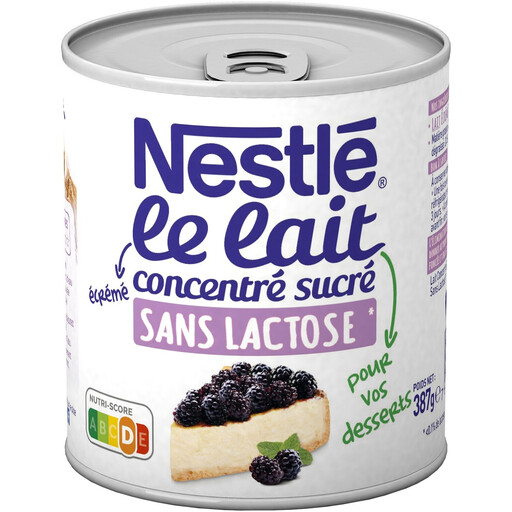 Image unavailable
Worth considering if your recipe calls for sweetened condensed milk. For a recipe that uses liquid milk, check the quantities and any sugar already included rather than swapping one for the other directly.
387 g pack. This product contains milk, so it is not a dairy-free alternative for anyone with a milk allergy.
No. Lactose-free milk should not be treated as a dairy-free substitute. The products mentioned contain milk; Assurance Maladie distinguishes between a food allergy and lactose intolerance. Check the ingredients in the recipe intended for the child.
Not for every recipe. Start with the type of milk specified and compare the fat content if you’re thinking of using a substitute. Lactel lists 3.6 g of fat per 100 mL for its Matin Léger whole milk; the semi-skimmed and skimmed versions mentioned here have different fat contents.
It can be a good option if you need milk for several recipes and can use the opened bottles within their recommended storage time. For the product reviewed, Candia advises keeping it chilled and using it within 4 days of opening; Auchan advises a maximum of 5 days at +6 °C for its product. Always follow the instructions on the product you buy.
Read the ingredients list and look for allergens, particularly milk if it needs to be excluded. The DGCCRF states that allergens must be highlighted on food labels; also check the storage instructions for the product you choose.