
Livraison le jour même ou le lendemain

Qualité garantie

Débloquez vos offres de bienvenue: Livraison GRATUITE | Jusqu'à -80 % | 30 jours d'essai gratuits à JoyPlus
Téléchargez l'application
Does your smartphone's zoom fall short during sports events or nature outings? Are you eyeing the image quality of DSLR cameras but are put off by their complexity and the hefty price tag of interchangeable lenses? The bridge camera is the perfect compromise: a versatile and accessible solution that might just surprise you.
As Joybuy product experts, our mission is to help you see things more clearly. This article breaks down the Kodak PIXPRO Astro Zoom range, a series of cameras designed for budding photographers and families looking to capture beautiful memories without the hassle. We'll dissect the key features to help you find the model that's right for you.
Before we compare models, let's look at the three criteria that will make all the difference when you're shooting.
A bridge camera's key advantage is, of course, its powerful zoom. Unlike a smartphone's digital zoom, which only degrades the image, the optical zoom uses a real lens system to get closer to the subject with zero loss of quality. A 40x optical zoom, for example, will allow you to photograph a bird on a distant branch or an architectural detail at the top of a monument with stunning clarity. This is an essential feature for a travel camera or for capturing your children's achievements on the sports field.
Resolution, expressed in megapixels (MP), defines the level of detail in your photos. A 20MP camera captures images detailed enough for large-format prints or for heavy cropping without sacrificing sharpness. This is a crucial point if you enjoy editing your shots or isolating a specific element in the image.
When using a powerful zoom, the slightest hand shake is amplified and almost always results in a blurry photo. Optical Image Stabilisation (OIS) is an internal mechanism that compensates for these micro-movements. It's a crucial feature for getting sharp handheld shots, especially at full zoom or when light is low.
Here are three models from the Kodak PIXPRO Astro Zoom range that target different users, from the curious beginner to the discerning amateur.
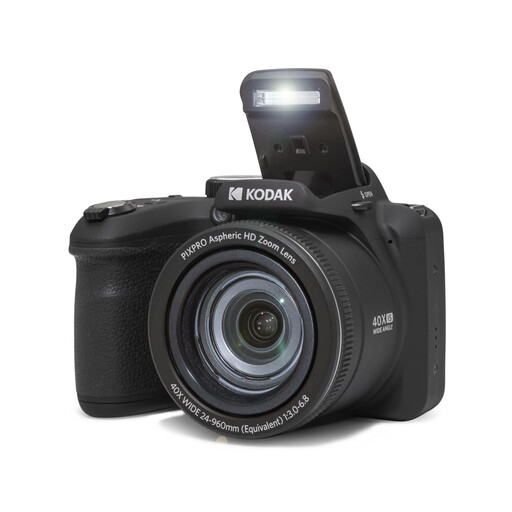
Why it stands out: The Kodak AZ405 strikes the perfect balance between a powerful zoom and incredibly simple handling. Its 40x zoom offers impressive versatility, while its 20MP sensor ensures detailed images.
Key features:
Who is it for? This is a particularly well-rounded camera for beginners. It's ideal for travellers and families who want a high-performance, easy-to-pack camera that can adapt to any situation, from family portraits to distant landscape shots.
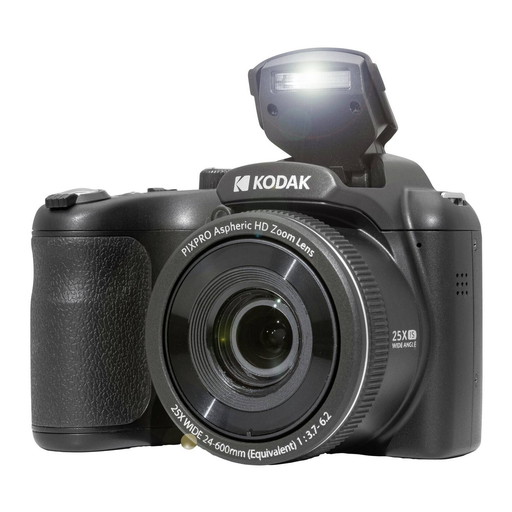
Why it stands out: The Kodak AZ255 is an excellent gateway into the world of powerful zoom cameras. With its 25x zoom and 22 automatic scene modes, it simplifies shooting so you can focus on what matters: the moment.
Key features:
Who is it for? This model is a smart option for those on a tighter budget or who don't need an extreme zoom. It's perfect for family photos, holidays, and for those who want a more capable camera than a compact without getting bogged down in complex settings.
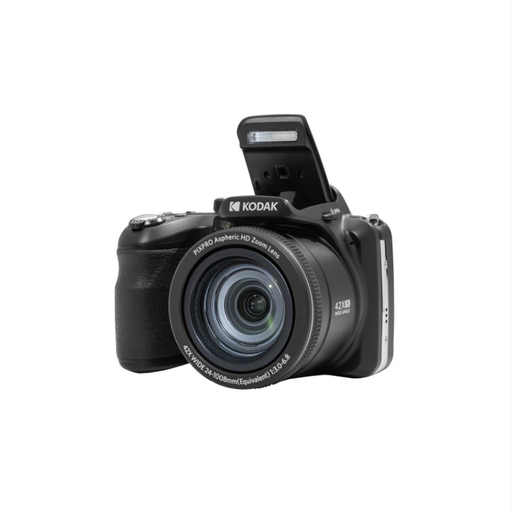
Why it stands out: The Kodak AZ425 takes versatility even further with its 42x zoom and a rechargeable battery. It's aimed at demanding amateurs looking for the greatest zoom range and maximum features.
Key features:
Who is it for? This camera is for aspiring wildlife photographers, sports event spectators, or anyone who wants maximum zoom flexibility in a single body. Its rechargeable battery is a real plus for frequent users.
If none of these models tick all your boxes, don't worry. The world of photography is vast, and every photographer has their own unique needs: ergonomics, specific features, design...
To discover other models and find the perfect camera to accompany you on all your adventures, feel free to browse our complete collection.
? Explore our full collection of cameras
1. Why choose a bridge camera over a smartphone? It's all about the optics! A bridge camera, like a Kodak bridge camera, has a powerful optical zoom that lets you get closer to a subject with zero loss of quality. In contrast, a smartphone is limited to a digital zoom, which is just a simple crop of the image. The result: a glaring loss of sharpness. Not to mention the much more stable and comfortable grip, which makes all the difference.
2. Is a Kodak bridge camera a good choice for a beginner? Absolutely. It's the ideal choice for getting started. It offers significantly better image quality and versatility than a compact camera or a smartphone, while remaining incredibly simple to use thanks to its automatic modes. It's the perfect stepping stone to learning the fundamentals of photography (framing, composition, playing with zoom) without the technical complexity of a DSLR and its interchangeable lenses.
3. What is the difference between optical zoom and digital zoom? Optical zoom is mechanical: the lenses inside the objective move to magnify the image, so quality and detail are perfectly preserved. Conversely, digital zoom is purely software-based. It simply crops into the image, which inevitably destroys detail and sharpness. The verdict is clear: for quality photos, only optical zoom matters.