
Livraison le jour même ou le lendemain

Qualité garantie

Débloquez vos offres de bienvenue: Livraison GRATUITE | Jusqu'à -80 % | 30 jours d'essai gratuits à JoyPlus
Téléchargez l'application
Printing photos at home is the best way to bring your memories to life, whether you're filling a family album, decorating a wall, or starting a creative project. But with a sea of options available, choosing the right paper can often be a headache. Glossy or matte finish? What paper weight should you choose? And most importantly, how can you be sure it's compatible with your printer?
Don't worry. This guide is here to demystify the different ranges of Kodak 10x15 photo paper and help you find the one that truly meets your needs. Whether you're an amateur photographer, a parent keen on archiving life's moments, or a scrapbooking enthusiast, read on!
Before diving into our selection, let's review the key criteria that will guide your decision. Because when it comes to a successful print, every detail counts.
This is the first thing to consider: the paper's finish has a direct impact on the look and feel of your prints.
Paper weight is simply the mass of the paper per square metre (g/m?). The rule is simple: the higher the weight (above 250 g/m?), the thicker, more rigid, and higher-quality the paper feels. A premium Kodak paper will always have a substantial weight, ensuring an excellent feel in the hand and exceptional durability. For scrapbooking or prints that will be handled frequently, aim for at least 200 g/m?.
The vast majority of Kodak photo papers are designed for inkjet printers. This technology sprays tiny droplets of ink that are absorbed by the paper's coating. Checking this compatibility is therefore crucial. Also, remember to select the correct paper type in your printer's settings before printing: this is the key to fast drying and true-to-life colours.
To guide you, we've selected three flagship Kodak paper products in the 10x15 cm (equivalent to A6) format, each tailored for a specific use.
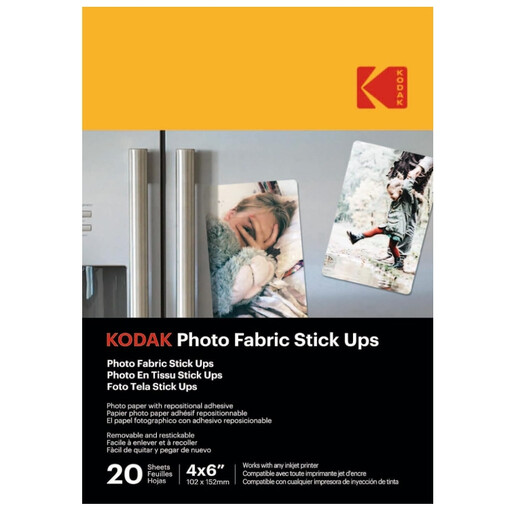
Why it stands out: This isn't your average photo paper: it turns your pictures into decorative stickers. Its secret? A repositionable adhesive that leaves no trace. You can stick, unstick, and move your photos as you please, without ever damaging your walls. Its fabric base also gives it excellent tear resistance.
Advantages:
Who is it for? For DIY enthusiasts, families looking to create an evolving photo wall, or for decorating a child's room. It's also the perfect medium for scrapbooking and collage projects.
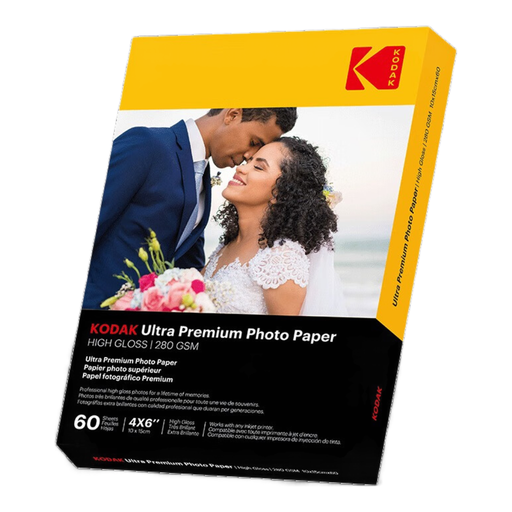
Why it stands out: This is the paper of choice for anyone seeking near-professional results. With its heavy weight and ultra-glossy finish, it makes colours and details pop with incredible sharpness. The result: vibrant prints that catch the light.
Advantages:
Who is it for? For discerning amateur photographers, high-end photo albums, frames that showcase an image, or simply for gifting a beautiful print.
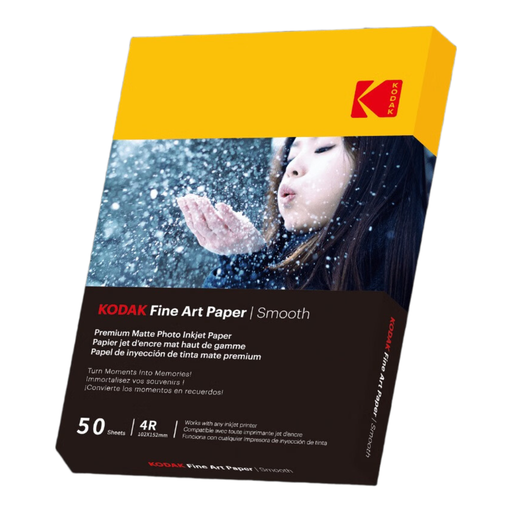
Why it stands out: This matte paper is distinguished by its smooth, completely reflection-free finish, which brings a sophisticated and artistic touch to your photos. Its 230 g/m? weight gives it a nice rigidity, making it very versatile.
Advantages:
Who is it for? Essential for portraits, black-and-white photography, exhibition photos, or any image where reflections are undesirable. It's the preferred paper for photographers seeking an elegant and professional finish.
Our selection focuses on three key uses, but the world of photo paper is much broader. Other sizes, weights, and finishes exist to meet more specific needs.
Feel free to explore our full range of inkjet photo paper to find the perfect paper that will elevate all your projects.
1. Is Kodak 10x15 photo paper compatible with all printers? The vast majority of Kodak photo papers are optimised for inkjet printers. They are not compatible with laser printers: the heat used to fuse the toner could melt or damage the paper's coating. Always check for compatibility before you buy.
2. Is the 10x15 cm format the same as A6? Yes, in practice, these two terms refer to the same thing. To be precise, the A6 format measures 10.5 x 14.8 cm, while 10x15 cm is the historic photo standard (derived from the American 4x6 inches). For home printing, they are perfectly interchangeable and fit the same frames and albums.
3. How should I store my photo paper to ensure its longevity? To preserve its quality, store your paper flat in its original packaging, away from light, humidity, and extreme temperature changes. This will prevent the sheets from curling and protect their surface from dust.