
Livraison le jour même ou le lendemain

Qualité garantie

Débloquez vos offres de bienvenue: Livraison GRATUITE | Jusqu'à -80 % | 30 jours d'essai gratuits à JoyPlus
Téléchargez l'application
With promises of healthy growth, protein-rich recipes and “easy-to-digest” formulas, choosing kitten food can quickly become a headache. A young cat aged 2 to 12 months has different needs from an adult. Its diet must support a particularly rapid stage of development, while taking its age, activity level and digestive sensitivities into account.
Before buying kitten kibble, take the time to check the ingredients, the product’s nutritional status and the pack size. Here are the main pitfalls to avoid, along with a selection to suit different households.
Claims such as “with chicken”, “with cod” or “high in protein” catch the eye, but they aren’t enough to assess a recipe. Start by checking the legal product description: for everyday meals, look for the words “complete food for kittens”. A treat, however much your pet enjoys it, is still a complementary food and cannot replace meals.
It’s also worth checking the actual amount of the highlighted ingredient. In the Purina One Kitten with Chicken recipe featured here, chicken makes up 17% of the ingredients. That tells you much more than a simple picture of a fillet on the pack.
A 5 kg bag may seem better value, but it’s a sizeable purchase if your kitten turns its nose up at the recipe or struggles to digest it. When trying a new food for the first time, a 300 g or 450 g pack gives you a chance to check whether your kitten enjoys it and how its stools look before moving on to a larger pack.
Store the kibble in a dry place and seal the bag carefully after each use. Purina One recommends using the product within four weeks of opening to preserve its freshness and flavour.
Kitten treats can be used during play or as a reward, but they should only be given occasionally. Catisfactions Salmon Treats are described as a complementary food for cats and kittens aged 2 months and over, with a recommendation of up to six treats a day for a kitten. Adjust the daily portion of your kitten’s main food accordingly.
The label should state the age group the product is intended for. Kitten food is generally suitable from weaning until 12 months. Some recipes are also suitable for pregnant or nursing cats, but this should be clearly stated in the manufacturer’s product information.
Purina One Bifensis Kitten with Chicken is described as suitable for kittens from weaning to 12 months, as well as pregnant or nursing cats. According to the information provided, it contains 41% crude protein and 20% crude fat. These figures make it easier to compare different products objectively, but they don’t prove that one food is better than another overall.
Compare:
High-protein kitten food is only useful if it also meets your young pet’s full nutritional needs. The percentage shown on the pack should never be the only factor you consider.
If your kitten has a sensitive stomach, introduce its new food gradually over several days. Also avoid changing the brand, texture and flavour all at once. Otherwise, if digestive problems arise, it will be difficult to identify the cause.
The Farmina N&D Ocean Kitten Cod 300 g product is described in the information available as suitable for kittens with sensitive stomachs. Its name pairs cod with pumpkin.
If your kitten vomits repeatedly, has persistent diarrhoea, loses its appetite or loses weight, ask a vet for advice. No kibble can replace professional guidance.
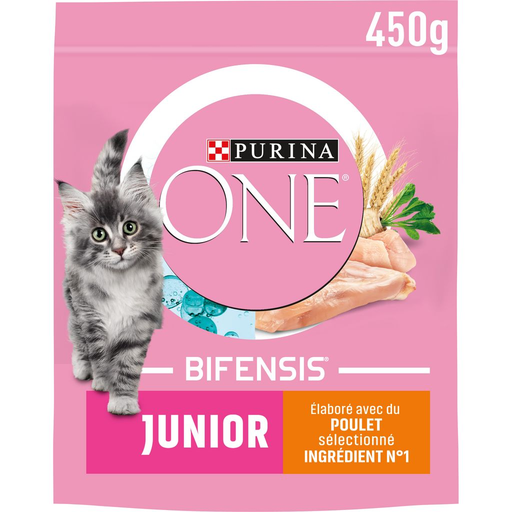
Why it suits this household: This smaller pack is a good choice for a first food transition or to see whether your kitten likes the recipe before buying a larger bag.
The 450 g pack reduces the risk of being left with a large stockpile if the recipe doesn’t suit your kitten.
Complete food for kittens, with 17% chicken and a stated 41% crude protein content.
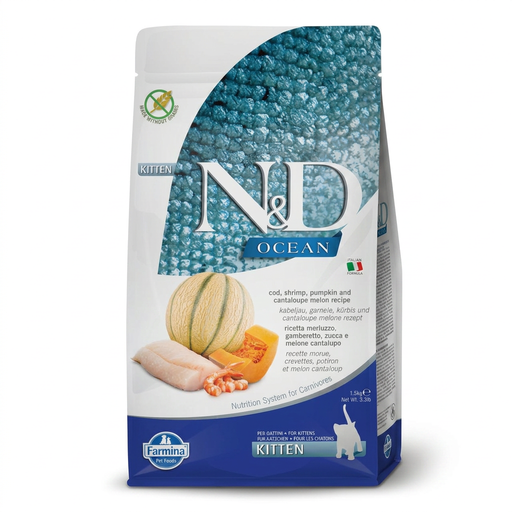
Why it suits this household: This medium-sized pack is ideal if you’re looking for a fish-based recipe but don’t want to go straight for a large bag.
The 1.5 kg pack lets you try a cod recipe without ending up with more than you need.
A recipe identified as Farmina N&D Ocean Kitten Cod, in a 1.5 kg pack suited to regular use.
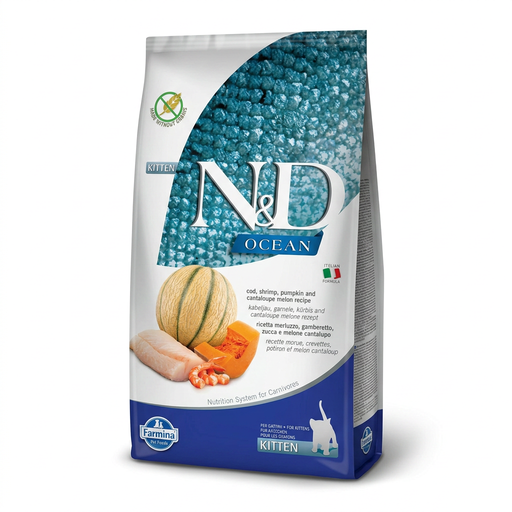
Why it suits this household: This larger pack could suit a household with several cats, or a kitten that already eats this recipe regularly.
It’s a practical option when you need a larger quantity, provided you know how well your kitten tolerates the food and store the kibble properly.
A 5 kg pack of cod-based food clearly intended for kittens.
For a little variety when rewarding your kitten, Catisfactions Salmon Treats are suitable for cats and kittens aged 2 months and over. The product information states that each treat contains less than 2 kcal, with a limit of six a day for a kitten. However, they are not a substitute for complete kitten food.
A kitten toy can also help keep playtime varied. The ZEZE Lemon Silvervine toy combines silvervine, catnip and crinkle paper in a 90 × 100 mm size. Supervise your kitten during its first few play sessions, inspect the fabric regularly and remove the toy if it becomes torn or the filling is exposed.
We’ve put together a comprehensive list, updated in real time, of products that meet these strict selection criteria and European safety regulations.
The amount depends on your kitten’s age, weight and activity level, as well as the recipe you choose. As a guide, Purina One recommends 50 to 65 g a day between 6 and 12 weeks, then 65 to 75 g between 12 and 26 weeks. Always follow the feeding guide on the pack and adjust the portion to your kitten’s body condition.
It’s generally best to make the change gradually over about a week. Mix a small amount of the new recipe with the old food, then slowly increase the proportion. This gives you a chance to monitor your kitten’s appetite and digestion.
No. Treats can be used as a reward, but they’re optional and should only be given as a supplement. Your kitten’s diet should be based on a complete food formulated for growth, with fresh water available at all times.