
Livraison le jour même ou le lendemain

Qualité garantie

Débloquez vos offres de bienvenue: Livraison GRATUITE | Jusqu'à -80 % | 30 jours d'essai gratuits à JoyPlus
Téléchargez l'application
Buying kitchen utensils is not simply a matter of choosing a colour or counting the number of pieces in a set. A pan that food sticks to, a handle that is difficult to store or an appliance that takes up too much space can quickly turn an appealing purchase into an impractical expense.
For everyday cooking, it is better to check compatibility with your hob, the materials used, maintenance requirements and how you will genuinely use the item. Here are the main pitfalls to avoid, along with a selection of equipment suited to different needs.
A 15- or 20-piece set may contain several accessories that you will hardly ever use, while leaving out a saucepan with a lid or an induction-compatible utensil. Before comparing prices, start by listing your needs: everyday cooking, baking, grilling, entertaining or storage in a compact kitchen.
Non-stick kitchen utensils make cooking and cleaning easier, but their coating requires a little care. Metal spatulas, excessively high temperatures and abrasive cleaning products can accelerate wear. By contrast, an uncoated surface, such as that of a stainless-steel wok, requires a different technique: gradual preheating, adding fat and carefully managing the temperature.
A saucepan that works on a gas hob will not necessarily work on an induction hob. Look for an explicit “induction” designation and check that the base is suitable. For oven use, the stated maximum temperature may apply to the entire product or only to certain components. Removable handles, lids and silicone parts may have their own temperature limits.
304 stainless steel is commonly used for surfaces that come into contact with food. It is not necessarily combined with a non-stick coating, so food may stick if the temperature and amount of fat are not properly controlled. In return, it offers excellent durability and works with a range of heat sources.
For a set with a ceramic coating, consult the product specifications to find out which substances are excluded, whether it is dishwasher-safe and which accessories are recommended. Keep the manufacturer’s instructions, particularly those relating to care and warranty coverage.
A 20 cm frying pan is suitable for one or two portions. A 26–28 cm model provides more room when cooking for several people. A 30 cm stockpot can be ideal for sharing-style meals, but it requires sufficient cupboard space and a hob large enough to support it properly.
For a stand mixer, a 5-litre bowl can handle doughs, whipped egg whites and quantities suitable for a family. However, remember to check the appliance’s weight, its stability on the worktop and the actual power rating stated by the manufacturer.
The phrase “dishwasher-safe” does not necessarily mean that repeated washing will have no effect on the appearance or coating. To preserve your frying pans and saucepans, washing with a soft sponge followed by prompt drying is often preferable. Stainless-steel utensils may also develop white or iridescent marks caused by water and mineral deposits. Diluted white vinegar can help remove them, provided this is consistent with the manufacturer’s recommendations.
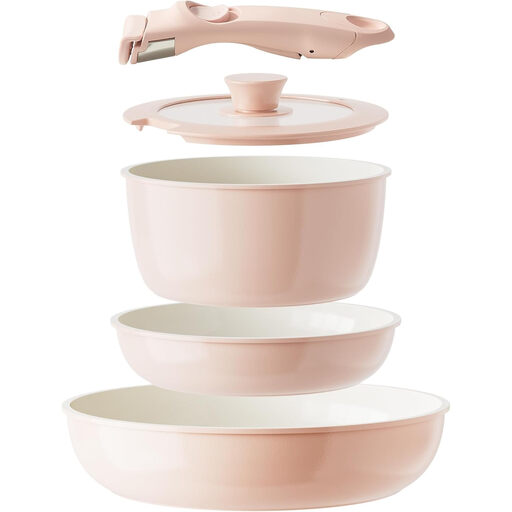
Why this choice suits this profile: this set includes a 20 cm saucepan with lid, two frying pans and a removable handle. Its stackable design is practical in a small kitchen or for a first cookware set.
The specifications indicate compatibility with gas, electric and induction hobs. The removable handle also reduces storage space, but check its maximum temperature in the instructions.
Five pieces, stackable storage, removable handle and cleaning listed as dishwasher-compatible.
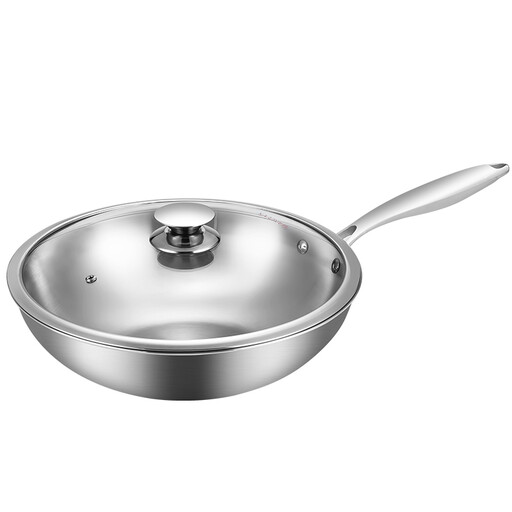
Why this choice suits this profile: this 28 cm stainless-steel wok is suitable for stir-frying, searing and everyday cooking. It is designed for those willing to adapt their cooking technique to an uncoated surface.
The specifications clearly state that there is no non-stick coating. Preheat the wok, add the oil, then cook over medium to low heat to minimise the risk of sticking.
304 stainless steel, glass lid, compatibility with gas, electric, ceramic and induction hobs, plus stated dishwasher compatibility.
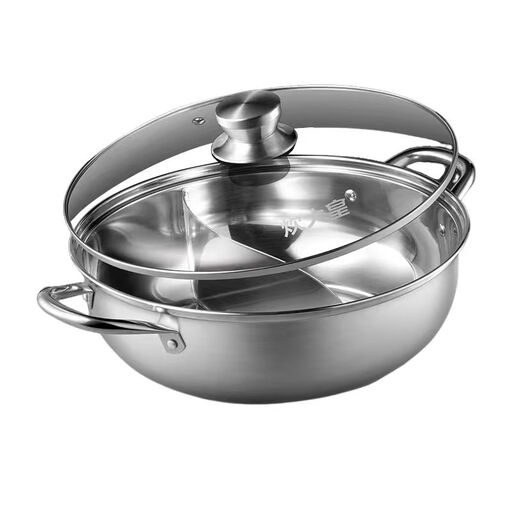
Why this choice suits this profile: its central divider allows you to serve two broths or two different recipes during a family meal or get-together with friends.
Its 30 cm diameter offers generous capacity, but check that it is stable on your hob and keep oven gloves to hand, as the handles may become hot.
304 stainless steel, two compartments and stated compatibility with gas, electric and induction hobs.

Why this choice suits this profile: this stand mixer is designed for bread doughs, cakes, pizzas, creams and any preparation that requires consistent mixing.
The stated wattage alone is not enough to assess the appliance’s real capabilities. Follow the recommended quantities and unplug it before changing attachments.
Stated 400 W motor, 5-litre 304 stainless-steel bowl, three attachments, pulse function and overheating protection.
We have brought together an up-to-date selection of utensils and appliances for everyday cooking, baking, grilling and social dining.
A versatile kitchen can combine a cookware set for everyday preparation, a stainless-steel wok for quick cooking and a non-stick saucepan for delicate ingredients. Barbecue accessories, such as tongs, an oil brush or stainless-steel scissors, are particularly useful during grilling season. A kitchen knife set can also streamline food preparation, provided you check that the storage solution is stable and the handles are comfortable.
Price should not be your only consideration. Take cleaning, available space, included accessories and frequency of use into account. For an electric cooking appliance, also check that its voltage is compatible with the French power supply, generally listed as 220–240 V.
Compatible products generally carry an explicit indication that they can be used on an induction hob. For frying pans and saucepans, the base must be sufficiently flat and designed to transfer magnetic heat effectively. If in doubt, consult the technical specifications rather than relying solely on the exterior material.
Use moderate heat, wooden or silicone utensils and a non-abrasive sponge. Avoid leaving an empty pan heating for too long. If recommended by the manufacturer, place protective layers between items when stacking them.
Wash them with a mild detergent, rinse them and dry them promptly. To minimise sticking in a stainless-steel wok, gradually preheat the surface, then add the fat and avoid excessive temperatures. Mineral marks can be treated with a small amount of vinegar, followed by thorough rinsing.