What should you check before choosing?
Start with the washing-up that builds up between washes, then check which size can be installed without making your kitchenette less practical to use.
| Criteria | What to check | What you need |
|---|
| Available space |
Measure the width, depth and height, as well as the door opening and the route for the hoses. According to Candy France, the countertop CP 6E51LS measures 550 × 501 × 443 mm, compared with 448 × 605 × 846 mm for the freestanding CDPH 2D1047S. |
I want to keep enough worktop space for preparing meals, or leave a clear walkway if the appliance is floor-standing. |
| Capacity |
Compare the stated place settings with the washing-up you actually produce, including saucepans and large containers. Candy France lists 6 place settings for the CP 6E51LS, 10 for the CDPH 2D1047S and 14 for the CF 4C6F0W. |
If a small machine regularly means I have to run several cycles, I’d rather consider a larger size than choose based on width alone. |
| Connections |
Check the water inlet, drainage and electrical socket specified in the model’s instructions. Candy France says the CP 6E51LS connects directly to the water supply; a model with a tank also needs a way to dispose of the waste water. |
My kitchenette needs to be able to supply water to the appliance and drain it, rather than assuming that a countertop model works without any connections. |
| Energy and water use |
Check capacity alongside the other information on the energy label. The European Commission says dishwasher labels include information such as energy use per 100 Eco cycles, water use per cycle, programme duration and noise. |
I want to compare figures on the same basis, then relate them to the amount of washing-up I usually do. |
Countertop dishwashers on Joybuy
These countertop appliances are worth considering if you’re looking for a dishwasher to place in a kitchenette. Compare their capacity and water supply method with your setup. This selection doesn’t replace looking at a 45 or 60 cm freestanding model if your loads need more space.
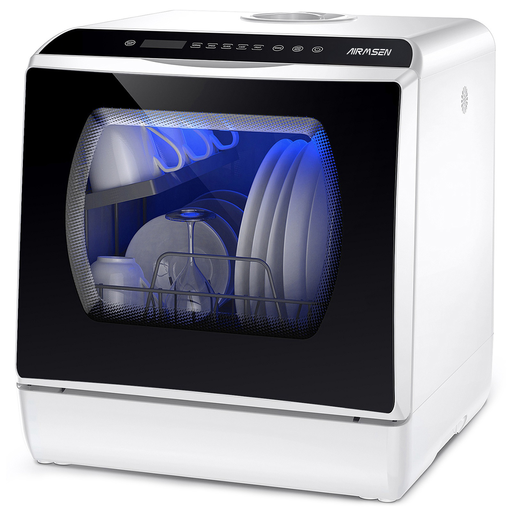 Image unavailable
AIRMSEN countertop dishwasher, 5 L tank
Worth considering if you want to fit an appliance into a small kitchenette. The title lists 5+1 cycles and a built-in 5 L tank. Before setting aside space for it, check the dimensions of the variant, how waste water is handled and its electrical specifications.
View on Joybuy
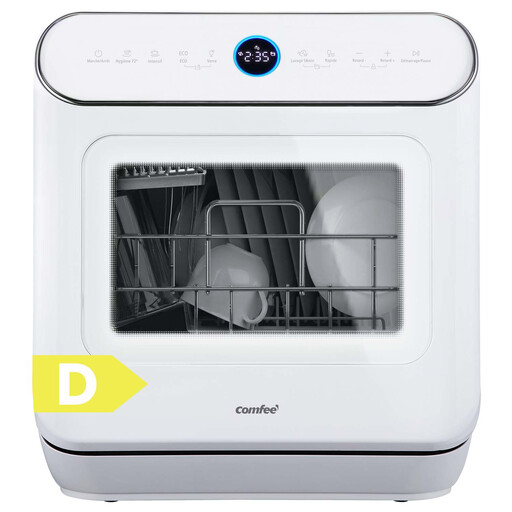 Image unavailable
COMFEE CDWMT305WD tabletop dishwasher, white
Worth comparing for smaller loads in a kitchenette. It has a stated capacity of 3 place settings, and the title lists 7 programmes. Check the instructions for how to drain the waste water and whether the capacity suits your washing-up.
View on Joybuy
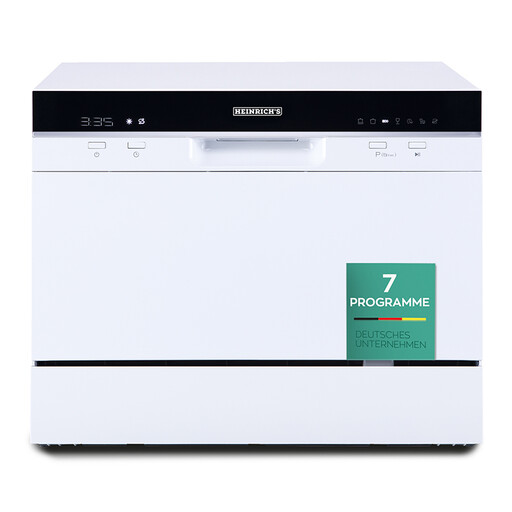 Image unavailable
Heinrich's HTG 8840 Weiss tabletop dishwasher, 6 place settings
Its stated capacity of 6 place settings may suit smaller loads if you have enough room on your worktop. The title lists 7 programmes. Measure the space and check that the hoses and connections are suitable for your water supply and waste outlet.
View on Joybuy
 Image unavailable
Comfee' CDWMTO201D(W) countertop dishwasher, white
Worth considering if the water supply is an important factor for your kitchenette: the title lists a built-in 5 L tank. Check the place-setting capacity, dimensions and drainage requirements for this variant before comparing it with your loads.
View on Joybuy
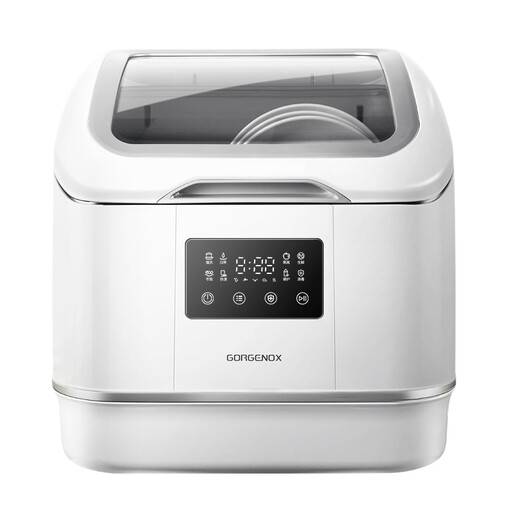 Image unavailable
GORGENOX DW4-D30A tabletop dishwasher, 3 place settings
With a stated capacity of 3 place settings, this model is designed for smaller loads. Before setting aside space for it, check its dimensions, exactly how it gets its water and how the waste water needs to be drained.
View on Joybuy
Frequently asked questions
Can you put a countertop dishwasher anywhere in a kitchenette?
No. Measure the appliance and choose a suitable surface, then check the connections specified in its instructions. Candy France says the CP 6E51LS connects directly to the water supply, so don’t confuse it with a model that has a tank.
When should you choose 6 place settings instead of a 45 cm model?
Choose based on the space you have and the size of your load. A 6-place-setting model may be enough for a small amount of washing-up if you’re short on floor space. If it regularly means running several washes and you can set aside around 45 cm of floor width, compare slimline models. Electro Dépôt says they can hold up to 9 to 10 place settings, depending on the model.
Is the energy rating enough to compare two appliances?
No. The European Commission says dishwasher labels also show energy use per 100 Eco cycles, water use per cycle, programme duration, capacity and noise. Consider all these figures together, taking into account how often you’d fill each appliance.
What should you check before connecting a dishwasher in a kitchenette?
Check the water supply, waste outlet, electrical socket and installation instructions for the exact model. If you’re unsure about the connections or the existing electrical installation, ask a professional to assess the situation rather than assuming it’s suitable for the appliance.
Does a model with a tank mean you don’t need to deal with drainage?
No. A tank may mean you don’t need a fixed water supply connection, but the waste water still needs to be drained according to the model’s instructions. Check the available space, electrical supply and capacity before buying, too.


