Start by considering the space available and how much washing up you generate between cycles. A compact countertop model suits smaller loads if you have room for it on your worktop, while a 45 cm freestanding model is worth considering if you use it more often. A 60 cm model needs more width, while an integrated model requires a compatible recess and door panel. Before you buy, also check the door clearance, water supply, waste outlet and electrical supply.
Which size is right for you?
Someone living in a studio with little washing up
If floor space is limited and around six place settings are enough between cycles, a compact countertop model could be a good option. You’ll need a suitable surface and should check the water supply, waste outlet and electrical supply required for the model.
A small household that cooks often
A 45 cm freestanding model lets you consider a larger capacity than a compact model with six place settings, without needing 60 cm of width. Que Choisir describes 45 cm models with capacity for nine place settings; exact capacities vary by appliance.
Someone living near an open-plan kitchen
If your dishwasher runs in your living space, compare the decibel levels and noise emission class shown on the energy label. Don’t assume that noise levels are determined by size alone. ADEME states that a rise of three decibels corresponds to almost twice the noise.
What should you check before choosing?
If your kitchenette has no built-in recess, measure the space before comparing different sizes. Then consider how each model’s capacity fits your washing-up routine.
| Criterion |
What to check |
Who it matters to |
| Size and layout |
Measure the height, width and depth, as well as the space for the hoses and the door to open. For a compact model, check the worktop too. |
If you need to keep your kitchenette usable without making layout changes, every centimetre counts. Around 36% of consumers would make this their top priority. |
| Capacity and frequency |
Count the dishes between cycles, including plates and pans; look at the basket layout, not just the number of place settings. |
If you cook often, you’ll want to avoid having to run multiple cycles because your appliance is too small. Capacity would be the top priority for around 29% of consumers. |
| Noise in an open-plan room |
Compare the decibel levels and noise emission class shown on the labels of the models you’re considering. |
If your kitchenette is part of your living space, you’ll want to run a cycle without the noise getting in the way of your activities. This would be the top criterion for around 21% of consumers. |
| Water and energy |
Compare kWh per 100 cycles, litres per Eco cycle and capacity. Also check how long the programme takes. |
If you run cycles regularly, you’ll want to understand how many resources are used to wash your dishes. Around 14% of consumers would prioritise this comparison. |
Mistakes to avoid
-
Assuming a compact model will fit on any worktop
A compact appliance can still take up a lot of depth: the specifications for the Bosch SKS62E32EU published by Darty give its depth as 50 cm.
Compare all the model’s dimensions with your available space, and check the surface, hoses and door clearance.
If you misjudge the space, you may have to move the appliance or alter the worktop.
-
Choosing based only on the number of place settings
The number of place settings doesn’t tell you how much room there is for pans and large dishes. A model that’s too small may also mean you have to run cycles more often.
Think about how much washing up you generate over one or two days, and check the basket layout of the model you’re considering.
-
Overlooking noise in an open-plan kitchen
Noise levels vary from one model to another, even between appliances of the same width. According to ADEME, an extra three decibels corresponds to almost twice the noise.
Compare the decibel levels and noise emission class on the label rather than assuming that a small appliance will be quiet.
-
Assuming the existing connections will be suitable
Where you can put the appliance also depends on the water supply, waste outlet and electrical supply. If a model has a built-in tank, you’ll still need to arrange somewhere for the wastewater to go.
Locate these connections before ordering, check them against the model’s instructions, and have the electrical supply or waste outlet checked if you’re unsure.
Brands to compare
Bosch
The SPS4EMW17E and SKS6ITB00E are examples of a 45 cm freestanding model and a compact countertop model respectively.
- Bosch lists the SPS4EMW17E as measuring 845 × 450 × 600 mm and producing 44 dB: useful details to check against the space available on your floor.
- According to Bosch, the compact SKS6ITB00E measures 450 × 551 × 500 mm. So you’ll also need to check that its depth suits your worktop.
Electrolux
Electrolux’s French freestanding range includes 45 cm and 60 cm appliances to compare based on the space and capacity you need.
- Electrolux lists, among others, a 45 cm model with capacity for nine place settings and a 60 cm model with capacity for thirteen.
- These capacities apply to the models mentioned, not every dishwasher from the brand.
Whirlpool
The freestanding WSFO3T223P is an example of a slim model for a floor-standing space.
- Whirlpool lists this model as 45 cm wide, with capacity for ten place settings and a noise level of 43 dB.
- Its stated dimensions of 85 × 45 × 59 cm still need to be checked against the available height, depth and clearance.
Comfee
The TD602E-W is an example of a compact freestanding model to consider when you have a smaller volume of washing up.
- The retailer’s product listing on Darty gives this model capacity for six place settings and a noise level of 47 dB.
- These specifications alone aren’t enough to tell you whether it will suit a particular worktop or open-plan kitchen.
A selection of Joybuy products
This selection includes compact countertop models for smaller spaces, as well as a 60 cm freestanding model to consider if your kitchenette has enough room. Compare their capacity with the amount you usually need to wash, and check the installation requirements for each appliance.
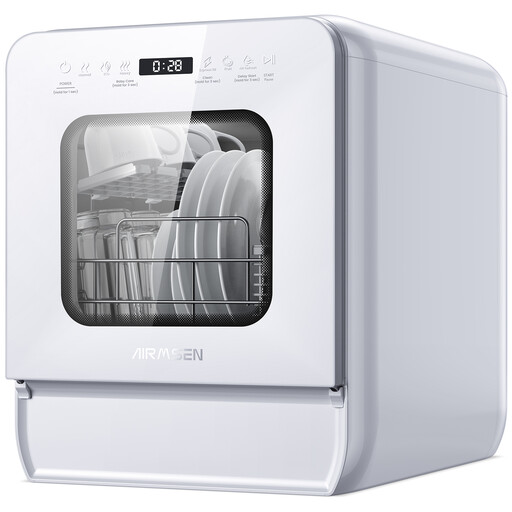 Image unavailable
AIRMSEN countertop dishwasher with 5 L tank
Worth considering if you’re looking for a countertop appliance with a water tank. The title lists nine programmes; check the full dimensions, the space needed on your worktop and where the wastewater will go.
View on Joybuy
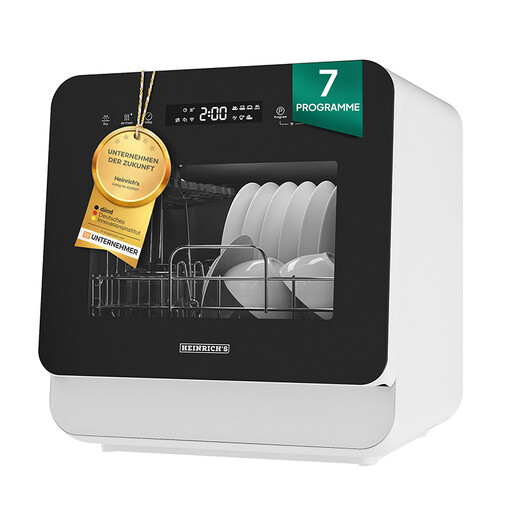 Image unavailable
Heinrich's HTG 8855, 3-place-setting countertop dishwasher
Check that its stated capacity of three place settings is enough for the amount of washing up you generate. The title mentions seven programmes and 56,3 dB; check the model’s noise level on its label, along with its dimensions and drainage requirements.
View on Joybuy
 Image unavailable
Heinrich's HTG 8840 Schwarz, 6-place-setting countertop dishwasher
Its stated capacity of six place settings could work if it matches the amount of washing up you accumulate between cycles. The title lists seven programmes and 47 dB; check the dimensions, surface and connections before choosing this size.
View on Joybuy
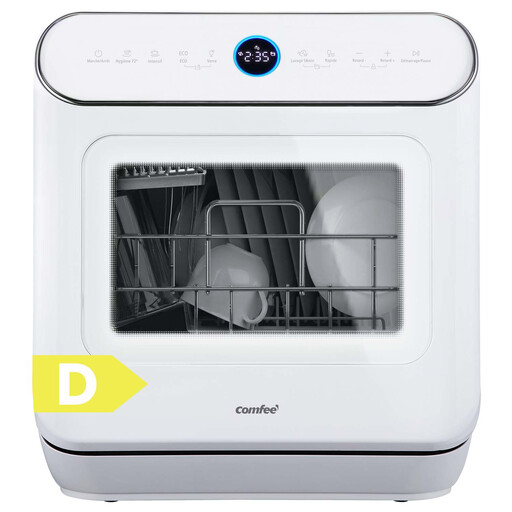 Image unavailable
COMFEE CDWMT305WD, countertop dishwasher
Worth considering for a worktop, provided you check its dimensions and water supply requirements. The title lists seven programmes and a 24-hour delay start; consult the instructions for filling and drainage requirements.
View on Joybuy
 Image unavailable
Samsung DW60M6050FS, 14-place-setting freestanding dishwasher
Consider this model if you need capacity for fourteen place settings and your kitchenette can accommodate a floor-standing appliance. The title lists seven cycles; check the overall dimensions, door clearance and connections before choosing it.
View on Joybuy
Frequently asked questions
Does a compact countertop dishwasher mean you don’t need any connections?
Not necessarily. A model connected to the mains needs a water supply and a waste outlet. If it has a tank, check how to fill it and where the wastewater needs to go. In all cases, consult the instructions for the electrical supply requirements.
What should you check before installing a dishwasher in a kitchenette?
Locate the cold water supply, waste outlet and a suitable electrical supply, then measure the appliance and allow for the door and hoses. Follow the model’s instructions for connection lengths and positions; BUT’s connection guide advises against using extension leads and multiway adaptors.
Do you need to allow for a dedicated electrical circuit?
Have the requirements for your installation checked before connecting the appliance. Legrand lists a dedicated circuit as something to allow for when installing a dishwasher, particularly in new or fully renovated properties. If you don’t know how an existing installation is configured, ask an electrician for advice.
How can you compare the energy use and noise levels of two models?
Compare the same details on their energy labels: kWh per 100 cycles, litres of water per cycle, capacity, decibels and noise emission class. ADEME states that these figures relate to the reference cycle; they don’t necessarily describe every programme.


