
Livraison le jour même ou le lendemain

Qualité garantie

Débloquez vos offres de bienvenue: Livraison GRATUITE | Jusqu'à -80 % | 30 jours d'essai gratuits à JoyPlus
Téléchargez l'application
A kitchen bin should hold everyday waste without obstructing movement, releasing unpleasant odours or clashing with the room. However, the features highlighted in product descriptions do not always make it easy to choose the right model.
Before opting for a pedal bin, a dual-compartment model or an automatic bin, it is worth checking its footprint, actual usable capacity and ease of maintenance. Here are the key criteria to review to avoid unpleasant surprises.
A bin advertised as 60 litres does not necessarily offer a single 60-litre compartment. It may instead consist of two 30-litre compartments or three 20-litre bins. This arrangement is practical for sorting waste, but each compartment naturally reaches its limit more quickly.
In a household that cooks frequently, a total capacity of 60 litres can reduce how often bags need to be taken out. In a small kitchen or a one-person household, however, it may take up a disproportionate amount of space.
In a photograph, a compact kitchen bin may appear perfectly suited to your space. Once installed, however, its lid could strike a wall or cabinet. Measure the available width, depth and height, and do not forget the total height when the lid is open.
Also consider the space required to remove the inner buckets and replace the bags. Under a worktop, a bin will generally need to remain accessible from the front.
Soft-close mechanisms reduce noise, but they do not eliminate the need to clean the mechanism regularly and check that no waste is obstructing it. An automatic bin runs on batteries or a dedicated power supply, depending on the model. You should therefore factor in the cost and replacement frequency of these consumables.
A lid fitted with a carbon filter can also help reduce certain odours. It does not, however, replace regular emptying of the bin or cleaning the surfaces that come into contact with waste.
For everyday use, 20- to 30-litre formats are often suitable for a dedicated compartment. A dual-compartment bin can, for example, separate general household waste from recyclable packaging. A three-compartment model provides even more precise sorting, provided you have enough space.
Before ordering, identify the types of waste actually produced in your household. There is no need to choose three bins if local sorting guidelines or your habits are limited to two categories.
A stainless-steel kitchen bin can generally be cleaned with a soft, slightly damp cloth. Fingerprint-resistant finishes retain a uniform appearance more easily, but they do not tolerate abrasive sponges or steel wool.
Removable inner buckets make rinsing and bag replacement easier. Check for handles, retaining rings or rims designed to prevent the bag from slipping to the bottom of the bin.
A bin with a lid conceals the waste and limits visual contact with its contents. A pedal bin, meanwhile, opens hands-free—an important advantage while preparing meals. A feature that holds the lid open at 90° makes cleaning and bag replacement easier.
Always place the bin on a flat, stable floor. Children should not play with the lid or pedal, as the mechanisms may present a pinching hazard. In an office, bathroom or bedroom, a small 1-litre bin will often be more suitable than a large model designed for the kitchen.
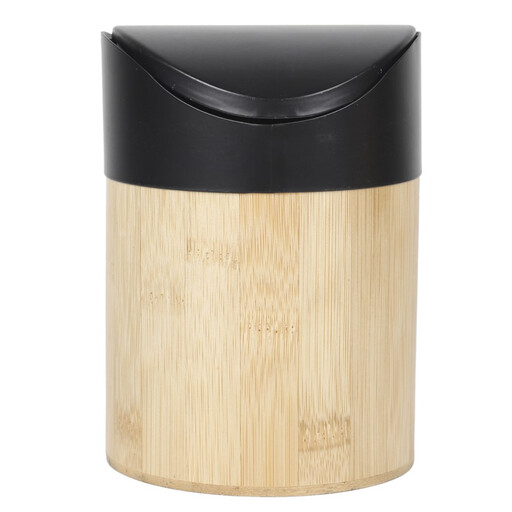
Why this choice suits this profile : With a 1-litre capacity, this compact bin fits easily in an office, bathroom, on a bedside table or on a worktop.
Its compact capacity prevents you from paying for unnecessary volume in small spaces. The hinged lid conceals small items of waste between emptying cycles.
1-litre format, hinged metal lid and bamboo exterior that can be cleaned with a damp cloth.
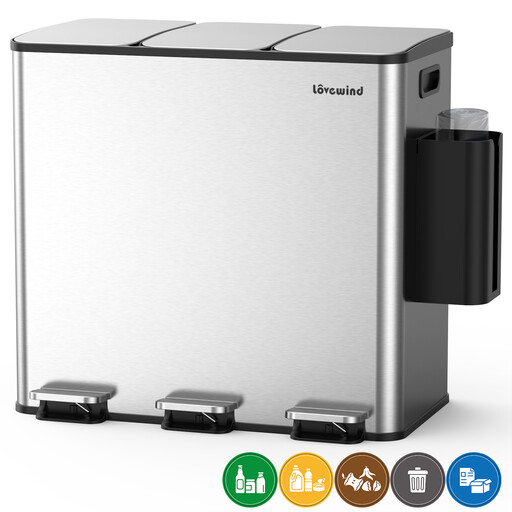
Why this choice suits this profile : This stainless-steel model features three independent 20-litre compartments for organised waste sorting in a family kitchen.
The capacity of each bin is stated separately, preventing confusion between total capacity and the space actually available for each category.
Three inner buckets, soft-close lid, 90° open position and magnetic labels for identifying waste categories.
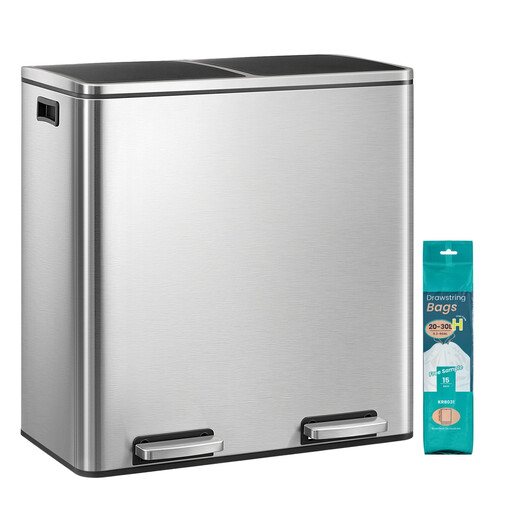
Why this choice suits this profile : Its two 30-litre compartments are suitable for a family or household that produces large quantities of general and recyclable waste.
The removable buckets with handles make emptying easier, while the two pedals allow the compartments to be opened without direct contact.
Stainless steel, two 30-litre bins, soft-close lid and 15 bags included.
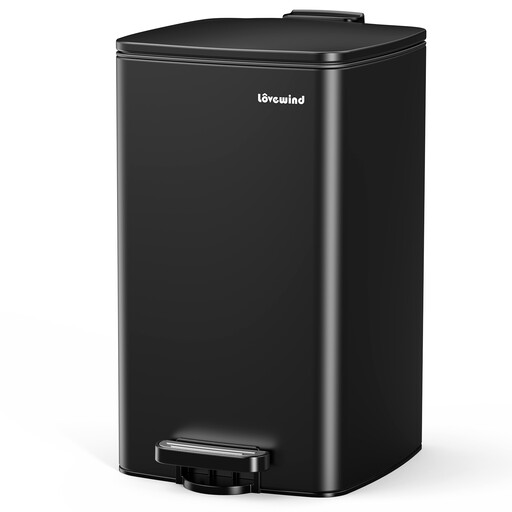
Why this choice suits this profile : Its square shape and 30-litre capacity fit neatly into a small kitchen, office, bathroom or space positioned against a wall.
The removable inner bucket simplifies maintenance and bag replacement, with no complicated installation required.
Hands-free pedal, 30-litre format, stainless-steel finish and soft-close lid.
We have selected a comprehensive, real-time updated list of products that meet these demanding criteria while complying with European safety regulations.
A total capacity of 40 to 60 litres may suit a family, depending on how often you cook, the number of occupants and your waste-sorting setup. With a dual-compartment bin, always check the capacity available in each compartment.
Yes. Its exterior can generally be cleaned with a soft cloth and a non-abrasive product. Removable inner buckets make rinsing easier. Dry all metal components thoroughly and avoid allowing liquids to collect at the bottom.
It may require batteries, refills or specific bags, depending on its opening and replacement system. Before buying, check the availability and price of consumables. For simple, predictable operation, a pedal bin remains a practical solution that requires no electrical power.