A project with a suitable external outlet
You’re planning to vent cooking air outside. Before choosing a venting hob, check that the duct can follow a suitable route and that the cabinet has room for the appliance and its connections.


A venting hob connected to an external outlet is worth considering if the duct and cabinet can accommodate the installation. Without a suitable outlet, recirculation requires a compatible model and regular filter maintenance. If you’d rather choose your hob and extraction separately, a separate downdraft extractor is another option, provided you check how much space it takes up. An extractor built into a cabinet also lets you keep the two appliances separate, but it still sits above the cooking area.
You’re planning to vent cooking air outside. Before choosing a venting hob, check that the duct can follow a suitable route and that the cabinet has room for the appliance and its connections.
You want to avoid an overhead cooker hood without creating an outlet to the outside. Recirculation may be an option, as long as you choose an appliance designed for this mode and can access the filters for maintenance.
You want to keep the space above the cooking area clear, but drawers, rails or the cabinet depth limit the room available below. Compare a separate extractor with a venting hob before cutting the worktop.
First, check how much space is really available and whether there’s a suitable route for the air. Then compare the compatible options by considering the maintenance they require and how much space you want to keep clear above the worktop.
| Consideration | What to check | Who this matters to |
|---|---|---|
| Space under the worktop | Compare the model’s installation diagram with the cabinet, drawers and planned cut-out. | If I want to keep my storage space, I need to know whether the appliance and its accessories will actually fit in the cabinet before making any changes to the worktop. Around 36% of consumers prioritise this compatibility. |
| External outlet | Check whether a connection is possible, and confirm the route and duct dimensions permitted in the instructions. | To vent air outside, I first need to know whether the existing outlet can be used for this installation. This is the main requirement for around 29% of consumers. |
| Filters for recirculation | Check which kit is compatible, the filter reference and the cleaning or replacement instructions. | Without external extraction, I want to be able to access the filters and maintain them over time; around 21% of consumers put this first. |
| Kitchen layout | Decide whether you want to rule out all extraction above the worktop, or whether an extractor built into a cabinet is still an option. | If there’s a window nearby or the kitchen is open-plan, I want to keep the space above the cooking area clear while choosing an installation that will work. This is the priority for around 14% of consumers. |
UFC-Que Choisir points out that a venting hob also takes up space in the cabinet and needs a suitable cut-out. So a hob that fits the worktop does not necessarily leave enough room for the drawers and rails.
Ask for the installation diagram for your chosen model, then check it against the cabinet, power supply and duct route before cutting.
You may need to alter the worktop or cabinet if you haven’t accurately assessed the space underneath.
Recirculation returns filtered air to the room, so the appliance needs the right set-up and compatible filters. Bosch, for example, says that a specific kit or module is required for the relevant configurations.
Check what’s included with your chosen model, whether the filters are accessible and what maintenance they need.
Cleaning or regenerating filters, where possible, is an ongoing task. Other filters need to be replaced as instructed.
The connection depends on the route and the components approved for the model. Elica notes, for example, that the outlet diameter and route length help determine which of its ducts to use.
Before planning the connection, ask the manufacturer or a qualified installer to check the instructions, proposed route and existing ventilation.
A system designed to remove cooking fumes and odours cannot, on its own, tell you whether your home’s ventilation is adequate. Work on an existing vent or duct could have consequences beyond the cooking area.
Before making any changes, ask a suitably qualified professional to check your home’s set-up and the requirements that apply to it.
These ranges illustrate different installation options and accessories. Check the instructions for the specific model you’re considering rather than relying on the brand name alone.
The range includes induction hobs with integrated extraction, including the PVS611B16E.
According to Electrolux, the KCC73443 is a 70 cm venting hob with a Bridge function that links two cooking zones.
The inductionAir range includes the ED87BHQ26E, an 80 cm venting hob.
Franke offers 2gether venting hobs, as well as separate extractor units designed to be fitted into a cabinet.
NikolaTesla hobs can be used with ducts and kits selected to suit the installation.
This selection includes an induction hob with integrated extraction and two cooker hoods designed to fit beneath a cabinet, alongside a separate hob. Under-cabinet hoods still sit above the cooking area, so they aren’t suitable for a project that rules out extraction in that position altogether.
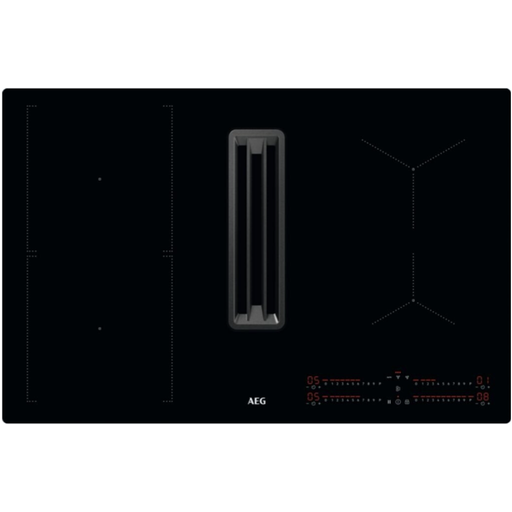 Image unavailable
Worth considering if you’d like to combine cooking and extraction in one hob, without an overhead cooker hood. This model is described as an 80 cm hob in black glass. Check its installation diagram, permitted extraction modes and compatible accessories, including the CBEHKIT kit, before preparing the cabinet.
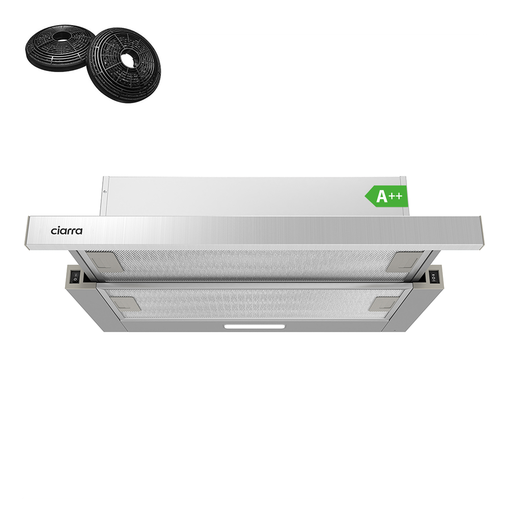 Image unavailable
Worth considering if you’re planning a separate hob and are happy to have an extractor beneath a cabinet above the worktop. This silver cooker hood has a stated maximum extraction rate of 370 m³/h. Check that it will fit your cabinet and confirm the intended extraction set-up before installation.
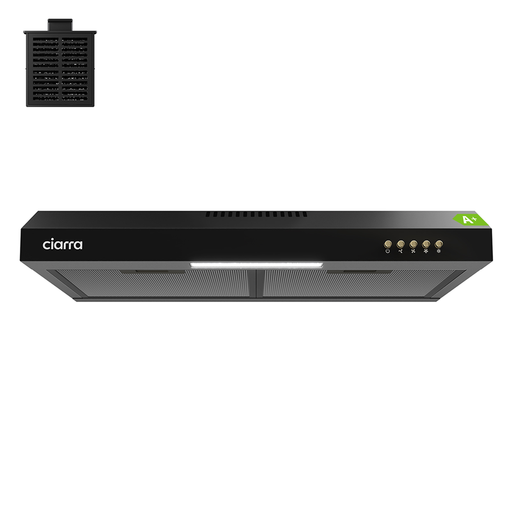 Image unavailable
Worth considering if you’re keeping a separate hob and have space beneath a cabinet above the cooking area. This black model is described as having push-button controls and both extraction and recirculation options. Check its instructions against your cabinet, any ductwork and the filters required.
Don’t assume that the ventilation systems in your home can be removed. Before altering a vent or duct, ask a professional to check your home’s set-up and the requirements that apply to it.
Measure the space on the worktop and inside the cabinet, then note the existing cut-out, drawers, rails and possible route for extraction accessories. Compare these measurements with the installation diagram for the exact model. The appliance’s external dimensions alone won’t tell you the size of the cut-out it needs.
Maintain the grease filter and odour filter according to the model’s instructions. Some filters can be regenerated, but the method Electrolux describes for certain filters shouldn’t be applied to a different appliance.
No, check what’s included with each model. Before ordering or preparing the cabinet, identify the kit and filters compatible with the model and installation method you’re planning to use.