
Livraison le jour même ou le lendemain

Qualité garantie

Débloquez vos offres de bienvenue: Livraison GRATUITE | Jusqu'à -80 % | 30 jours d'essai gratuits à JoyPlus
Téléchargez l'application
A well-organised kitchen isn't just about aesthetics; it's also (and most importantly) a guarantee of everyday functionality. But here's the problem: faced with an overwhelming number of options, it's easy to fall into a trap and invest in solutions that prove disappointing in practice. Lids that no longer close after three dishwasher cycles, stylish accessories that are impossible to clean... nasty surprises are common.
As the Head of Product Recommendations at Joybuy, my mission is to help you cut through the noise. Let's skip the marketing jargon and focus on what really matters. Here are the pitfalls to avoid and the key points to check to choose kitchen storage solutions that will genuinely make your life easier.
For a purchase you won't regret, there are three points to examine closely: the material, the locking system, and stackability.
The choice of material directly impacts the use, durability, and hygiene of your containers.
A good locking system is the cornerstone of an airtight and liquid-tight seal. Lids with four-sided clips and a removable silicone gasket are generally the most reliable solution. For dry goods, screw-on or deep-set lids can also be very effective at preserving freshness.
For picture-perfect pantry organisation, opt for square or rectangular shapes with straight sides. Flat or slightly indented lids allow you to stack containers stably, thus maximising every square inch of your shelves.
Because every kitchen is unique, here are a few products that cater to specific profiles, all while meeting the quality criteria we've just discussed.

Why we chose it: This set is the perfect partner for prepping your meals for the week. Its eight different sizes adapt to all needs: main dishes, sides, snacks... The borosilicate glass allows you to go directly from the fridge to the microwave or oven (without the lid), making it a lunch box solution that is as versatile as it is healthy.
Unlike low-end plastics, borosilicate glass doesn't warp, stain, or retain any odours. Its clip-locking system is designed for a long-lasting seal.
Its great versatility thanks to the 8 different sizes. A healthy, hygienic material that is highly resistant to thermal shock.
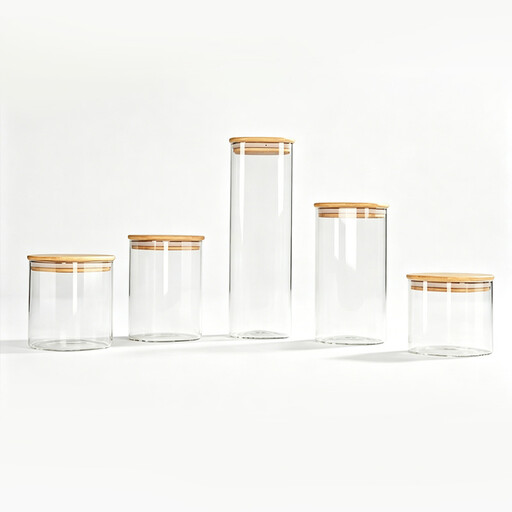
Why we chose it: For those who love impeccable shelves, this set is the perfect compromise between aesthetics and functionality. The transparent glass body allows you to identify pasta, rice, or legumes at a glance, while the wood-effect lids add a warm touch. The different heights are ideal for storing dry goods bought in bulk.
Here, design doesn't sacrifice practicality. The cylindrical shape remains efficient for storage, and glass is a safe and hygienic material for food contact.
An elegant design that makes you want to display your jars. The airtight lids ensure optimal preservation.
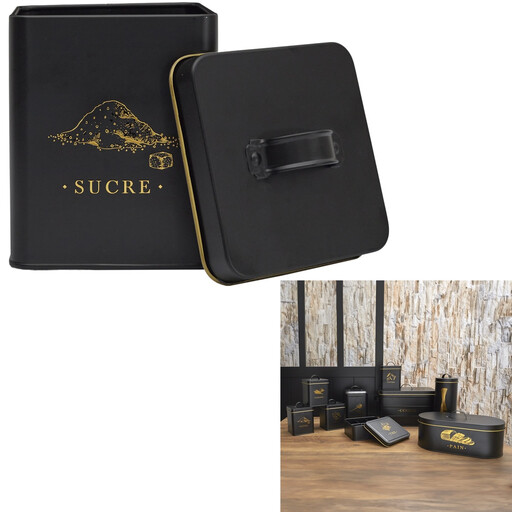
Why we chose it: Proof that storage can be a true decorative piece. Perfect on a worktop or in a coffee corner, this black and gold metal box protects sugar from moisture and light while adding a touch of elegance. The perfect example of a stylish kitchen accessory that sacrifices nothing in terms of function.
It focuses on a single function, but it performs it perfectly. Its metal construction is built to last, and its compact square shape optimises space, a far cry from impractical, overly complex designer objects.
Its sturdy, opaque metal construction. A sophisticated design that turns a simple container into a decorative piece.
We have curated a complete selection of products that meet our strict selection criteria and current safety standards.
How can I prevent plastic containers from absorbing odours or stains? For stubborn stains (like tomato sauce), the first step is to wash the container immediately. If an odour persists, fill it with a mixture of water and baking soda and let it sit for several hours before rinsing. Opting for high-quality, less porous plastic also greatly limits this issue.
What is the lifespan of an airtight storage container? It all depends on the material and the quality of its seal. A well-designed borosilicate glass container can last for years. For plastic models, the weak point is often the lid or the gasket. A system with robust clips and a thick, removable silicone gasket (essential for proper cleaning) will ensure much better longevity.
Can any glass container go in the oven? Absolutely not! It's crucial to know the difference. Only borosilicate glass is designed to withstand significant thermal shock and can therefore go in the oven (usually up to 400°C). Soda-lime glass, which is more common for everyday tableware, would likely shatter from the heat. Always check the manufacturer's instructions and, in any case, remember that the plastic lid must absolutely never, ever go in the oven.