
Livraison le jour même ou le lendemain

Qualité garantie

Débloquez vos offres de bienvenue: Livraison GRATUITE | Jusqu'à -80 % | 30 jours d'essai gratuits à JoyPlus
Téléchargez l'application
Recycling is now a part of our daily lives. But let's be honest: finding the perfect bin for your kitchen can often be a headache. Between the different sizes, materials, and opening systems, it's easy to get lost. The goal? To find an efficient sorting system that fits perfectly into your kitchen without sacrificing space or style.
As a product recommendation expert at Joybuy, my mission is to guide you. This guide offers practical advice and a curated selection to help you find THE kitchen recycling bin that will suit your needs and your home's decor.
Before diving into our selection, let's review the key criteria for making the right choice.
This is the starting point: what volume do you need? It all depends on the size of your household and your habits.
A dual-compartment system is almost essential for easily separating recyclables from general household waste. Some models go even further with a third, smaller bin for compost. Also, consider the volume distribution: do you prefer two equally sized bins, or one large bin for recyclables and a smaller one for everything else?
For an item you use dozens of times a day, ergonomics are key. A pedal bin offers a major hygiene advantage: no need to touch the lid with your hands. Most recent models include a soft-close feature, which puts an end to annoying slamming noises.
In terms of materials, two main contenders dominate the market:
Your choice here will depend on your kitchen's layout and the space you have available.
Enough theory, let's get practical! Here is our selection of models that caught our eye, whether you're looking for a large capacity, an integrated solution, or a simple auxiliary bin.
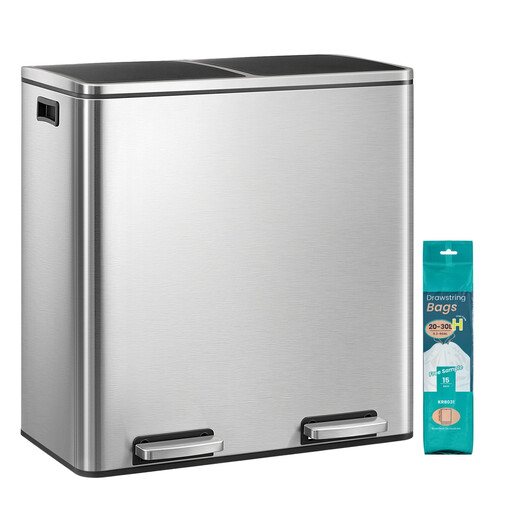
Why it stands out?: This model checks all the boxes: a large capacity, an elegant design, and well-thought-out features. With its two 30L compartments, it reaches a total volume of 60L, ideal for families. Its stainless steel construction gives it a modern look and excellent durability.
Advantages?:
Who is it for?? Families or households that generate a significant amount of waste and are looking for a freestanding solution that is functional, robust, and stylish for their kitchen recycling setup.
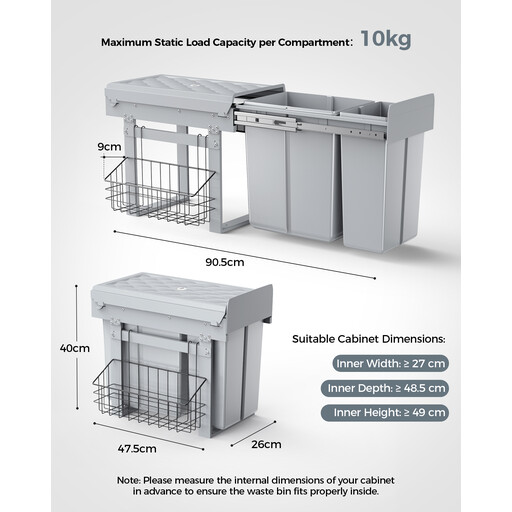
Why it stands out?: This built-in bin is the smartest solution for optimising space. Designed to fit into a kitchen cabinet (from 30 cm wide), it becomes completely invisible once the cupboard door is closed. Its sliding rail system ensures full and easy access to both bins.
Advantages?:
Who is it for?? For small kitchens or for anyone who wants a completely invisible waste sorting system. It's the top choice for maintaining a clean, minimalist aesthetic.
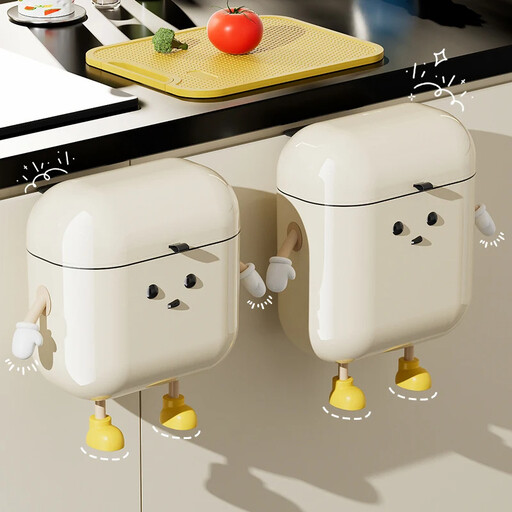
Why it stands out?: This small 9L bin is an incredibly effective auxiliary solution, designed for biowaste (peelings, food scraps...). It hangs on a cabinet door or can be mounted on the wall, always within reach when you're cooking.
Advantages?:
Who is it for?? Anyone looking for a complementary bin for organic waste, or a minimalist solution for a studio apartment. It's the perfect partner to a larger dual-compartment bin.
Didn't find what you were looking for in this selection? No worries, every kitchen is unique, and many other options are available.
To explore a wider range, with other capacities or specific models like a kitchen cabinet bin with a lid, feel free to browse our full category.
Explore more kitchen bins on Joybuy.fr
For a family of four, a total volume of 50 to 60 litres is generally recommended to avoid having to empty it constantly. A 2-compartment bin configuration of 2x30L, like the Ochama model presented, is a very balanced option for managing both general household waste and recyclables.
To maintain your stainless steel bin and preserve its shine, a soft, damp cloth with a drop of washing-up liquid is sufficient. Then, wipe with a dry cloth to prevent water spots. Above all, never use abrasive products, scouring pads, or bleach: you risk scratching or permanently damaging the surface.
The ideal location depends on your kitchen's layout. A built-in bin under the sink is a solution that is as discreet as it is practical, as this is where a lot of waste is generated. If you opt for a freestanding model, place it in a high-traffic area that doesn't obstruct movement but remains easily accessible, for example, at the end of a countertop or in a corner.