
Livraison le jour même ou le lendemain

Qualité garantie

Débloquez vos offres de bienvenue: Livraison GRATUITE | Jusqu'à -80 % | 30 jours d'essai gratuits à JoyPlus
Téléchargez l'application
A kitchen recycling bin should make your daily routine easier without taking up too much space or turning cleaning into a chore. However, some features highlighted on product pages can be misleading. A large capacity, a silent lid or a double compartment aren't enough to guarantee a pleasant experience over time.
Here are the main pitfalls to avoid before buying, along with a selection of formats suited to different households.
A 60-litre kitchen bin might combine two 30-litre compartments or three 20-litre bins. The total volume doesn't tell you how much space is actually reserved for general waste and recyclable packaging.
For a household that recycles regularly, two 30-litre bins offer a simple and effective split. Three 20-litre compartments allow you to separate more categories, but each bin also fills up more quickly.
A bin can look compact in a photo yet stand over 60 cm tall. Before installing one, check its width, depth, height with the lid open and the space needed in front of the bin.
In a small kitchen, a 40-litre slim bin can slide between a cabinet and a fridge. Conversely, a two-compartment 60-litre model needs a stable, clear area.
A pedal, soft-close mechanism or removable buckets are only genuinely useful if the mechanism stays accessible and the bins come out without force. A bin with a soft-close lid reduces slamming, but it doesn't mean you can skip cleaning the hinges and lid rim regularly.
Also check the type of bags compatible with each compartment. Narrow bins may need bags in specific sizes, even when the stated capacity seems generous.
A stainless steel bin fits easily into a contemporary kitchen. Depending on the finish, however, the steel can show fingerprints. For external cleaning, a soft, slightly damp cloth is usually enough. Avoid abrasive products and steel wool.
Removable buckets with handles make changing the bag and washing easier. For a plastic bin, use a soft sponge and soapy water. Always let all the parts dry completely before putting in a new bag – this will help limit moisture and bad odours.
A pedal bin lets you open the lid without touching the surface with your hands. This is especially handy during meal preparation, as long as you place the bin on a flat floor to stop it tipping over.
A soft-close mechanism is a nice feature in an open-plan kitchen or flat. Children under 3 years old should be kept away from pedals, lids and hinges, which can pose a pinching risk. Don't overload the buckets and never use the bin for hazardous or sharp waste.
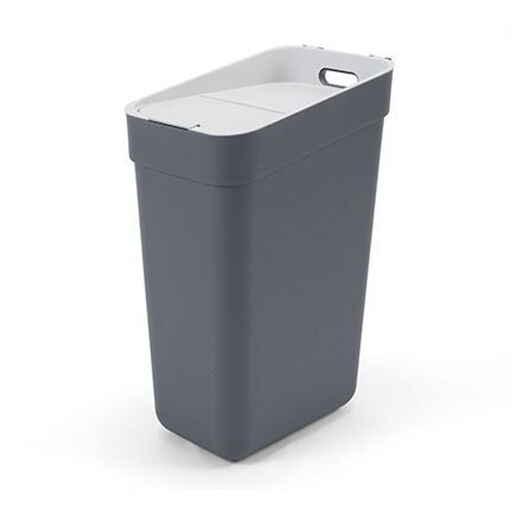
Why this choice suits this profile: With its 30-litre capacity and vertical design, this model works perfectly as a first recycling bin in a kitchen, utility room or garage. The price shown on the page makes it easy to compare with more sophisticated pedal models.
The stated capacity refers to a single bin. So there's no risk of confusing total volume with distribution across several compartments. Its design requires no wall mounting or special installation.
30-litre capacity, material made from 70% recycled content according to the product page, anthracite colour and cleaning with soapy water.
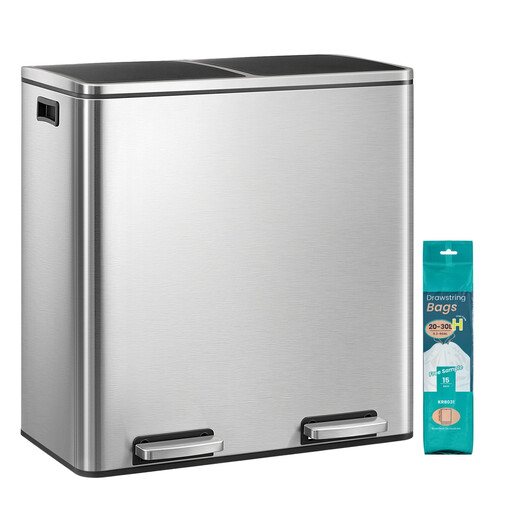
Why this choice suits this profile: This stainless steel model combines a total capacity of 60 litres, two pedal lids and a soft-close mechanism. Its dimensions of 59 × 32.5 × 65.2 cm should, however, be checked against the available space before buying.
The two removable 30-litre inner buckets make the split clear and simplify emptying. The soft-close mechanism limits slamming but doesn't claim to eliminate odours on its own.
Stainless steel outer body, hands-free opening, buckets with handles and 15 bags included according to the product page.
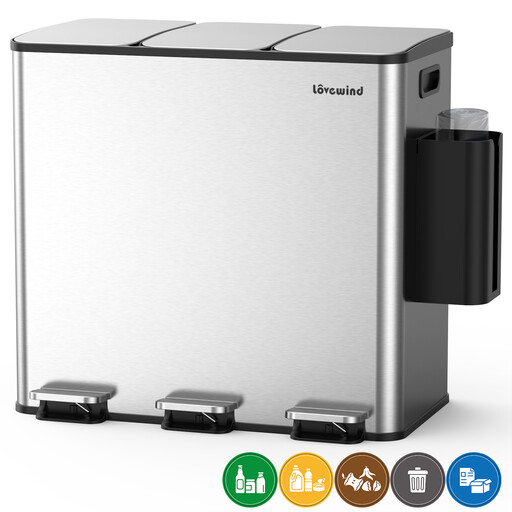
Why this choice suits this profile: The three independent compartments are ideal for households that separate several waste streams. This system can also work well in a family kitchen where packaging builds up quickly.
The 60 litres are split across three 20-litre bins, giving a clear picture of the volume actually available. The coloured magnetic labels make it easy to identify categories, as long as you follow local recycling guidelines.
Three independent lids, stays open at 90°, inner buckets and a stainless steel surface that is claimed to be fingerprint-resistant.
For narrow spaces, the Curver Slim Pedal Bin 40 L features a pedal opening and a removable inner bucket. In an office, bathroom or on a worktop, the 1-litre desktop bin in bamboo and metal is suitable for small waste. It won't, however, replace a bin designed for bulky packaging.
We've selected a full range, updated in real time, of products that meet these demanding criteria as well as European safety standards.
A household of several people could opt for 60 litres, split between two or three compartments. However, your local collection frequency and your consumption habits are still key factors. A large volume isn't necessarily useful if you take the rubbish out every day.
Use a suitable bag, empty wet waste regularly and clean the removable buckets. Never pour liquids directly into the bin. A lid that closes properly helps contain odours, but nothing beats regular maintenance and proper sorting of materials.
A standard pedal bin doesn't need any power supply – it works using a mechanical mechanism. Automatic models, on the other hand, may use batteries or a rechargeable battery. In that case, check the stated battery life, the type of charging and the cost of consumables before deciding.