
Livraison le jour même ou le lendemain

Qualité garantie

Débloquez vos offres de bienvenue: Livraison GRATUITE | Jusqu'à -80 % | 30 jours d'essai gratuits à JoyPlus
Téléchargez l'application
Waste sorting has become second nature in most households. The problem? It can quickly turn a tidy kitchen into a chaotic jumble of mismatched bags and bins. Finding a recycling bin that is practical, hygienic, and stylish can be a real puzzle. How do you balance the demands of recycling with your kitchen's aesthetic?
This guide is here to help. As product experts at Joybuy, our mission is to break down the technical specifications for you and provide objective insights, free from marketing jargon. Let's review the criteria that really matter and explore a selection of models that have caught our eye.
Before you start shopping, a few key points deserve your attention. These are the details that will make all the difference in your daily routine.
This is the starting point: what volume and how many compartments do you really need? A 2-bin trash can is often a good compromise for separating general household waste from recyclables (the classic "yellow bin" items). If you compost or sort glass at home, a 3-compartment trash can will be necessary.
The total capacity, measured in litres, depends on the size of your household and the frequency of waste collection in your area. A 60L trash can (usually 2x30L or 3x20L) is a popular choice for families, as it offers a good balance between footprint and capacity. For a single person or a couple, a total volume of 30 to 40 litres will be more than enough.
In the kitchen, hygiene is non-negotiable. A kitchen trash can must therefore be easy to clean. Stainless steel (or a stainless steel trash can) remains the gold standard for its durability and modern look. Most recent models feature a fingerprint-proof coating, a welcome bonus that saves you from constant polishing.
Also, check that the inner buckets (often made of plastic) are removable and have handles. It's a game-changing detail when it comes time to empty or clean the bins.
Some details that might seem superfluous can actually make a huge difference to your daily convenience:
Here are a few models that stood out to us for their smart design and features, all created to simplify your kitchen recycling.
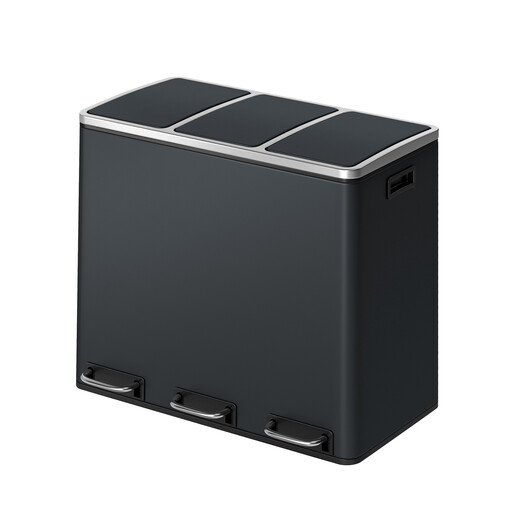
Key features This model offers a complete sorting solution with its three 18-litre compartments. It's perfect for neatly separating general waste, recyclables, and biowaste for compost. Its steel construction and understated greenish-grey design blend easily into modern kitchens.
Benefits
Who is it for? For households that want precise sorting (including compost) in a compact, all-in-one unit.
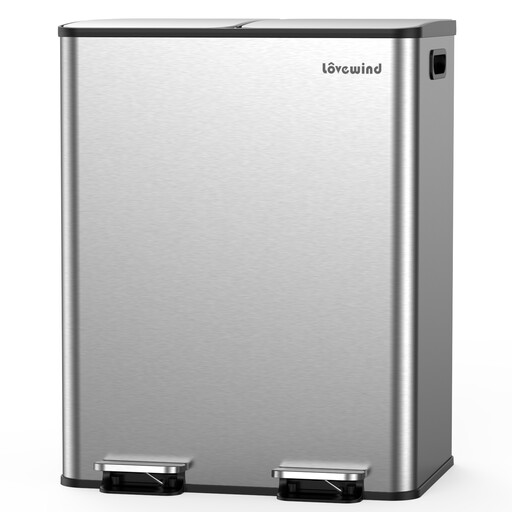
Key features With its large 60L capacity, this 2-bin trash can is designed for families or those who fill their bins quickly. Its silver stainless steel finish is treated to resist fingerprints. Each compartment has its own pedal and handle, simplifying daily sorting and handling.
Benefits
Who is it for? Ideal for families or flatmates looking for a simple, durable, and high-volume sorting solution for everyday waste and recycling.
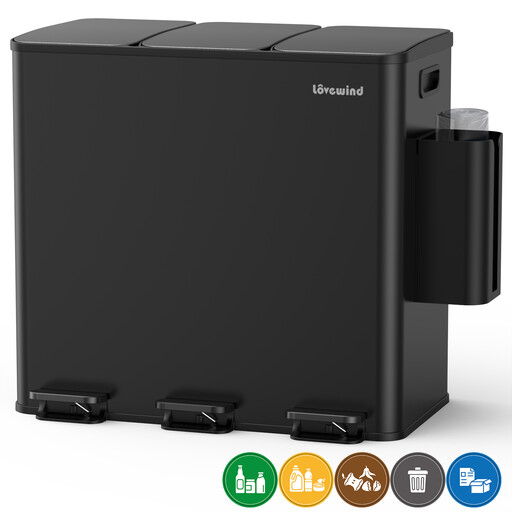
Key features This model takes organisation a step further. In addition to its 3 compartments of 20L each, it comes with coloured magnetic labels to identify each sorting bin. It also includes a magnetic storage box for bin liners—a clever detail to keep everything at hand. Thanks to its flat back, it sits flush against a wall, and its lid is designed not to hit the wall when opened.
Benefits
Who is it for? For the organisation pros who want a complete, customisable sorting solution packed with smart details to optimise space and usability.
Is your ideal model not in this selection? Every kitchen is unique. To find the bin that perfectly matches your needs in terms of size, materials, or number of compartments, explore our full collection.
? Discover our full range of kitchen recycling bins
For a family of four, a total capacity of 50 to 60 litres is generally ideal. A 2 x 30L or 3 x 20L configuration offers a good compromise to last the week without having to empty the bins every couple of days.
To maintain a stainless steel trash can, use a soft, slightly damp microfibre cloth. For stubborn stains, a little soapy water (Marseille soap or washing-up liquid) is sufficient. Then, dry with a clean cloth to prevent limescale marks. Above all, avoid abrasive products or the scouring side of sponges, which could scratch the surface.
Yes, a pedal bin is a real advantage for kitchen hygiene. It allows you to open the lid without any hand contact, which is especially practical when you're cooking. This limits the spread of bacteria between the bin and your worktop.