
Livraison le jour même ou le lendemain

Qualité garantie

Débloquez vos offres de bienvenue: Livraison GRATUITE | Jusqu'à -80 % | 30 jours d'essai gratuits à JoyPlus
Téléchargez l'application
Choosing a kitchen bin? Easy, right? Not so fast. A mechanism that gives out after six months, stainless steel that rusts, or inner buckets that are impossible to remove… A poor choice can quickly turn this everyday object into a real headache. To save you from this frustration, our editorial team has broken down the common pitfalls to avoid and the criteria that truly matter.
The market is flooded with models making tempting promises, but not all are created equal when it comes to durability and design. Here are three things to watch out for to make the right choice.
Beyond aesthetics, a few technical specifications make all the difference. They will help you objectively compare models and find the one that truly fits your household and your habits.
This is the first question to ask yourself. A 60L recycling bin is generally a good starting point for a family of 3 to 4. This capacity is most often split into two 30-litre compartments: a perfect setup for separating general waste from recyclables (like plastics and packaging).
For those who are more serious about sorting (glass, paper, biowaste...), a 3-compartment recycling bin (e.g., 3 x 20L) is an excellent option. This type of kitchen waste separator centralises everything in one place, provided you have the necessary floor space.
This is a crucial factor for longevity. A stainless steel bin with a decent gauge and, ideally, a fingerprint-proof coating will guarantee better durability and much easier maintenance. For the inner buckets, PP (polypropylene) plastic is an excellent choice: it's durable, lightweight, and wipes clean in a snap. Check for handles on the buckets: it's a small detail that makes all the difference when it's time to empty them!
The pedal bin for the kitchen has become the standard, and for good reason: hygiene. But be warned, not all mechanisms are created equal. Opt for a wide, preferably metal, pedal that feels sturdy from the very first step.
The other essential comfort feature is the soft-close lid. This damper system prevents the loud 'CLANG!' of a slamming lid. A detail that's anything but minor, especially in an open-plan kitchen or when children are sleeping.
To illustrate these criteria in action, here are a few models that caught our eye and meet specific needs.
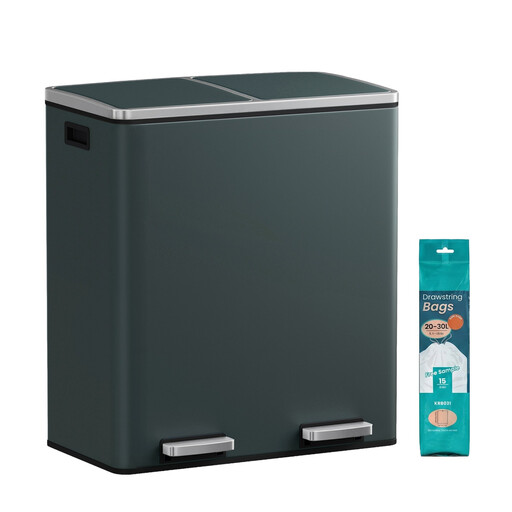
Why it's perfect for them: Its 60L (2x30L) capacity is perfectly sized to handle a family's waste volume. The two distinct pedals make sorting intuitive, even for the youngest members of the household.
Its pedal mechanism is designed for heavy use, and the soft-close feature protects the hinges from wear and tear and your ears from loud slams.
The removable inner buckets, made of PP plastic and equipped with handles, make emptying and cleaning incredibly simple.
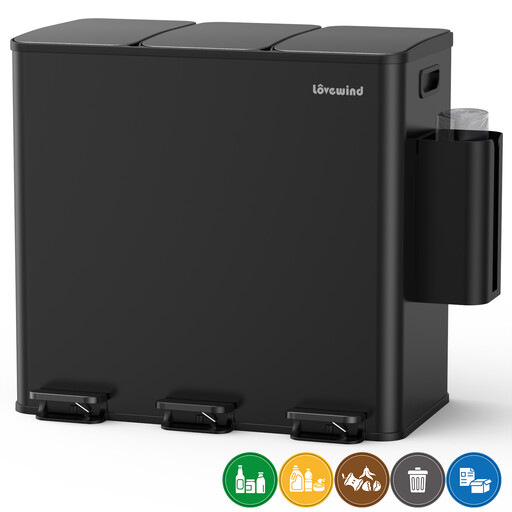
Why it's perfect for them: Its three independent compartments allow you to manage three separate waste streams (e.g., general waste, packaging, glass) in a single unit. It's a great way to streamline your recycling routine without cluttering your space with multiple bins.
Its stainless steel body features an effective fingerprint-proof and anti-rust coating. The reinforced pedals are built to withstand thousands of uses.
The extra touch? It comes with magnetic labels to identify each compartment. Smart and practical for the whole family.
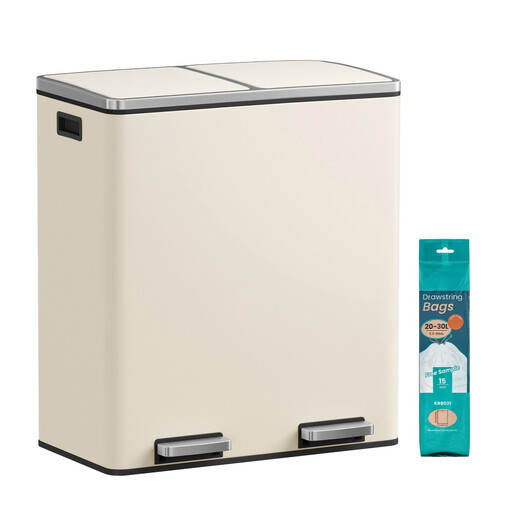
Why it's perfect for them: Its cream colour and clean lines allow it to blend elegantly into a modern kitchen. Finally, a functional object that makes no sacrifices on style.
The soft-close lid preserves the peace in open-plan kitchens, while its smart design prevents the lid from hitting the wall. A detail that matters.
Despite its generous capacity, its slim, rectangular shape (approx. 59 x 32.5 cm) makes it easy to place along a wall or at the end of an island.
Discover our full selection of products that meet our standards for quality and durability.
For routine cleaning, a simple damp microfibre cloth is all you need. For more stubborn marks, a little soapy water or a dedicated stainless steel cleaner will do the trick. Always remember to dry it thoroughly with a clean cloth to prevent water spots. Most importantly, never use an abrasive sponge, which would permanently scratch the surface.
Yes, in most cases. For a 30L bucket, a standard 50L bag is ideal, as it provides enough slack to fold over the rim. For a 20L bucket, a 30L bag will fit perfectly. Some smarter models even include a hole or a retainer ring to hold the bag in place and prevent it from slipping.
Absolutely! It's a small hydraulic damper that slows the lid's descent, allowing it to close silently. In daily use, it's a real bonus: no more sudden slams, the mechanism wears out more slowly, and the securely closed lid contains odours more effectively.