
Livraison le jour même ou le lendemain

Qualité garantie

Débloquez vos offres de bienvenue: Livraison GRATUITE | Jusqu'à -80 % | 30 jours d'essai gratuits à JoyPlus
Téléchargez l'application
Choosing a kitchen bin might seem trivial. Yet, this purchase directly impacts the hygiene, organisation, and even the style of your kitchen on a daily basis. Faced with an overwhelming number of options, it's easy to get it wrong and regret your choice: a pedal that gives out, a lid that slams shut, or a surface that gets covered in smudges from the very first week.
As the Head of Product Curation at Joybuy, my mission is to help you decode the marketing jargon and focus on what really matters. Here are the three most common mistakes to avoid and the objective criteria for making the right choice, once and for all.
To invest in a model that will keep you happy for years to come, focus on these three essential points.
The ideal capacity depends on the size of your household and your recycling habits. For a family of 3 to 6, a 60L bin is often a good starting point. But the most important factor is the configuration:
Always check the dimensions of the removable inner buckets to judge the actual usable volume.
The longevity of your kitchen recycling bin depends on two critical points:
Beyond the basic structure, certain details make all the difference in daily use:
Here are a few models that meet these quality criteria, designed for different needs and lifestyles.
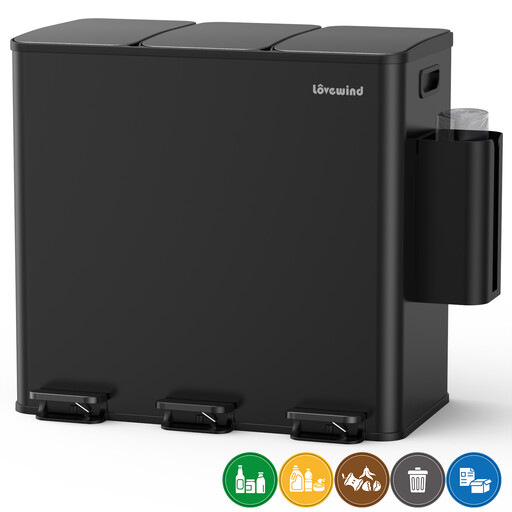
Why we love it: Perfect for large families who take recycling seriously. The three compartments allow you to manage general waste, recyclables, and glass or organic waste in a single, streamlined unit.
Its three independent 20L buckets offer a clear and well-distributed usable volume, avoiding the misleading capacity trap. The reinforced steel pedal is designed for heavy use.
Maximum organisation: 3 compartments with independent lids and pedals. Helpful features: Magnetic sorting labels and integrated charcoal filters for odour control.
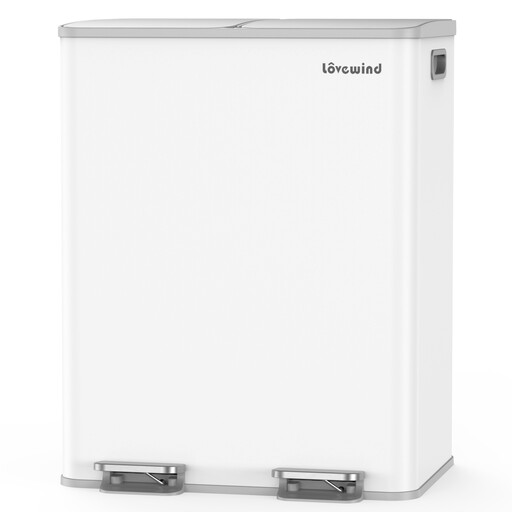
Why we love it: Ideal for modern kitchens where design is as important as practicality. Its white finish and sleek look blend in discreetly, while the two 30L compartments meet the sorting needs of a couple or small family.
Its steel finish is treated to resist fingerprints, avoiding the nightmare of hard-to-clean stainless steel. The silent-close mechanism puts an end to slamming lids.
Soft and silent close: The lid closes without a sound thanks to a damping system. Practical design: Sturdy pedals, removable buckets with a liner-retaining ring.
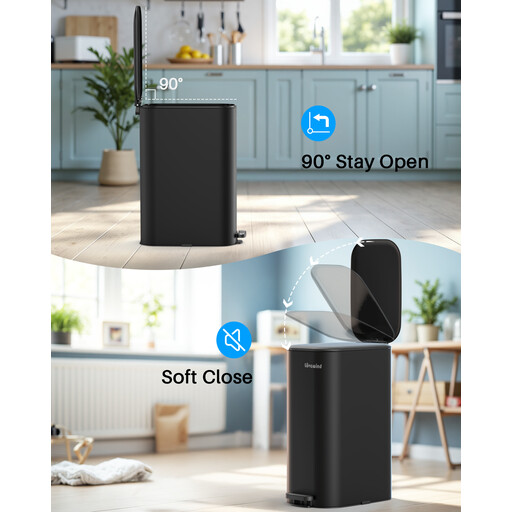
Why we love it: For those living in flats or with a compact kitchen. Its slim profile allows it to slide into the tightest spaces, while still offering a 30L capacity that's sufficient for one or two people.
This model focuses on quality components rather than a bulky size. Its reinforced pedal and anti-fingerprint finish make it a durable choice that doesn't sacrifice quality for compactness.
Space-saving: Its slim, rectangular profile is designed for tight spaces. Hygienic and practical: Pedal operation, soft-close lid, and a removable inner bucket.
Explore our full selection of bins that meet our quality criteria and current safety standards.
The choice mainly depends on your local council's recycling rules and your personal habits. A 2-compartment bin is sufficient for most households (general waste + recyclables). Switch to a 3-compartment bin if you want a dedicated section for glass, organic waste (compost), or paper, and if you have the space for it.
It all depends on the quality of the mechanism and how you use it. A good model with a reinforced steel pedal, tested for over 100,000 or 200,000 cycles, can last for years without failing, even with heavy family use. Conversely, entry-level models with plastic parts can give out in less than a year.
For effective maintenance, empty the compartments regularly. Once a week, clean the inner buckets with warm, soapy water, then dry them thoroughly before putting them back. For the stainless steel exterior, a simple damp microfibre cloth is enough to remove smudges. Most importantly, do not use abrasive products that could scratch the coating. Some models even integrate charcoal filters in the lid to neutralise odours: a real bonus.