
Livraison le jour même ou le lendemain

Qualité garantie

Débloquez vos offres de bienvenue: Livraison GRATUITE | Jusqu'à -80 % | 30 jours d'essai gratuits à JoyPlus
Téléchargez l'application
Choosing a kitchen recycling bin might seem like a simple task, but it's a purchase that makes a big difference in your day-to-day life. The wrong decision can quickly become a source of frustration: bad odours, a lack of practicality, tedious cleaning... To help you avoid any unpleasant surprises, our guide breaks down the essential criteria and the pitfalls to watch out for before you make your choice.
The market is flooded with models making tempting promises. However, certain features—or the lack thereof—can render a product unusable after just a few months.
To ensure you don't regret your purchase, focus on these few technical points that make all the difference in daily use.
The first question to ask yourself is about volume. For a single person or a couple, a total capacity of 30 to 40 litres is often sufficient. For a family of three or four, a 60 L dual-compartment bin is a much better fit.
It's crucial to check that the buckets are removable and have handles. This is a small detail that makes all the difference when carrying waste to the collection point and during cleaning.
The choice of material isn't just a matter of aesthetics: it determines the hygiene and lifespan of your bin.
These details make all the difference in your daily routine.
Every household has different needs. Here is a selection of models suited to specific uses.
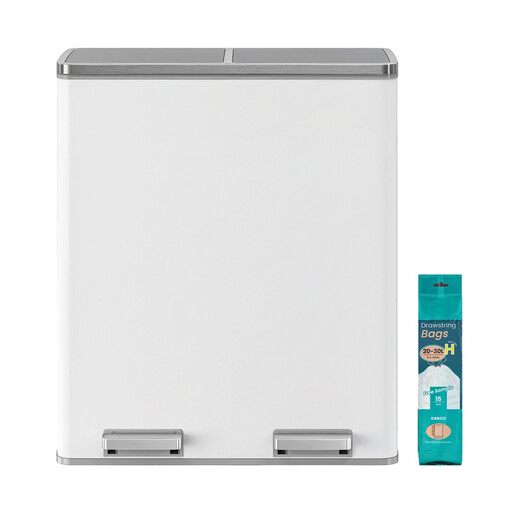
Why we love it: With its 60-litre total capacity (2 x 30 L), it's perfectly sized for a family. It makes it easy to manage the daily volume of general waste and recyclable packaging.
Its steel body and sturdy pedals are designed to withstand the test of daily use. The inner plastic buckets, complete with handles, can be removed effortlessly for emptying and cleaning.
Its large 60 L capacity reduces trips to the main bins, while the soft-close lid keeps your kitchen peaceful.
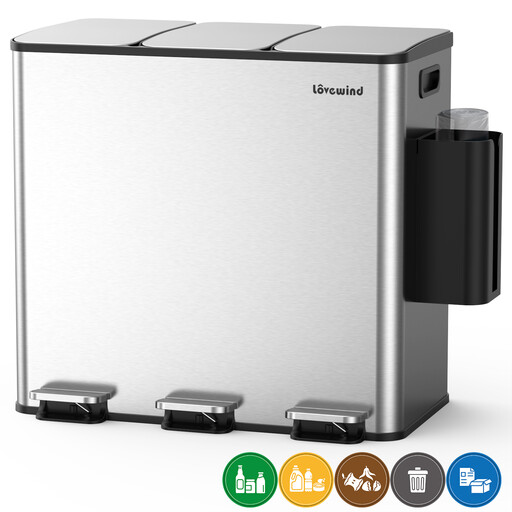
Why we love it: For recycling purists, this three-compartment model is the ultimate all-in-one solution. It allows you to manage three separate waste streams (glass, packaging, general waste) in a single unit.
Each compartment has its own lid and pedal—a smart design that isolates odours. Its design allows it to be placed flush against a wall without the lids hitting it on opening.
The included magnetic labels help the whole family know which bin is which and prevent sorting mistakes. The 90° stay-open lid feature is a real bonus when you're cooking.
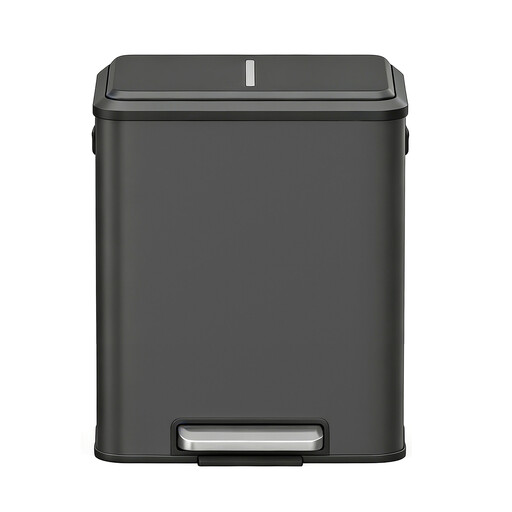
Why we love it: With its 30 L capacity (2 x 15 L) and tall, vertical design, this is the perfect solution for studios and small kitchens where every square inch counts. It lets you sort your waste without sacrificing floor space.
Its compact size doesn't stop it from being well-designed. Its steel body is sturdy and easy to maintain, and its removable buckets with handles ensure hygienic management.
Its small footprint allows it to fit in anywhere, while still offering the essential features: two compartments, a comfortable pedal, and a silent-close lid.
Discover our full selection of products that meet our criteria for quality and durability.
For a family of 4, aim for a total capacity of 50 to 60 litres. This is the ideal volume to avoid having to take out the bins every other day. A 2-compartment bin configuration of 2 x 30 L is an excellent compromise for managing the week's general waste and recyclables.
The secret is consistency. Once a week, remove the removable buckets, wash them with hot, soapy water, then dry them thoroughly before putting in a new bag. For the stainless steel body, a simple damp microfibre cloth with a little dish soap is enough. Most importantly, never use abrasive cleaners or scouring pads, as you risk permanently scratching the surface.
Both have their pros and cons. Stainless steel is prized for its robustness, modern look, and impeccable hygiene: being non-porous, it doesn't retain odours or bacteria. Plastic, which is lighter and cheaper, is more resistant to small bumps. Its drawback is that it tends to stain and absorb odours over time. For the kitchen, stainless steel therefore remains the benchmark for durability and ease of maintenance.