
Same-day & Next-day Delivery

Quality Guaranteed

Unlock Your Welcome Offers: FREE Delivery | Up to 80% OFF | Free 30-day JoyPlus trial
Download the APP
A great dish isn't just made on the stovetop. It all starts much earlier, on the cutting board, with tools that turn preparation into a pleasure. However, choosing a kitchen knife set can quickly become a headache. Faced with an overwhelming number of options and opaque marketing jargon, it's easy to make a purchasing mistake. As a product specialist for this publication, my mission is to help you navigate the marketing traps.
Let's forget the tempting promises. Instead, let's focus on the mistakes to avoid and the real criteria that make the difference for a smart, long-lasting purchase.
The market is flooded with products that look appealing in photos but reveal unpleasant surprises with use. Here are the three most common mistakes:
Making the right choice is simply a matter of focusing on a few key points.
The stainless steel label is a prerequisite, but it doesn't tell the whole story. The quality of steel depends on its composition. For example, a steel like 30Cr13, often found in reliable kitchen knives, offers an excellent balance between ease of sharpening and corrosion resistance. Steels from the 400 series are also known for their durability in home use. The key is to find a balance: a very hard blade will hold its edge longer but will be more difficult to sharpen, while a softer blade will sharpen easily but require more regular maintenance.
How the knife is assembled is crucial for its durability and comfort in use. Check if the blade extends into the handle. This is called the "tang." A full tang design (where the blade runs the full length of the handle) is a sign of sturdiness and ensures better balance, reducing fatigue during prolonged cutting. A well-balanced knife should not feel too heavy toward the blade or too heavy toward the handle.
A functional knife set doesn't need a dozen pieces. For 90% of daily tasks, this winning trio is all you need:
Let's get practical with a few products that meet clear needs, with no frills.
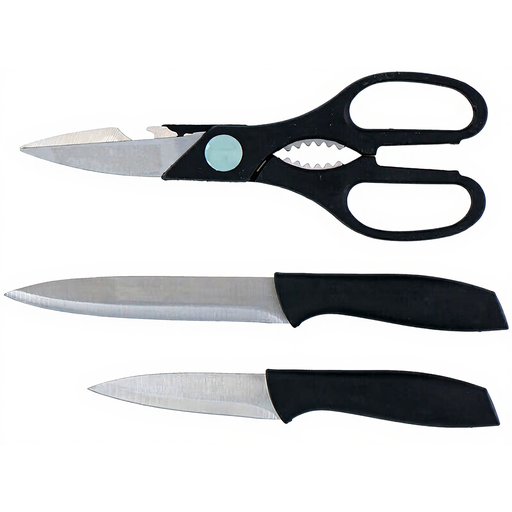
Why we recommend it: Perfect for a first apartment or for replacing the basics. This set gets straight to the point, providing the necessary tools for daily tasks without the clutter of superfluous pieces.
It avoids the "mega-set" trap by focusing on three truly versatile tools: a chef's knife, a utility knife, and multi-function scissors.
The multi-function scissors (with a bottle opener) make it even more practical for everyday use.
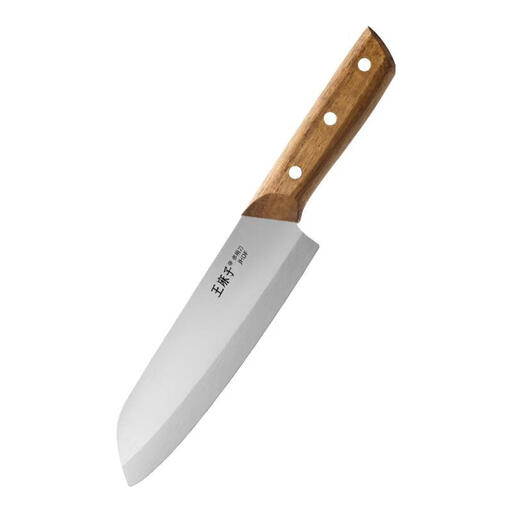
Why we recommend it: For the home cook who loves to vary their preparations, the Santoku is a trusted ally. It excels at slicing, dicing, and finely chopping vegetables, fish, and meats.
It sidesteps the jargon trap by clearly stating its material: a 400 series stainless steel, a concrete technical detail, not a marketing slogan.
Its acacia wood handle provides a grip that is as comfortable as it is beautiful, and its blade makes it a formidable all-purpose knife.
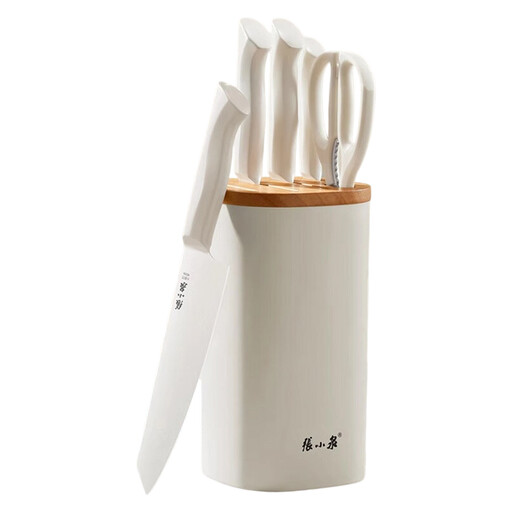
Why we recommend it: For those who want a complete, durable, and perfectly organized setup. This set offers an integrated storage solution and a selection of blades to cover more specific needs.
Far from a catch-all "mega-set," this is a relevant selection of useful knives, delivered with a block that protects the blades and keeps the countertop tidy.
The all-in-one solution with its storage block: your knives are always within reach, well-protected, and perfectly organized.
Buying a good knife is only the first step. To keep it performing well and safely (a dull knife requires more force, increasing the risk of slipping), regular maintenance is essential. Using a knife sharpener is the simplest and most effective method for maintaining the edge of your blades.
A model like the SHIBAZIZUO three-stage sharpener allows you to easily restore, sharpen, and polish your blades. A few passes are all it takes to restore your knife's sharp bite.
Discover our complete selection of kitchen knives, chosen for their value and durability.
The classic chef's knife (French or German style) has a more pointed tip and a pronounced curve, making it ideal for a rocking motion. The Japanese Santoku knife has a straighter blade and a rounded tip. It is often lighter and shorter, favoring a vertical chopping motion. The choice depends on your habits and preferred cutting technique.
The golden rule: never put them in the dishwasher! Harsh detergents and impacts with other utensils can damage the blade and handle. Opt for hand washing with warm, soapy water, followed by immediate drying with a soft cloth. Store your knives in a block, on a magnetic strip, or in a drawer with blade guards to prevent the edges from getting damaged.
If you have very specific needs or want to upgrade gradually, buying knives individually is an excellent approach. You can choose the perfect chef's knife for you, then complement it with a paring knife from another brand. For a first kitchen setup or to ensure aesthetic and functional consistency, a well-curated knife set remains a practical and often more cost-effective solution.