
Livraison le jour même ou le lendemain

Qualité garantie

Débloquez vos offres de bienvenue: Livraison GRATUITE | Jusqu'à -80 % | 30 jours d'essai gratuits à JoyPlus
Téléchargez l'application
A kitchen extractor hood should remove smoke, steam and odours without turning mealtimes into a noisy ordeal. However, a detailed product listing does not necessarily guarantee the right choice. In a small kitchen, studio flat or open-plan room, three pitfalls come up time and again: an airflow rate shown without context, an appliance that is incompatible with the existing installation, and filter maintenance costs that are seriously underestimated.
Here are the criteria to consider before buying, followed by a selection of models suited to different needs.
A high figure in m³/h naturally attracts attention. However, it often corresponds to the most powerful setting, or even the intensive mode. Noise level, duct diameter, the number of bends and the length of the duct can all significantly reduce real-world performance.
When comparing two extractor hoods, check the specifications for each operating level where possible, rather than looking only at the maximum figure. A model advertised at 650 m³/h may make sense in an open-plan kitchen, while an appliance rated at 200 to 370 m³/h may be perfectly suitable for everyday cooking in a small room.
An externally vented extractor hood sends smoke- and odour-laden air outside through a duct. It requires a compatible duct and an installation permitted in your home. A recirculating extractor hood, on the other hand, passes the air through a carbon filter before returning it to the room. This solution is particularly suitable for flats without an external outlet, but the carbon filter must be maintained or replaced in line with the manufacturer’s recommendations.
Convertible models, which support both modes, offer greater flexibility if you move home or renovate.
A saturated grease filter can slow down airflow and encourage deposits on furniture and walls. Before choosing, check whether it is washable, easy to remove and, where necessary, dishwasher-safe. For frequent use, a reusable metal filter can help reduce spending on consumables. In recirculation mode, however, you will need to plan for regular carbon-filter replacement.
A 60 cm kitchen extractor hood is suitable for many standard hobs and cookers. It should at least cover the full width of the cooking area, or extend beyond it where the layout allows. 90 cm models are better suited to large hobs, frequent cooking and open-plan kitchens.
Check the instructions for the minimum height required above the hob. This varies depending on the type of cooking and the manufacturer’s recommendations.
As a first point of comparison, a high airflow rate can be useful in an open-plan kitchen or when cooking produces a lot of smoke. However, it must be matched by a suitable installation. A duct that is too narrow, too long or has numerous bends may increase noise while reducing the extractor hood’s effectiveness.
In recirculation mode, check the reference of the compatible carbon filter and its availability. For an externally vented installation, check that the duct is present, along with the connection accessories and non-return flap.
An extractor hood described as a quiet extractor hood should be assessed based on its noise level in decibels, taking into account the setting to which that figure applies. As an indication, the specifications for the models featured below show maximum noise levels of between 59 and 64 dB for several wall-mounted appliances. Comfort also depends on the kitchen’s acoustics and the duct layout.
An extractor hood with LED lighting improves visibility over the cooking area. However, check the position of the lighting and whether the light source can be replaced. Finally, compare the energy rating and stated annual consumption. An A+++ rating shown on a product listing does not necessarily mean that every appliance in the category uses the same amount of electricity: always check consumption in kWh/year and the power rating.
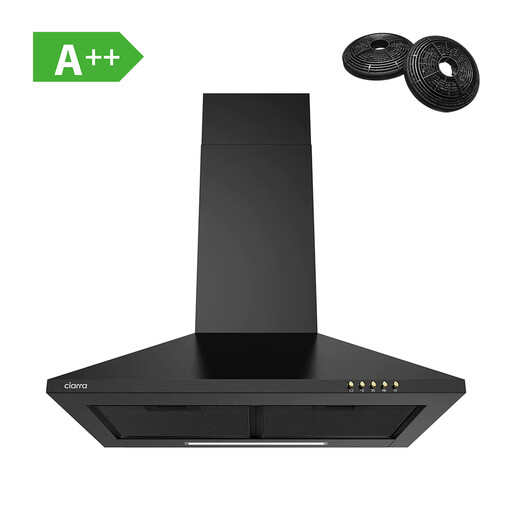
Why this choice suits this profile : This 60 cm wall-mounted format is suitable for a standard kitchen and can operate in both recirculation and external extraction modes. The mechanical push-button controls are easy to use every day.
The listing mentions a washable aluminium metal filter and two ventilation modes. If you use recirculation mode, you will still need to allow for carbon filters.
600 mm width, three speeds, integrated lighting, stated A++ energy rating and a maximum stated noise level of 63 dB.
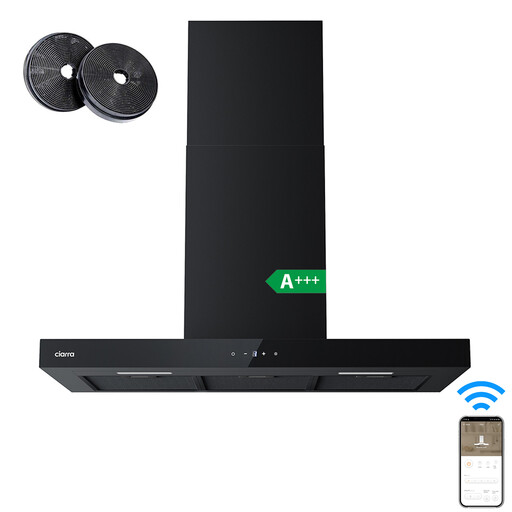
Why this choice suits this profile : Its 90 cm format, Wi-Fi-enabled touch controls and stated airflow rate of 650 m³/h make it suitable for large hobs and open-plan kitchens.
The listing distinguishes between recirculation and extraction modes, and mentions the carbon filters and duct. Check the exact configuration before installation.
Stated airflow rate of 650 m³/h, four levels with intensive function, washable aluminium filters, stated A+++ rating and a maximum stated noise level of 59 dB.
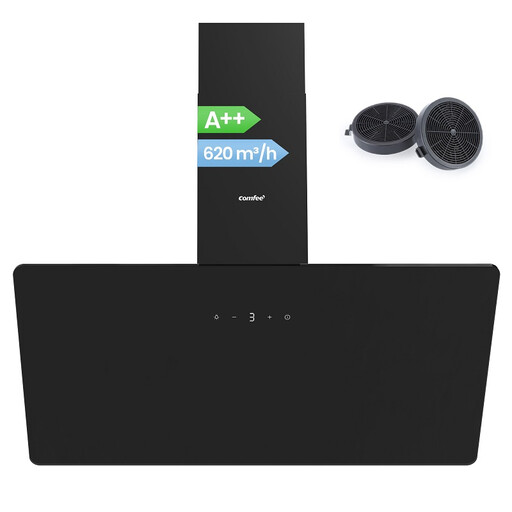
Why this choice suits this profile : Its angled front and four speeds are suitable for regular cooking, large hobs and kitchens where space in front of the extractor hood is limited.
The listing specifies the two ventilation modes and the presence of a five-layer aluminium filter. The stated noise level of 59 dB should be considered alongside the setting being used.
Stated airflow rate of 620 m³/h, touch controls, LED lighting, stated A++ energy rating and installation possible in recirculation or extraction mode.
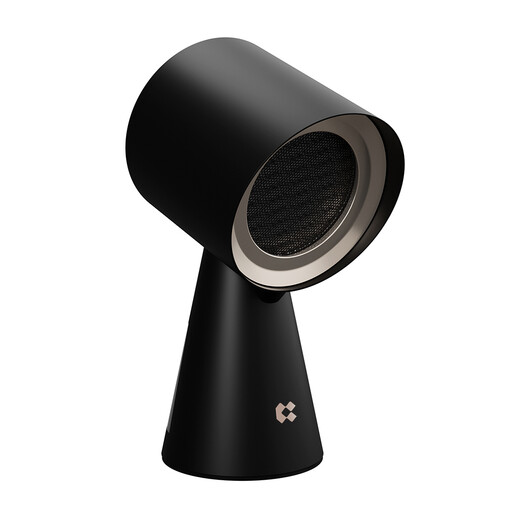
Why this choice suits this profile : This tabletop appliance operates in recirculation mode, with no drilling or wall duct required. It may be suitable for a studio flat, rental property or temporary cooking area.
Its standalone operation means you do not have to choose a wall-mounted extractor hood that is incompatible with your home. However, its stated airflow rate is lower than that of a fixed model.
Two speeds, compact dimensions, stated 110–240 V power supply and multi-layer filters to be cleaned after use.
We have put together a complete, real-time selection of products that meet these demanding criteria and European safety standards.
Yes, provided you use the carbon filters designed for the model and follow the installation clearances. The extractor hood returns filtered air to the room, but it does not replace the home’s general ventilation. Filters must be maintained in accordance with the instructions.
Compare the stated airflow rate with the noise level, rather than focusing on a single figure. An extractor hood rated at 580 to 650 m³/h may be suitable for a large room or frequent cooking, while a more compact model will often be sufficient in a small kitchen. The quality and configuration of the duct also play a decisive role.
It depends on how often you use the appliance. For regular cooking, cleaning every two to four weeks is a good starting point, adjusted according to the amount of grease that has built up. Switch off the power before carrying out any work and use only the products and parts recommended in the instructions.