
Livraison le jour même ou le lendemain

Qualité garantie

Débloquez vos offres de bienvenue: Livraison GRATUITE | Jusqu'à -80 % | 30 jours d'essai gratuits à JoyPlus
Téléchargez l'application
A kitchen extractor hood needs to remove smoke, steam and grease without taking up too much space or drowning your meals in a constant hum. Yet some product listings simply highlight a maximum extraction rate or an attractive design, without going into installation requirements or maintenance considerations.
Before you place your order, take a moment to check three points that are often overlooked:
A ducted extractor hood pushes air outside through a duct. This option works well for kitchens that already have a suitable outlet. Before you go ahead, though, check the duct diameter, its route, and any building regulations or rental restrictions that may apply.
A recirculation hood, on the other hand, filters the air before returning it to the room. It’s a practical choice when no duct is available, particularly in flats. However, it does require a charcoal filter in addition to the grease filter. The grease filter – usually metal and washable – also needs regular cleaning to prevent a build-up of residue.
Convertible models, which can be used in either ducted or recirculation mode, offer more flexibility if you move house or renovate.
A 60 cm kitchen hood suits many standard hobs, but always measure your space before choosing. A 90 cm hood will cover a larger hob more effectively, provided you have a wide enough wall and suitable space.
The distance between the hob and the hood should follow the instructions in the manual. For the COMFEE’ KWH-SLIF17B-60 model, the guide recommends a height of between 650 and 750 mm. This figure can’t be automatically applied to every appliance.
Measured in m³/h, the airflow rate tells you how much air the hood moves. It’s not enough to compare two models on this alone: the noise level, measured in dB, and the performance loss caused by the duct or filters are just as important.
In an open-plan kitchen, go for a quiet extractor hood at its normal speeds rather than one that’s only shown at its best – that is, at maximum speed. Product listings may also detail the noise level for each speed. Some Ciarra 60 cm models, for example, quote 51 dB on the first speed, compared with 63 dB at maximum.
A high-power extractor hood can be useful for frying or frequent cooking. But a powerful motor needs to be paired with a properly sized installation. Also check the annual energy consumption and energy rating shown on the specification sheet.
A washable metal grease filter cuts down on repeat purchases. Check that it’s easy to remove, can withstand regular cleaning and, where stated, is dishwasher-safe. In recirculation mode, the charcoal filter may be supplied or sold separately, depending on the model.
An extractor hood with LED lighting improves visibility over the hob. Mechanical push-button controls are simple and straightforward, while touch controls and app-based operation add extra features – but also more electronics to consider.
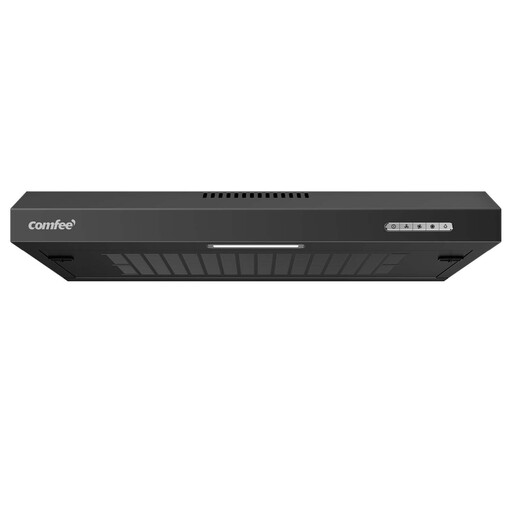
Why this choice suits this profile: This 60 cm hood fits easily into a small kitchen and offers three speeds with simple controls.
The listing distinguishes between the two extraction modes and states that the charcoal filter for recirculation is sold separately.
Stated extraction rate of 200 m³/h, removable aluminium filter, LED lighting and stainless steel finish.
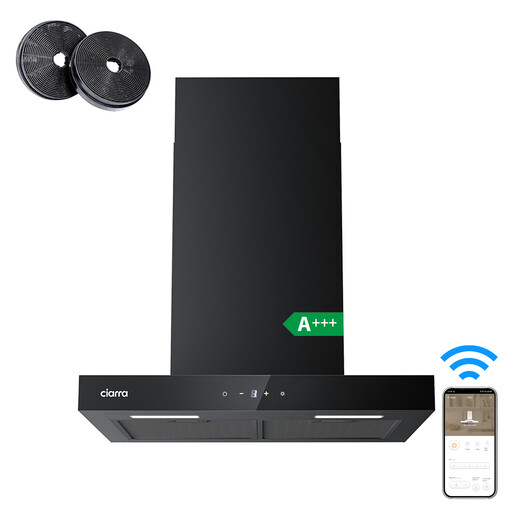
Why this choice suits this profile: Its black wall-mounted design, touch controls and app operation fit perfectly into a contemporary kitchen.
The listing distinguishes recirculation, with charcoal filters included, from external ducting, which requires a duct.
Maximum stated extraction rate of 650 m³/h, maximum noise level of 59 dB, A+++ energy rating and Wi-Fi control.
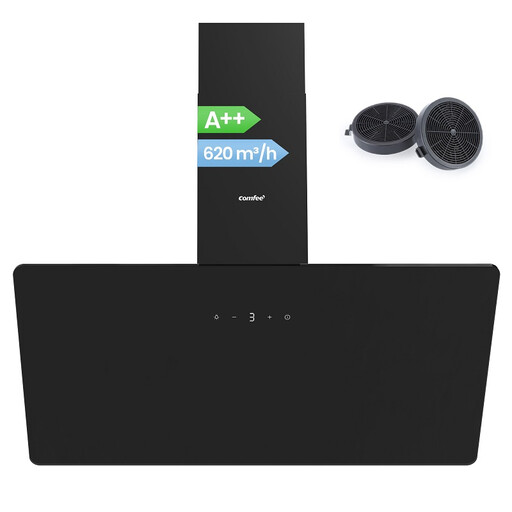
Why this choice suits this profile: Its 90 cm width and four speeds are ideal for larger hobs and frequent cooking.
The listing separately states the maximum extraction rate, maximum noise level and both ventilation modes.
Stated extraction rate of 620 m³/h, four speeds, A++ energy rating and stated noise level of 59 dB.
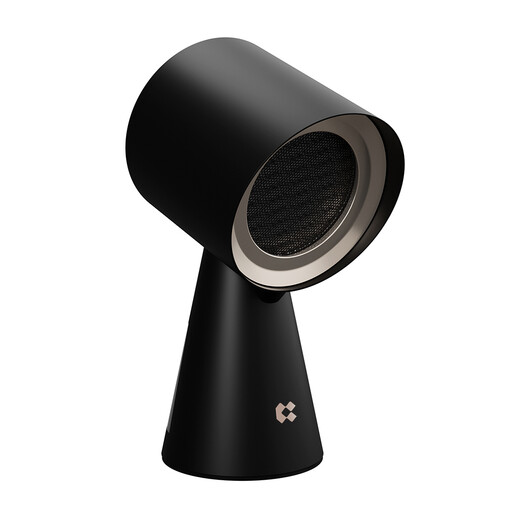
Why this choice suits this profile: This compact design works without wall mounting or ducting – ideal for a kitchenette, rented property or temporary cooking setup.
It doesn’t claim to replace a wall-mounted hood: its operation relies solely on filtration and its extraction rate is more modest.
Two speeds, compact dimensions of 165 × 343 mm and removable filters that need cleaning after each use.
Before fitting, check the electrical compatibility, the strength of the wall or cabinet support, the available height and the contents of the box. For ducted extraction, the duct should be as short and straight as possible to minimise airflow loss. If you’re in any doubt, call in a qualified professional and follow the manufacturer’s instructions.
Clean the grease filter every two to four weeks, depending on how often you cook. Wipe the exterior with a soft cloth and avoid abrasive products. In recirculation mode, keep an eye on the charcoal filter and replace it according to the model’s recommendations. Always unplug the appliance before carrying out any maintenance.
We’ve put together a complete, real-time updated selection of products that genuinely meet these demanding criteria and European safety standards.
A 60 cm hood can work with a hob of the same width, provided you check the actual dimensions, depth and installation height. For a larger hob or heavy use, a 90 cm model will offer better coverage if your kitchen layout allows.
Yes, it can work in this setup, but it doesn’t expel air outside. It relies on a grease filter and a charcoal filter to treat the air. The charcoal filter must be maintained or replaced regularly, following the manufacturer’s instructions.
The cost depends on the power, energy rating, usage time and electricity price. To compare models, look at the annual energy consumption stated in kWh rather than just the wattage. If you regularly use recirculation mode, also factor in the cost of charcoal filters.