
Livraison le jour même ou le lendemain

Qualité garantie

Débloquez vos offres de bienvenue: Livraison GRATUITE | Jusqu'à -80 % | 30 jours d'essai gratuits à JoyPlus
Téléchargez l'application
A stained hob, a greasy extractor hood or an oven covered in burnt residue won't necessarily all be cleaned by the same kitchen degreaser. Yet packaging often competes with similar promises: fast action, powerful formula, multi-surface compatibility or effortless results. To avoid an unnecessary purchase, it's best to check compatibility with your materials, the required dwell time and the safety precautions.
A powerful degreaser might be perfectly suited to barbecue grills or oven walls, but too harsh for aluminium, painted surfaces, seals or a ceramic hob. The term "multi-surface" doesn't mean the product is suitable for every material.
Before you spray, check the list of compatible and incompatible surfaces. On a delicate or older material, always test on an inconspicuous area first.
A degreasing spray wiped off immediately may not tackle baked-on grease. Conversely, leaving an alkaline or chlorine-based product on for too long can damage certain finishes.
Dwell time generally varies depending on the surface temperature and the level of soiling. Follow the instructions on the label and never mix different products.
An eco-friendly cleaner may limit certain controversial ingredients or carry a recognised label. That doesn't mean you can ignore the usage instructions. The biodegradability of surfactants, the presence of a European Ecolabel or Ecocert certification are more meaningful than a simple "natural" or "green" claim.
A degreasing spray makes it easy to target dirty areas and reduces handling, but it can create aerosols. Ventilate the room and avoid inhaling the product. A gel adheres better to vertical surfaces and is more suited to thick soiling. Powders, such as soda crystals or bicarbonate of soda, are used to prepare a solution or paste, provided you follow the dosage.
For frequent use, compare the volume, concentration and number of doses rather than just the price of the bottle.
Wear gloves when the label recommends it, and protect your eyes if there is a risk of splashing. Never mix a product containing bleach with another cleaner: dangerous gases can form. Surfaces that come into contact with food must be rinsed with drinking water when the label specifies this.
European hazard statements, precautionary advice and incompatible surfaces should be checked before you buy, not after the first use.
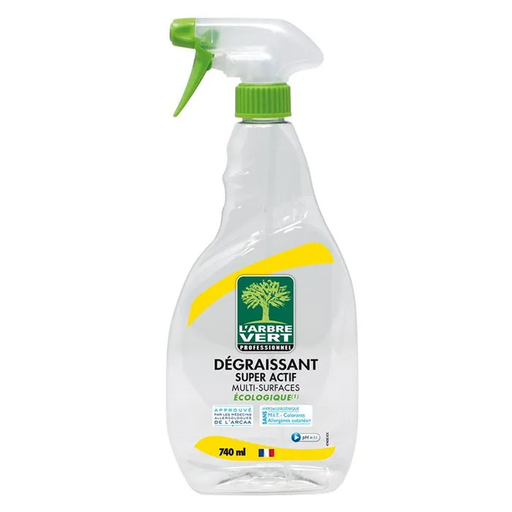
Why this suits this profile: Its 740 ml spray format is ideal for routine cleaning of washable surfaces, including enamel, tiles and painted or laminated surfaces.
The product sheet specifies possible uses on heavily soiled surfaces and recommends a preliminary test on an inconspicuous area for delicate materials.
Formula certified by the European Ecolabel, recyclable packaging and biodegradable surfactants according to the product sheet.
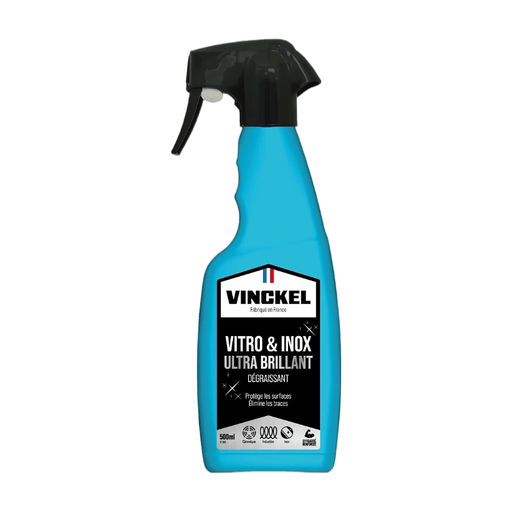
Why this suits this profile: It targets highly visible surfaces such as stainless steel, ceramic hobs, induction hobs, sinks and extractor hoods, with a finish designed to minimise streaks.
It does not present itself as a universal cleaner: its use is clearly targeted at glass, stainless steel, ceramic hobs and induction hobs.
500 ml bottle, made in France and Origine France Garantie certification mentioned on the product sheet.
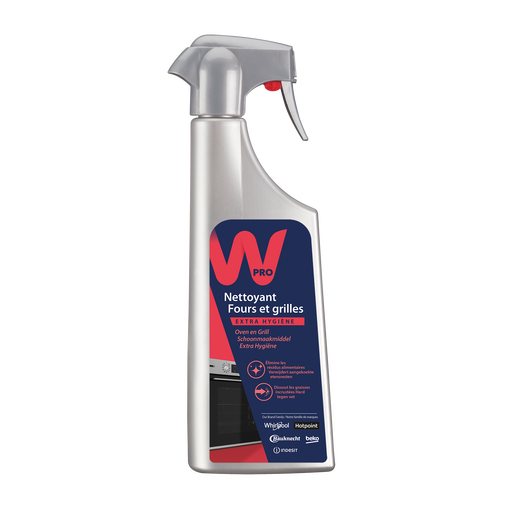
Why this suits this profile: Its product sheet specifies use on ovens, hobs, barbecues, rotisseries and extractor hoods, with a dwell time that varies depending on the surface temperature.
Aluminium and painted surfaces are explicitly excluded, which prevents using a product intended for cooked-on grease too broadly.
500 ml format, can be used on a cold or warm surface according to the instructions, lemon fragrance and mandatory rinsing after application.
We have compiled a comprehensive list, updated in real time, of products that meet these strict selection criteria and European safety regulations.
An oven cleaner or a degreaser specifically designed for burnt-on grease will generally be more effective than a standard multi-surface cleaner. Always check its compatibility with the type of oven and the materials present. Some products are not recommended, or even prohibited, on aluminium, catalytic liners, seals or painted surfaces.
Only if the product sheet explicitly mentions ceramic or induction hobs. Use a soft cloth, avoid abrasive powders and do not spray directly near the electronic controls. A cleaner designed for glass surfaces and stainless steel will often be more suitable than an oven product.
It all depends on how often you use them. In a kitchen where meals are prepared every day, a quick wipe after cooking helps limit build-up. Plan a deeper clean of the hood, grills and barbecue as soon as the grease becomes sticky or forms a visible film. The right product is one whose compatible surfaces, dosage and precautions precisely match your equipment.