
Livraison le jour même ou le lendemain

Qualité garantie

Débloquez vos offres de bienvenue: Livraison GRATUITE | Jusqu'à -80 % | 30 jours d'essai gratuits à JoyPlus
Téléchargez l'application
A kitchen cutting board must withstand everyday food preparation, be easy to clean and stay firmly in place on the worktop. Yet some products focus more on appearance or on claims that are difficult to verify. A board that is too thin may warp, a poorly maintained surface can retain odours, and a format that is too small can turn every cut into a balancing act.
Here are the key criteria to review before buying, followed by a selection suited to different uses in France.
The stated dimensions do not always correspond to the space actually available for cutting. Handles, edges and juice grooves can significantly reduce the usable area. When preparing several vegetables or cutting a piece of meat, check the overall dimensions, as well as the thickness and the available flat surface.
A large cutting board measuring around 40 cm in length can suit a family, provided you have a sufficiently deep worktop and suitable storage space.
The word “antibacterial” in a product name does not replace basic food-hygiene practices. Rinse the board after every use, clean it with a suitable washing-up liquid and dry it thoroughly. For raw meat and fish, use a separate surface or board from the one reserved for ready-to-eat foods whenever possible.
A double-sided cutting board can make this organisation easier, provided the two sides are clearly differentiated or reserved for separate uses.
A wooden cutting board or bamboo cutting board should generally not be left to soak in water. Dishwashers are often discouraged, as prolonged heat and moisture can encourage warping and cracking. Drying the board upright, combined with occasional application of a food-safe oil, can help preserve the surface — always follow the manufacturer’s instructions.
Look for a clear indication that the product is suitable for food contact, and review the seller’s information about the manufacturer, importer or responsible person in the European Union. These details are more meaningful than a simple marketing claim such as “natural” or “professional”.
A thick board is often heavier and less likely to slide, but it also takes up more space. Check for non-slip feet, the stated rigidity and the total weight.
For everyday use, a rectangular format of approximately 40 × 28 cm offers a good balance between cutting space and storage. Larger models are better suited to batch preparation or cutting large pieces of meat. A board that is too lightweight may move under the pressure of a knife.
A cutting board with a juice groove can collect liquid released by fruit, vegetables or meat. Its depth and width matter more than the mere presence of a groove in the product description.
A cutting board with a handle is easy to carry from the kitchen to the table. If you intend to use it for serving, however, check that the handle does not take up too much of the usable surface.
Finally, a dishwasher-safe cutting board should be explicitly described as such in the product listing or instructions. Do not infer dishwasher compatibility solely from the presence of steel, plastic or a composite material.
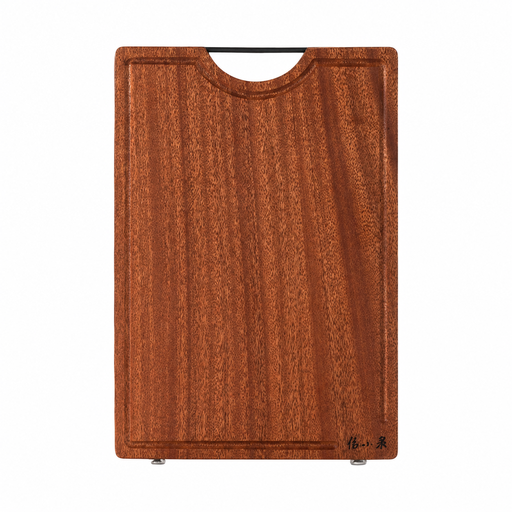
Why it suits this profile: its 400 × 280 mm rectangular format is well suited to everyday preparation of vegetables, fruit and herbs in a family kitchen.
The dimensions are clearly stated, so you can compare them with your worktop before buying. If the listing does not specify dishwasher compatibility, washing and drying should be done by hand.
Solid wood construction and a rectangular shape. The compliance information identifies a responsible party established in France.
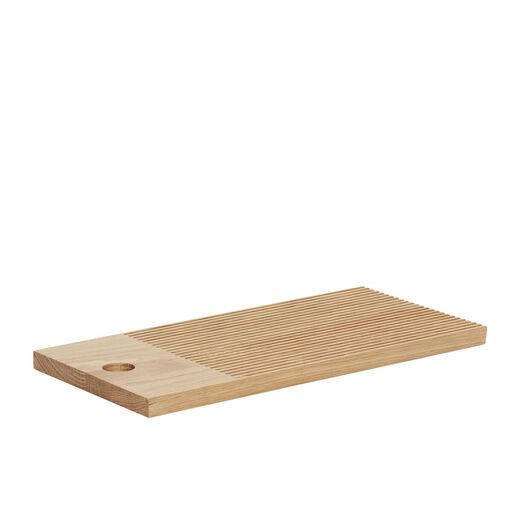
Why it suits this profile: this 40 × 20 cm FSC oak board can be used for preparation, then for serving cheese and charcuterie.
The listing states that the product is not dishwasher-safe. This is important to note, as wooden boards are often damaged by this type of maintenance error.
FSC-certified oak, a 2 cm thickness and dual-purpose design for both chopping and serving.

Why it suits this profile: its three sizes allow you to switch between uses: everyday preparation, cutting meat or serving cheese.
This set is not suitable if you are looking for a dishwasher-safe board: the listing specifies hand washing only.
Three sizes, a juice groove and integrated handles. The manufacturer describes the bamboo as carbonised; this refers to the production process and does not guarantee long-term durability.
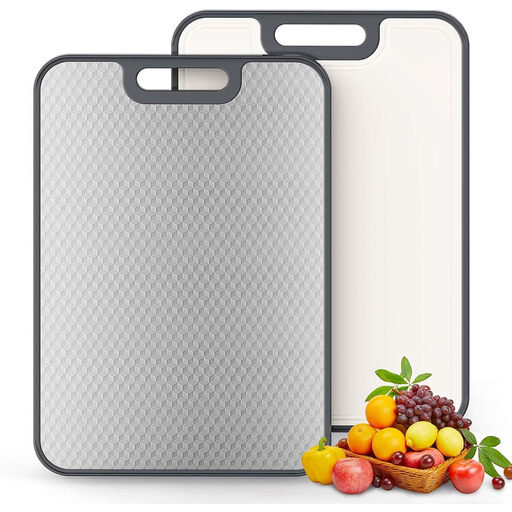
Why it suits this profile: its double-sided design is ideal for households that want to keep meat preparation separate from fruit and vegetable preparation.
The listing confirms dishwasher compatibility, but both sides should still be rinsed and dried properly after the cycle.
Stated size of 17 × 12 inches, approximately 43 × 30 cm, with a stainless steel and PP surface, double-sided design and dishwasher-safe maintenance.
We have brought together an updated selection of products that meet these criteria, with a range of sizes, materials and care requirements.
Stainless steel and models combining steel and PP can generally be cleaned with water and washing-up liquid. Some are also dishwasher-safe. Wood and bamboo require more care: hand washing, immediate drying and periodic maintenance in line with the manufacturer’s instructions.
It depends on how frequently it is used, the pressure applied by knives and how well it is maintained. Replace the board if it develops deep cracks, raised areas, warping that makes it unstable or cuts that are difficult to clean. A heavily scored surface eventually becomes less practical, whatever the material.
It is useful for foods that release a lot of liquid, such as tomatoes, citrus fruit or certain meats. For chopping herbs or cutting vegetables with little juice, however, it takes up part of the surface without offering a meaningful advantage. The right choice therefore depends on your recipes and the space available on your worktop.