
Livraison le jour même ou le lendemain

Qualité garantie

Débloquez vos offres de bienvenue: Livraison GRATUITE | Jusqu'à -80 % | 30 jours d'essai gratuits à JoyPlus
Téléchargez l'application
A kitchen cutting board is used several times a day to prepare vegetables, bread, meat, fish or cold meats. Yet when buying one, we often focus on the colour or price. In practice, the drawbacks soon become apparent: a surface that is too small, a board that slips, laborious cleaning or a groove that is too shallow to contain juices.
Before choosing, it is worth separating genuinely useful features from marketing claims that are difficult to verify.
A 40 × 28 cm board may seem generously sized, but a handle, raised edge or juice groove can sometimes reduce the space actually available for cutting. In a family kitchen, check both the overall dimensions and the cutting surface.
Smaller formats are handy for fruit, bread or cheese. A larger model will be considerably more comfortable when preparing larger quantities of vegetables or cutting a joint of meat.
A non-slip cutting board can help prevent movement, but it should always be placed on a clean, dry and flat surface. A board that is too light or slightly warped may still move, despite having non-slip feet.
You should also avoid cutting on a board suspended by its handle or placed on a storage rack: these solutions are designed for storage, not for safe food preparation.
Wood and bamboo generally require hand washing followed by quick drying. By contrast, a plastic cutting board may be dishwasher-safe, but this must be confirmed in the product details.
A board described as durable is not necessarily suitable for repeated knife strokes, high temperatures or prolonged soaking.
For any product intended to come into contact with food, consult the manufacturer’s information, care instructions and available compliance details. This information is more meaningful than a simple promise of long-lasting performance.
A compact format is easy to store in a small kitchen or flat. Conversely, a thicker board will often feel more stable.
The Monarch Cutting Board Natural measures 20 × 40 × 2 cm: a sufficiently spacious format for cutting that can also be used for serving. Thinner models take up less space, but can sometimes feel less comfortable when preparing larger quantities.
A cutting board with a juice groove is particularly useful for foods containing lots of liquid, such as meat, citrus fruit or tomatoes. The groove’s depth and width matter more than simply having one.
A cutting board with a handle makes it easier to carry ingredients to a frying pan or dish. It can also be hung up to save space. In a small kitchen, a set of cutting boards with a stand allows you to separate different uses while keeping the surfaces accessible.
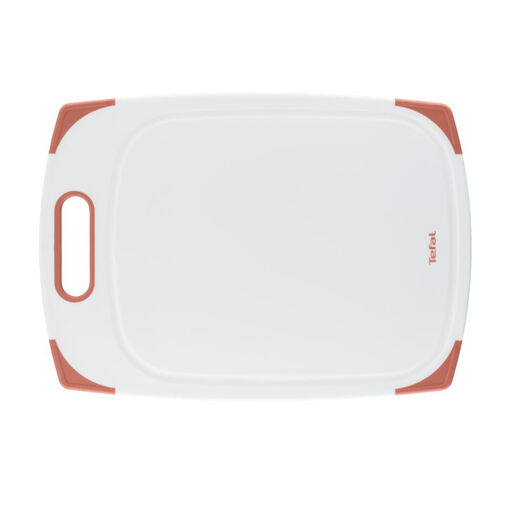
Why this choice suits this profile: Its practical size, handle and dishwasher-safe design make it a versatile, easy-to-use first cutting board.
The product details specify a non-slip surface, a juice groove and a thickness of 0.9 cm, rather than relying solely on appearance.
Plastic construction, integrated handle, juice groove and stated dishwasher compatibility.
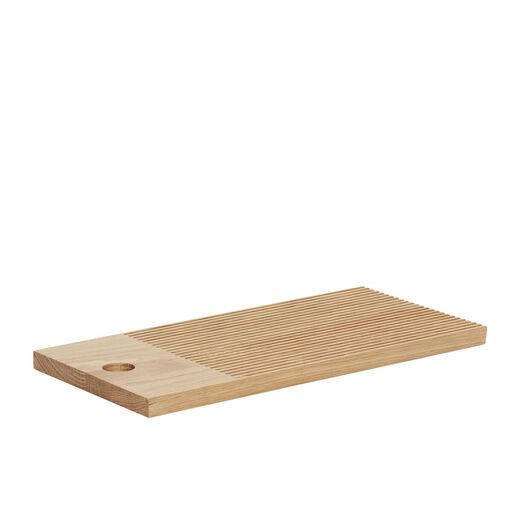
Why this choice suits this profile: This 2 cm-thick cutting board made from FSC-certified oak is equally at home in the kitchen or at the centre of the table.
Its dimensions and thickness are clearly stated. The product details also specify that it is not dishwasher-safe.
FSC-certified oak, 20 × 40 cm format, 2 cm thickness and dual use for cutting and serving.
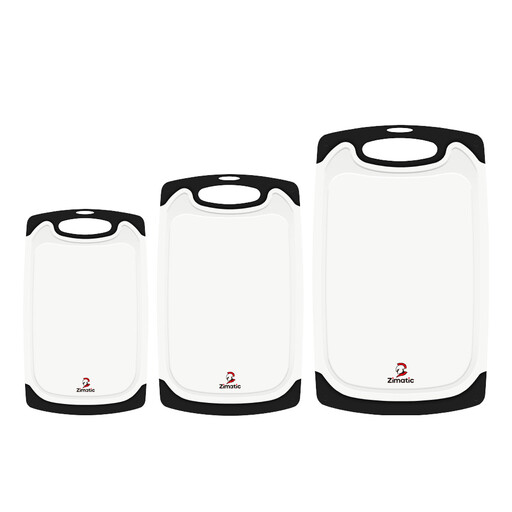
Why this choice suits this profile: This set, advertised with deep grooves, non-slip handles and dishwasher-safe cleaning, is suitable for a wide range of preparations.
The different surfaces allow you to dedicate a board to certain foods and limit cross-use.
Set of boards, non-slip handles, juice grooves and stated dishwasher compatibility.
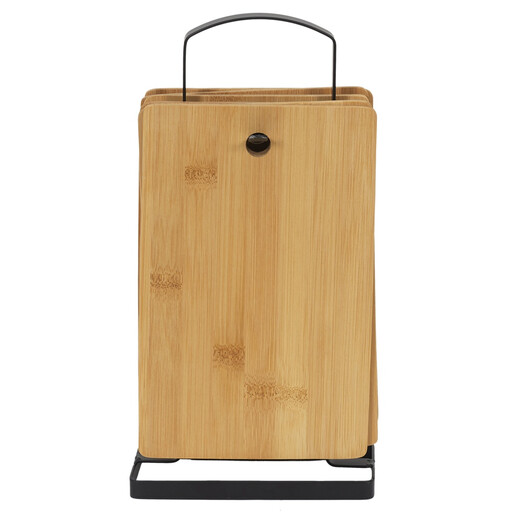
Why this choice suits this profile: The four 14 × 22 cm bamboo boards are stored on a metal stand and can also be used to serve cheese, bread or cold meats.
The stand keeps storage visible and organised. However, the product details specify that hand washing is required.
Four bamboo boards, metal stand, compact format and the option to use them for serving cold meats.
We have brought together a complete, real-time updated selection of products that meet these demanding criteria as well as European safety requirements.
After each preparation, remove any residue, wash the surface according to the manufacturer’s recommendations, then dry it thoroughly. To prevent cross-contamination, clean the board carefully after cutting raw meat, poultry or fish, before using it for food that is ready to eat.
Replace it if you notice deep cuts, cracks, delamination, splinters or warping. A wooden or bamboo board should never be left submerged. For plastic boards, follow the specified temperature and cycle when dishwasher use is permitted.
Plastic is suitable for those who want quick cleaning, especially when it is dishwasher-safe. Wood and bamboo offer a warmer presentation, but require hand washing and immediate drying. The best choice therefore depends above all on your care routine and the foods you prepare most often.
Yes. It can contain some of the liquid released by meat, fruit or any other particularly juicy food. However, it does not replace regular cleaning. Before buying, also check the board’s stability, dimensions and groove depth.
There is no fixed lifespan that applies to every model. Frequency of use, material, washing method and the condition of the surface all play a decisive role.
Regular inspection is more useful than following a set timetable: when the cuts become deep or the board starts to warp, it is best to replace it.