
Livraison le jour même ou le lendemain

Qualité garantie

Débloquez vos offres de bienvenue: Livraison GRATUITE | Jusqu'à -80 % | 30 jours d'essai gratuits à JoyPlus
Téléchargez l'application
A kitchen bin needs to fit in with your habits, your home and your recycling routine. Yet some of the features highlighted in product listings can create false expectations. An automatic opening mechanism doesn't necessarily solve the problem of odours, while a large capacity can quickly become cumbersome in a small kitchen.
Before you make a purchase, here are the main pitfalls to avoid and the criteria to consider.
A 40-litre kitchen bin can work well for a household that produces a regular amount of waste, but it also needs enough floor space. On the other hand, a compact bin may fill up very quickly in a family home.
Make sure you check:
A bin with a lid hides waste and limits exposure, but its effectiveness also depends on how well it seals, how often you empty it and the type of rubbish. Vegetable peelings and food scraps can quickly start to smell inside a closed bin.
For everyday use, it's better to look for:
Claims of 'odour control' describe a design feature, not a guarantee that bad smells will disappear completely.
A pull-out bin for under the sink requires you to measure the cabinet precisely. The minimum width, the available depth and the position of the hinges can make installation impossible.
A pedal bin also needs to stay stable and have a pedal that is wide enough. With an automatic model, you also need to plan for the power supply and clean the areas exposed to splashes regularly.
For everyday use, sizes from 10 to 20 litres are often suitable for small kitchens or for temporarily collecting organic waste. A 40-litre kitchen bin can reduce how often you need to take out the bag, provided you have a suitable spot for it.
If you separate packaging, glass or residual waste, a dual-compartment bin lets you sort two streams in one place. However, check the capacity of each compartment: depending on your habits, two different volumes can be more practical than a perfectly even split.
In a home with children, check the stability of the model, the weight of the lid and whether there are any areas where fingers could get caught. Sharp, corrosive or flammable waste, as well as large amounts of liquid, should not be placed in these containers.
Painted steel offers a rigid structure, while plastic is often easier to clean and makes the whole unit lighter. A removable inner bucket with a handle makes changing the bag and washing simpler.
Choose a surface that is easy to wipe down with a damp cloth and a mild detergent. Abrasive products can scratch the finish. For a compost bin, the charcoal filter should be replaced according to the manufacturer's recommendations: on the EDA model shown below, replacement is advised every six months.
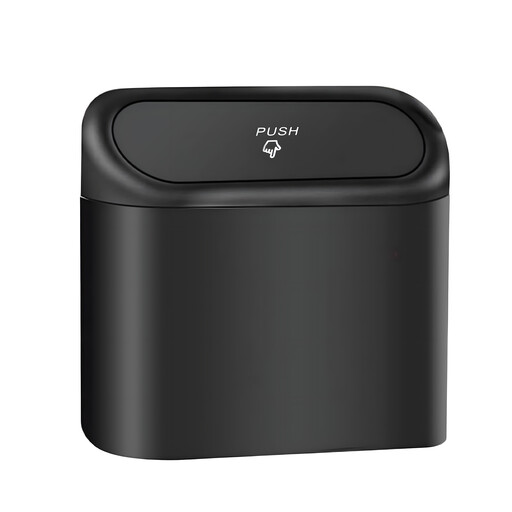
Why this choice suits this profile: This small 1.4-litre bin is ideal for light waste in a car, office or small room. Its removable hook lets you hang it or place it on a flat surface.
Its size stops you from choosing an oversized bin for a secondary use. The press lid helps limit odour spread, though you still need to empty it regularly.
ABS construction, dimensions of 15.5 × 13.5 × 6.5 cm, removable lid and hanging or freestanding installation.
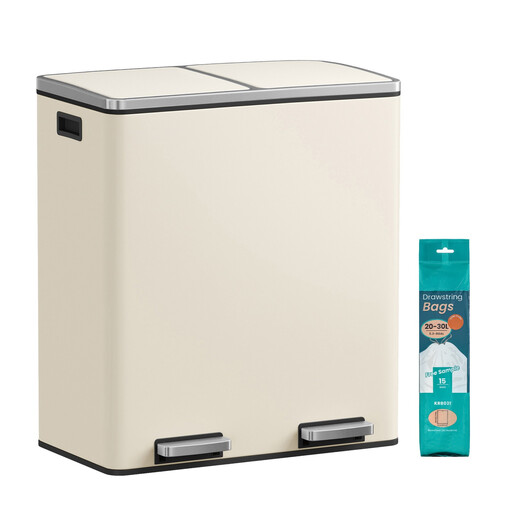
Why this choice suits this profile: Households that want to incorporate recycling into a visible kitchen will appreciate the dual compartment, foot pedal opening and soft-close lid.
The two removable buckets mean you're not reliant on a single bag, and cleaning is easier. The soft-close lid reduces banging, but you should check the dimensions before buying.
Two compartments, buckets with handles, pedal and dimensions of 59 × 32.5 × 65.2 cm.
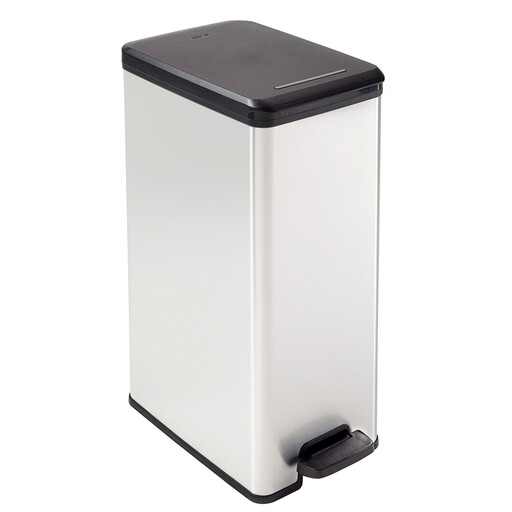
Why this choice suits this profile: This model is aimed at families or utility rooms that need a 40-litre capacity in a slim format.
The listing mentions a slim silhouette and a removable inner bucket – two things to look for when a large capacity shouldn't take up the full width available.
40-litre capacity, pedal opening, slim design and removable inner bucket.
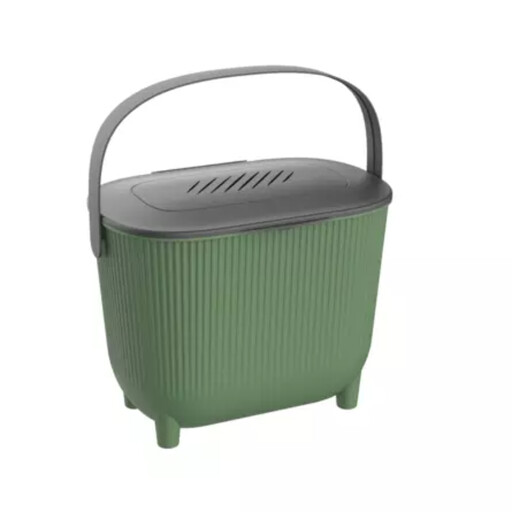
Why this choice suits this profile: Its 10-litre capacity and handle make it ideal for collecting peelings and coffee grounds before transferring them to an outdoor composter.
The built-in charcoal filter helps limit odours, provided it is replaced as instructed and the bin is emptied regularly.
10-litre capacity, lid with charcoal filter, ergonomic handle and reportedly made from recycled polypropylene.
We've put together a comprehensive, real-time updated list of products that meet these strict selection criteria and European safety regulations.
A capacity of 30 to 40 litres can work for a household that produces a lot of residual waste. For recycling, pay particular attention to how the capacity is split between compartments. A 10-litre + 20-litre model can be more practical than a single bin of the same total volume, depending on how much packaging and food waste you have.
Its operation may require batteries or a power source, depending on the model. You'll also need to buy compatible bags and clean the sensor regularly. So compare the cost of consumables and how often they need replacing before you buy, rather than just looking at the initial price.
Measure the internal width of the cabinet, the available depth and the height under the worktop. Also check the door opening and the position of the pipework. Some systems, like the Lovewind model in a 10-litre + 20-litre configuration, are designed for cabinets at least 30 cm wide and are fixed to the back of the cabinet using screws.