What should you check before replacing an appliance ?
Start with how often you use each appliance, then compare the figures relevant to its category. The bill figures below come from a survey conducted by Becoming for France’s National Energy Ombudsman among 2 000 households in mainland France in September 2025. They reflect concerns about energy costs, not plans to buy household appliances.
| Priority | What to check | Your needs and the households surveyed |
|---|
| Annual use |
Note the function and frequency of use of each appliance. To estimate your usage, ADEME’s Wattris tool lets you enter your appliances, as well as their operating hours and durations. |
I want to focus on the appliances that matter in my home. In the National Energy Ombudsman’s survey, 85 % of households surveyed said energy bills took up a significant share of their budget; among those who change their habits to reduce energy use, 87 % do so to cut their bills. |
| Cooling |
Compare kWh/year for fridges or freezers with the same function and a similar capacity. Check the compartment volumes and noise levels shown on the label, as recommended by the European Commission. |
My appliance runs continuously: does its capacity still match what I need to store ? |
| Dishwashing |
For similar capacities, compare kWh/100 cycles, litres per cycle, eco programme duration and the noise level shown on the dishwasher’s label, as recommended by ADEME and the European Commission. |
If I often run cycles with only a small load, I want to choose a capacity that suits the loads I usually wash. |
| Hob cooking |
Check the technology, cut-out dimensions, connection requirements and cookware compatibility. The European Commission does not provide an energy label for hobs. |
I often cook on the hob. Before switching technology, I want to know whether it will suit my kitchen and pans. |
| Oven cooking |
Compare usable capacity and kWh per cycle for the same cooking mode. The European Commission’s label gives separate figures for conventional and fan-assisted cooking. |
Do I use the oven often enough for replacing it to take priority over an appliance I use more ? |
| Repair |
Find the exact reference number of your current appliance, then check the availability of parts, documentation and repair options. ADEME presents the repairability index as a guide for the relevant categories. |
Before buying a new appliance, I want to know whether a repair would meet my needs. |
Appliances for different needs
These Joybuy models cover three of the options explored here: replacing a fridge-freezer, a dishwasher or an electric hob. Compare each option with an appliance of the same type and your household’s actual needs.
 Image unavailable
CHiQ JR263LGE, 262 L Low Frost fridge-freezer
Worth considering if the 262 L capacity suits your storage needs. The model name indicates a 70/30 split, a width of 54 cm and a height of 176 cm. Compare its annual energy use on the label with that of appliances with a similar capacity.
View on Joybuy
 Image unavailable
Haier HTW5618ENMG, 360 L 3-door fridge-freezer
The 360 L capacity is worth considering if it meets your storage needs. The model is described as Total No Frost, rated E, with Wi-Fi and My Zone. These features alone don’t establish how much electricity it will save. Check the compartment capacities, dimensions and kWh/year on the label.
View on Joybuy
 Image unavailable
Samsung DW60M6050FS, freestanding dishwasher, 14 place settings
Its capacity of 14 place settings is worth comparing with the size of your usual loads. The model name mentions 7 cycles. To assess its energy use and everyday practicality, check the kWh/100 cycles, litres per cycle and eco programme duration on the label for the exact model.
View on Joybuy
 Image unavailable
Candy CFQQ5T817EPS, 467 L 4-door fridge-freezer
The 467 L capacity is worth considering if you need the extra storage. The model is described as Total No Frost, rated E and fitted with Smart Inverter. None of these features replaces a comparison of kWh/year with appliances of the same type and a similar capacity. Check its dimensions too.
View on Joybuy
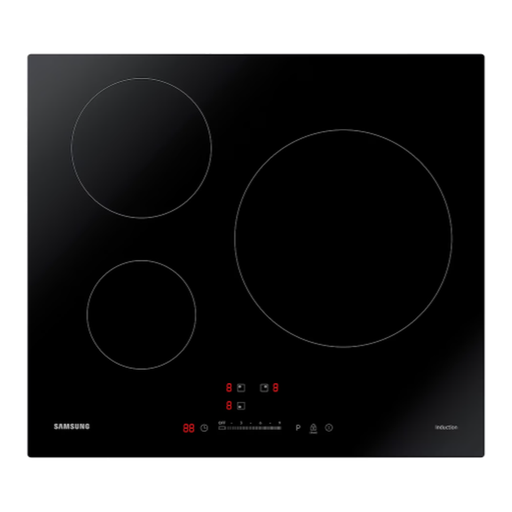 Image unavailable
Samsung NZ63M3707AK, 3-zone induction hob, 7200 W
If you’re thinking about switching to induction, first check the cookware, cut-out and connection requirements. The model name indicates 3 zones and 7200 W. This power rating alone doesn’t tell you how much energy your cooking will use.
View on Joybuy
Frequently asked questions
Is the letter on the energy label enough to help me choose ?
No. Also compare energy use and capacity across appliances with the same function: kWh/year and volumes for fridges and freezers, or kWh/100 cycles and place settings for a dishwasher. For ovens, the European Commission gives separate kWh per cycle figures for each cooking mode. Choose the mode and capacity that match how you use it.
How can I compare hobs without an energy rating ?
The European Commission does not provide energy labels for hobs. Consider the technology, dimensions, connection requirements and whether your cookware is compatible. Don’t assume a hob’s energy use based on its stated power alone.
What should I check if the dishwasher’s eco programme needs to fit my schedule ?
Check its duration on the label for the exact model. ADEME and the European Commission explain that the label also shows energy use per 100 cycles, water use per cycle and capacity. Consider all these figures together, and don’t assume the programme will fit your schedule.
Where can I check a model’s energy information ?
For an appliance covered by energy labelling rules, check its label and search for its reference in EPREL, the European Commission’s public database. Separately check the dimensions, installation requirements and repair options for the model you’re considering.
Does a dishwasher fault mean I need to replace it ?
No. Ask a professional to identify the fault and provide a quote for the exact model, then check whether parts and documentation are available before deciding. ADEME recommends considering repairability when choosing an appliance.


