Which households are these choices right for?
The appliance to look at first depends on what you use regularly and the capacity you actually need.
Households replacing a fridge
If your appliance runs continuously, compare its usable capacity with your storage needs. The European Commission says fridge labels show annual energy consumption, capacity and noise levels. ADEME also points out that a larger or over-equipped appliance may use more energy.
Households that run the dishwasher often
If you run frequent cycles, choose a capacity you can fill at your usual pace. According to ADEME and the European Commission, the label also lets you check kWh/100 cycles, water use per cycle and the duration of the Eco programme used as the reference.
Households that cook regularly
For an oven, compare its capacity and kWh per cycle in the cooking mode you use. The European Commission does not require hobs to carry an energy label, so your choice also comes down to your cookware and cooking habits.
What should you compare before replacing an appliance?
First, identify the appliance that matters most to your daily routine. Then compare models in the same category, using the relevant energy-consumption measure and a capacity that suits your needs.
| Priority |
What to check |
What matters to me |
| Refrigeration |
Compare fridges with a similar type and usable capacity. According to the European Commission, the label shows kWh/year, compartment capacities and noise levels. |
I want enough room for my food without choosing compartments or features my household won’t use much. |
| Dishwashing |
According to ADEME and the European Commission, check kWh/100 cycles, litres per cycle, the number of place settings and the duration of the reference Eco programme. |
The capacity should suit the amount of washing-up I collect between cycles. I also need to fit the Eco programme’s duration into my routine. |
| Oven |
The European Commission says oven labels show kWh per cycle for conventional and fan-assisted cooking, as well as capacity. Compare ovens of a similar size using the same mode. |
I cook dishes of a certain size, so a large cavity won’t help if I don’t use the extra space. |
| Hob |
Hobs do not have a mandatory energy label, according to the European Commission. Check the size of the cooking zones and whether your cookware is compatible, particularly with induction. |
I often cook on the hob and want to use my usual pans. Their size and whether I use a lid are part of the way I cook. |
| Exact model |
Match the model number being sold to its energy label and product information sheet. For labelled appliances, the Ministry of the Economy says the QR code links to data registered in EPREL. |
Before I order, I want to make sure the specifications I’ve checked are for the exact version on offer, not a similar model. |
Brands available in these categories
A brand appearing across several appliance categories doesn’t, by itself, tell you anything about the energy consumption of a particular model.
Bosch
Bosch Electroménager France offers cooking, washing and refrigeration appliances.
- According to Bosch, you can search for manuals using the E-Nr number shown on the appliance rating plate.
- To assess energy use or capacity, check the label and product information for the exact model rather than looking at the range as a whole.
Miele
Miele France offers ovens, hobs, dishwashers and refrigeration appliances, among other products.
- These categories offer models to consider for a range of kitchen projects.
- Compare each model using the information relevant to its category. A feature or range alone is no proof of lower energy consumption.
Whirlpool
Whirlpool France lists fridges, dishwashers, ovens and hobs.
- For some appliances, the brand lets you search for spare parts by model number.
- Check the exact model number, installation dimensions and energy-consumption information before choosing a model.
Models for refrigeration and washing up
These Joybuy options include fridge-freezers in different sizes and a compact dishwasher. Start by choosing the category that suits how you use it, then check the capacity, installation requirements and information for the exact model you’re considering.
 Image unavailable
Haier HTW5618ENMG, 3-door fridge-freezer, 360 L
Worth considering if 360 L suits your storage needs. The product information lists Total No Frost, Wi-Fi, My Zone and an E energy rating. Check whether these features are useful to you, and check the energy label for the exact model.
Measure the space available and check how the fridge and freezer compartments are divided before choosing this format.
View on Joybuy
 Image unavailable
CHiQ JR263LGE, 262 L fridge-freezer
Its stated capacity of 262 L and width of 54 cm are worth considering if kitchen space or storage needs are limited. The product name specifies a 70/30 split, a height of 176 cm and a Low Frost system.
Check the clearance needed for installation, the usable space in each compartment and the energy label for the model being sold.
View on Joybuy
 Image unavailable
Candy CFQQ5T817EPS, 4-door fridge-freezer, 467 L
This 467 L model is designed for substantial storage needs, but consider how much food your household actually keeps. The product name mentions Total No Frost, Smart Inverter and an E energy rating.
Check the dimensions and the clearance needed to open the doors, then match the exact model number to its energy label before comparing annual energy consumption.
View on Joybuy
 Image unavailable
Sonlu CC-520WE, 444 L fridge-freezer
Its stated capacity of 444 L is worth considering if you need plenty of storage space. The product name mentions a frost-free system, 40 dB and an E energy rating. Check these details against the product information and energy label for the exact model.
Check the dimensions, access routes and clearance needed to open the doors before planning its installation.
View on Joybuy
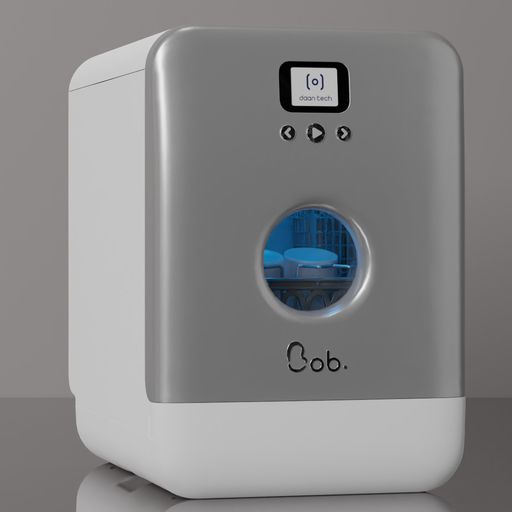 Image unavailable
Bob Mini, compact dishwasher, 3 place settings, 34 cm
Compare its stated capacity of 3 place settings with the amount of washing-up you produce between cycles. Check you have room on your worktop, as well as suitable water supply and drainage options.
To compare its energy use with other dishwashers, check the information for the exact model and the programme it refers to, including kWh/100 cycles and the Eco programme’s duration.
View on Joybuy
Frequently asked questions
Can you compare a fridge’s kWh/year with a dishwasher’s kWh/100 cycles?
No. These figures describe different reference uses. According to the energy labels outlined by the European Commission, a fridge shows annual energy consumption, while a dishwasher shows consumption for 100 reference cycles. Start by comparing models in the same category with a suitable capacity.
What is the QR code on the energy label for?
For appliances covered by the scheme, it links to product information registered in the European EPREL database, according to the Ministry of the Economy. Before relying on the specifications, check that the model number shown matches the one being offered for sale.
Does an electric hob have an energy rating comparable to an oven’s?
No. The European Commission says hobs are not subject to the energy-labelling requirements that apply to ovens. When choosing a hob, check the cooking zones and whether your cookware is compatible, especially if you’re considering induction.
Can the repairability index help you choose a dishwasher in France?
Yes. For dishwashers covered by the scheme, it gives you an additional point of comparison: ADEME says the score is out of 10. Check the score for the exact model, then look into spare parts and service arrangements that matter for the way you use it.


