Parents of children under 3
Age comes before flavour or format. Manger Bouger says that 0%, skimmed and semi-skimmed products are not suitable for this age group. Check the ingredients of the product you choose, even if it’s marketed for children.


If you’re picking up a few essentials, start with your child’s age, then compare the ingredients and storage instructions. The word “mild” doesn’t guarantee that no sugars have been added. According to Manger Bouger, 0%, skimmed and semi-skimmed products are not suitable for children under 3. If you can’t keep a product chilled, only choose one that can be stored at room temperature if the packaging says so and its ingredients are suitable for your child.
Age comes before flavour or format. Manger Bouger says that 0%, skimmed and semi-skimmed products are not suitable for this age group. Check the ingredients of the product you choose, even if it’s marketed for children.
A mild taste, fruity flavour or child-friendly packaging won’t tell you everything about the recipe. Check the ingredients and nutrition information to compare products. The “of which sugars” figure also includes naturally occurring sugars.
Your journey time matters just as much as the format. Yoghurt that needs to be refrigerated must be kept chilled, while storage at room temperature before opening only applies to products whose packaging says this is allowed.
When choosing a dairy product for a child, first check that it’s suitable for their age, then look at the ingredients and finally make sure its storage requirements fit your journey.
| What matters | What to check | Who it’s for |
|---|---|---|
| Age and type of dairy product | Check the age guidance and ingredients, especially for 0%, skimmed or semi-skimmed products for children under 3. Manger Bouger advises against these products for this age group. | For a child under 3, I want to avoid choosing a product just because it’s labelled “for children”, without checking the ingredients. This would be the top priority for around 42% of consumers. |
| Flavour and added sugars | Compare the product name, ingredients and nutrition information. If it matters to you, look for the exact wording “no added sugars”. | If my child prefers milder flavours, I want to know what’s actually in the product rather than relying on its flavour. Around 33% of consumers would put this question first. |
| Transport and storage | Check the use-by date and storage temperature, and note the instructions for before and after opening. | If I can’t go straight home, I need to find a product that can be stored safely during my journey. This would be a priority for around 25% of consumers. |
Children’s aisles include yoghurts, fromage frais and desserts made with different recipes. A mild flavour or texture doesn’t tell you how much sugar a product contains.
Read the ingredients and check the “of which sugars” figure. If you’re looking for a product with no added sugars, make sure this is stated on the packaging.
According to Manger Bouger, 0%, skimmed and semi-skimmed products are not suitable for children under 3. An age recommendation on the front of the pack doesn’t mean you can skip checking the ingredients.
For this age group, check the ingredients before choosing a yoghurt, fromage frais or dairy dessert.
The DGCCRF advises that rising temperatures encourage microbial growth. Always follow the use-by date and storage instructions, even when you’re just picking up a few essentials.
Pick up chilled products at the end of your shop and put them in the fridge as soon as you can. Only transport a product at room temperature if its packaging says it can be stored that way before opening.
These ranges are examples of products you can compare. Their inclusion here doesn’t guarantee that another product in the range has the same ingredients or that it’s available in your shop.
Petit Yoplait includes a plain fromage frais in 60 g pots, which Yoplait markets for children over 3.
Carrefour’s children’s range includes petits-suisses, fromage frais, flavoured yoghurts and pouches.
The Marque Repère range includes Delisse plain, stirred plain and plain yoghurt with cane sugar, in various pack sizes.
Auchan describes Naturnes P’tit Onctueux nature as a dairy dessert for babies from 6 months, with no added sugars.
Lidl’s yoghurt range includes products from Envia and Yoplait.
These products suit two different needs: a plain dairy dessert in pots, marketed for babies, and a flavoured fermented milk drink in individual portions. For both, check the age guidance and ingredients before deciding whether they’re suitable for your child.
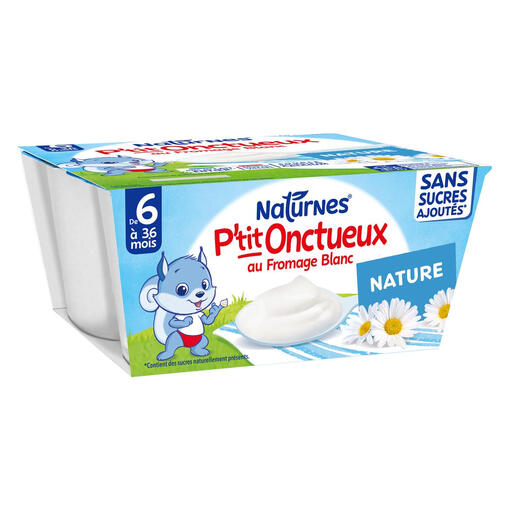 Image unavailable
Individual pots may be a convenient option for a baby, provided the recipe is suitable for their age. This product contains fromage blanc made with skimmed milk. The “from 6 months” guidance doesn’t, on its own, address Manger Bouger’s advice about skimmed products for children under 3. Check the ingredients on the packaging before buying.
According to the product information, refrigerate after opening and consume within 48 hours.
 Image unavailable
The individual drink portions may be a handy choice when portability is your priority. The recipe contains added sugar, so don’t mistake it for a no-added-sugars option. Check the age guidance on the packaging before buying it for a young child.
No. The word may describe the taste or texture, but it doesn’t tell you about the ingredients. If you’re looking for a product with no added sugars, check the packaging for this claim and read the ingredients. The “of which sugars” figure shows the total amount of sugars, including those that occur naturally.
No. According to Manger Bouger, 0%, skimmed and semi-skimmed products are not suitable for children under 3. Check the ingredients of the product you choose, even if its packaging or labelling suggests it’s for children.
Only choose a product whose packaging explicitly says it can be stored at room temperature before opening, and check that it’s suitable for your child’s age. For example, Auchan says Naturnes P’tit Onctueux nature can be stored between 5 and 25 °C before opening. This guidance doesn’t apply to refrigerated yoghurts.
Check the use-by date, the temperature stated on the packaging and whether you can keep the product chilled until it reaches the fridge. The DGCCRF advises that rising temperatures encourage microbial growth, so pick up chilled products at the end of your shop and avoid leaving them in the car while you’re out.