
当日/次日达

品质保障

开启新人专享福利: 全场免邮 | 低至 2 折 | 免费试用 30 天 JoyPlus 会员
下载 Joybuy
As back-to-school season or class trips approach, the search for the perfect stainless steel lunch box for your child often turns into a real headache. Between promises of durability and a sea of adorable designs, it's hard to make sense of it all. Yet the goal is simple: a container that's healthy, sturdy, and most importantly, easy for your child to use independently in the cafeteria. Unfortunately, unpleasant surprises are common, and many parents end up regretting their purchase.
Before you decide, watch out for these common traps that can turn a good investment into a total hassle:
To avoid these pitfalls, simply focus on a few key technical features. They will make all the difference in daily use.
Stainless steel is rightfully praised for its robustness and its non-reactive nature with food. It doesn't retain odours or stains, and most importantly, it doesn't impart any taste to the food. Most quality models use 18/8 (or 304) stainless steel, a food-grade standard known for its corrosion resistance.
For any plastic parts (lid, dividers, clips), a BPA-free kids' lunch box label (Bisphenol A) is a non-negotiable prerequisite to ensure the product's health safety.
This is the decisive factor, especially for younger children. Take a close look at the mechanism. Systems with large, single clips or latches are often easier for little hands to manage than lids with four independent clips. A good design promotes the child's autonomy and ensures they can access their meal without frustration (or having to bother an adult). The Maped Picnik brand, for example, has developed closing systems designed with kids in mind.
A foolproof seal relies on the quality of the silicone gasket nestled in the lid. It should be thick, well-fitted, and removable for deep cleaning (and to prevent mould growth!). For compartmentalised meals, check if the dividers themselves are leak-proof to avoid the tragedy of salad dressing invading the dessert cookies. A kids' stainless steel bento format with fixed or removable compartments is an excellent solution for organising a complete and balanced school lunch container.
Every family has specific needs. Here are a few options that cater to distinct use cases, keeping practicality and safety criteria in mind.
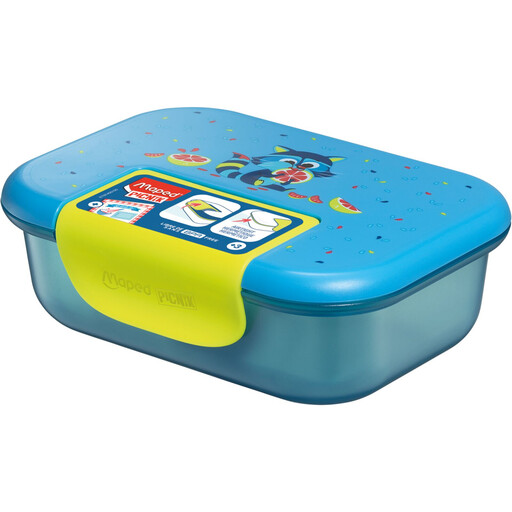
Why it's perfect for them: Perfect for little preschool hands discovering their independence. Its design was entirely conceived for them, to avoid the small frustrations of lunchtime.
Its large clip is a breeze for kids to handle and avoids the trap of overly stiff latches. Cleverly, the attached lid won't get lost in the playground.
Easy opening: The single-clip system is ultra-intuitive.
Smart design: Sturdy stainless steel base and an attached lid so nothing gets lost.

Why it's perfect for them: Essential for parents who want to pack soup, a saucy dish, or yesterday's leftovers for their child. Its thermal insulation keeps the meal warm for several hours.
This type of jar is, by definition, perfectly sealed for transporting liquids without any risk of leaks. Its 316 stainless steel construction, a step above 304, is a guarantee of durability.
High-performance insulation: Keeps food hot (or cold) for 4 to 6 hours.
Superior stainless steel: 316 steel is even more resistant to corrosion than the standard 304.
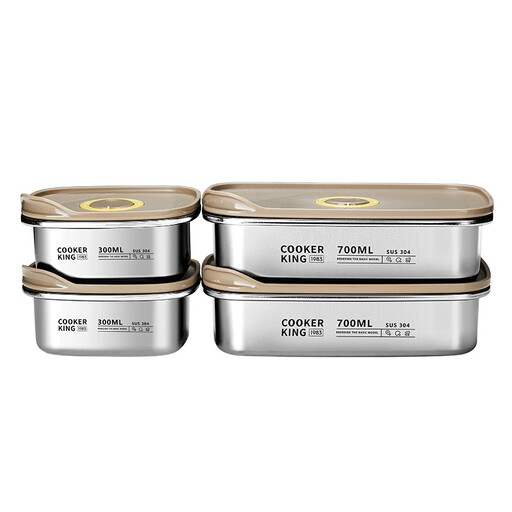
Why it's perfect for them: For meal prep enthusiasts who prepare the week's lunches and snacks all at once. This set of several different-sized boxes offers maximum flexibility for storing in the fridge or taking on the go.
No complex mechanisms here, just simple, effective, and durable lids. Their main advantage is their stackable design, a real bonus for optimising cupboard space.
Highly versatile: A complete set to adapt to any scenario (meals, snacks, storage).
Optimised storage: The boxes nest or stack for maximum space-saving.
We have selected a full range of products that meet our quality criteria and current safety standards.
Most stainless steel bases are dishwasher-safe. However, to preserve the lifespan of silicone gaskets and plastic parts, hand-washing the lid is often preferable. Make sure to dry all parts thoroughly before storing the box to prevent any mould growth.
No, never! Metal should never be placed in a microwave oven. It poses a fire risk and can permanently damage your appliance. If you need to reheat a dish, transfer the food to a microwave-safe container.
Both types of stainless steel are food-grade and perfectly safe. 18/8 (or 304) stainless steel is the most common and offers excellent rust resistance. 316 stainless steel contains molybdenum, which gives it even higher resistance to corrosion, especially from salt and acidic foods. It is often used for high-end products or insulated containers like the Maxcook jar featured above. For standard daily use, 18/8 stainless steel is more than sufficient.