
Livraison le jour même ou le lendemain

Qualité garantie

Débloquez vos offres de bienvenue: Livraison GRATUITE | Jusqu'à -80 % | 30 jours d'essai gratuits à JoyPlus
Téléchargez l'application
A kids’ scooter can accompany trips to the park, family outings or those first steps in learning to balance. But a model that looks perfect in a photo won’t necessarily suit your child’s height, skill level or the terrain they’ll be riding on.
Before you place your order, three common mistakes keep cropping up:
For beginners, a 3-wheel kids’ scooter offers better stability than a two-wheel model. On most of these, the front wheels let you turn by leaning the handlebar and shifting your body weight. It’s a more intuitive way to steer, requiring less coordination from little ones just starting out.
Models designed for children from age 3 are generally made for flat surfaces: gardens, playgrounds or pedestrian parks. Always check:
For a child aged 1 to 3, a first-age scooter with a seat, wide wheels and limited speed can offer a gentler transition. It must always be used under direct adult supervision, away from roads, stairs and slopes.
A lightweight adjustable scooter lets you set the handlebar height to suit your child’s size. Too low, and they’ll have to hunch over; too high, and manoeuvres become less natural and less precise.
When choosing a growing scooter, don’t just look at the age range on the box. Instead, check:
Around age 6, some children are ready to move to a two-wheel model. Foldable scooters are handy in the car boot, on holiday or for storing in a flat. Before every ride, though, make sure the folding mechanism is properly locked.
A large-wheel scooter, for example one fitted with 205 mm wheels, handles small bumps more easily and keeps its momentum better. On the flip side, it’s bulkier than a compact kids’ scooter.
For tricks, choose a build designed for freestyle: reinforced deck, fixed handlebar, wheels suited to landings and a reliable clamping system. A foldable leisure scooter shouldn’t be used for jumps unless the manufacturer explicitly allows it.
The ABEC 5 or ABEC 9 ratings refer to bearing quality. On their own, they don’t tell you how the scooter will actually perform. The rider’s weight, wheel diameter, ground surface and maintenance all play a part too.
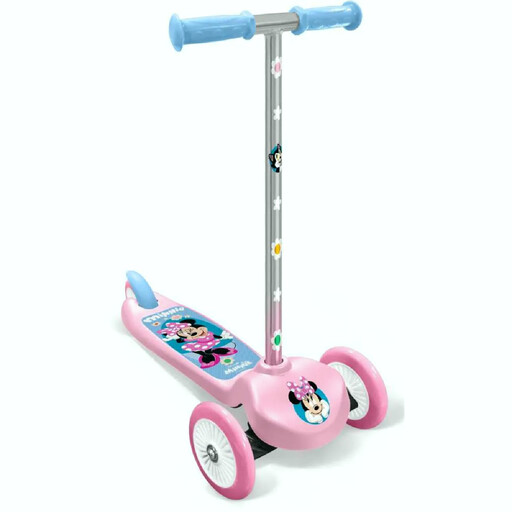
Why this fits the profile: With three wheels, a non-slip deck and lean-to-steer direction, this model is suitable for first outings from age 3, on flat ground and under adult supervision.
The page states a maximum weight of 20 kg and makes clear the product isn’t intended for public roads. That helps you tell an outdoor toy from a proper means of transport.
Three wheels, ABEC 5 bearings, rear brake and assembly limited to fitting the handlebar.

Why this fits the profile: Aimed at children from age 8 as well as teenagers, this scooter is for those who want to progress at the skatepark with a model built for tricks.
The page clearly distinguishes freestyle from simple cruising. It also mentions a T-6061 aluminium deck, an adjustable handlebar and a one-piece fork.
110 mm wheels, ABEC-9 bearings, non-slip deck and quiet rear brake according to the product description.

Why this fits the profile: This freestyle starter model is aimed at children aged 7 to 14 who want to learn tricks step by step, with a rigid structure and minimal assembly required.
The page states it’s a model for tricks, not a foldable kids’ scooter for transport. Its fixed handlebar avoids the compromises that come with a folding mechanism.
6061 aluminium frame, reinforced deck, 4130 chromoly steel handlebar, triple clamp and rear brake.
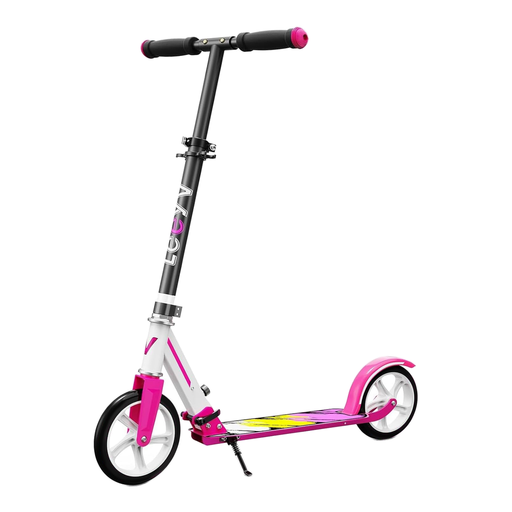
Why this fits the profile: With its large wheels and adjustable handlebar, this model suits children from age 6, teenagers and, within the weight limit, some adults too.
The description states a diameter of 205 mm, a maximum weight of 220 lb and a rear brake. That lets you compare these specs with how you plan to use it.
Two large polyurethane wheels, adjustable handlebar, non-slip grips and a foldable design.
We’ve put together a full selection, updated in real time, of products that meet these exacting criteria as well as European safety requirements.
Before every ride, check that the handlebar, wheels and folding clamp are all tight. On models with a rear brake, make sure it springs back into position properly. For cleaning, use a slightly damp cloth and avoid high-pressure water jets.
A helmet is strongly recommended. When learning or practising tricks, add knee and elbow pads. Models designed for young children are not intended for use on roads open to traffic. Follow the manufacturer’s instructions, markings and warnings, especially those about small parts and the maximum load.
A kids’ scooter can last several seasons as long as it remains suitable for the rider’s weight and height. However, badly worn wheels, play in the steering, a cracked deck or a faulty brake mean you should stop using it immediately.
A three-wheel scooter with a non-slip deck, lean-to-steer direction and rear brake is generally easier to handle. Check that your child meets the stated age and weight requirements, then stick to flat surfaces and always have an adult present.
Yes, especially for storing at home or carrying in the car. But check the mechanism is locked before every ride and choose an adjustable handlebar that suits your child’s height.
Routine maintenance usually comes down to cleaning and checking the screws, wheels and brake. The main expenses come when you need to replace worn wheels, bearings or grips. Before buying, check that spare parts are available and what the warranty covers.