Parents preparing lunchboxes
Individually portioned bars make it easier to prepare several snacks to take with you. To compare recipes, check the weight and nutritional values per bar, then look at the allergens listed on the packaging.


For a snack to take with you, choose a multipack based on the weight of each bar, the recipe’s allergens and the nutritional values per serving, rather than relying on the word ‘protein’ alone. Manger Bouger recommends a varied snack for children, such as bread, a piece of fruit or a dairy product. A bar can be a handy occasional option if its ingredients are suitable, but it shouldn’t become the automatic choice.
Individually portioned bars make it easier to prepare several snacks to take with you. To compare recipes, check the weight and nutritional values per bar, then look at the allergens listed on the packaging.
The number of bars isn’t the whole story: a box of smaller portions and a box of heavier bars may not suit the same snacking routine.
The exact recipe matters more than the product range name. Some of the products featured by Carrefour and Auchan contain peanuts, tree nuts, milk or soya, or carry warnings that other allergens may be present.
When preparing snacks to take with you, first check the recipe and portion size, then consider each bar as part of the whole snack.
| What to check | Look out for | Who is it for? |
|---|---|---|
| Portions and portability | Count the bars, compare the weight of each one and check whether they’re individually wrapped if they need to be taken with you. | When you’re preparing several lunchboxes, being able to divide up the portions without opening the whole box is especially useful. Around 31% of consumers prioritise this kind of organisation. |
| Allergens and ingredients | Read the ingredients list and any ‘may contain’ warnings for the specific flavour; don’t assume another recipe has the same ingredients. | If an ingredient needs to be avoided, a convenient format can’t make an unsuitable recipe suitable. For around 31% of consumers, ingredient compatibility is the top priority. |
| Part of the snack | Compare the nutritional information per 100 g, then per bar, particularly the sugars, fat and salt where listed. | When putting together a varied snack, the word ‘protein’ alone doesn’t tell you what a whole bar contributes. Around 23% of consumers focus first on the overall snack. |
| Intended use of the recipe | Look for any indication that the bar is intended for after exercise, and check the ingredients list for sweeteners. | When a bar is marketed for sport or contains sweeteners, some people first want to know whether it’s suitable for everyday use. Around 15% of consumers prioritise this question. |
This label doesn’t tell you everything about sugars, fat, allergens or the recipe’s intended use. Manger Bouger recommends offering children a varied snack.
Compare the ingredients list and nutritional values per 100 g, then consider what one bar would contribute to the snack you have planned.
Four 32 g bars, five 32 g bars and eight 40 g bars don’t contain the same total weight or offer the same portion size.
Check how many snacks you want to prepare, then compare the weight per bar and nutritional values per 100 g separately.
The recipes featured by Carrefour and Auchan contain different ingredients and have different ‘may contain’ warnings. Information that applies to one bar won’t necessarily apply to another.
Check the label for your chosen flavour and every new box you buy, especially if an allergen needs to be avoided.
Auchan describes its Eat'N Move range as intended to be eaten after exercise. That doesn’t, by itself, mean it’s suitable as an everyday snack for a child.
Start with what you actually need: portability, portion size and ingredients. Then compare the recipe with other snack options.
Protein cereal bars are available in boxes of 4 × 40 g and 8 × 40 g, among other formats. Auchan says its box of eight bars contains individually wrapped portions.
Carrefour offers, among other products, Protein seed and chocolate cereal bars in boxes of 4 × 32 g.
Auchan describes this range of protein cereal bars, available in packs of 5 × 32 g, as intended to be eaten after exercise.
These boxes of four 40 g bars are suited to anyone looking for portions to share across several snacks or pop into a lunchbox. Check the exact recipe before choosing.
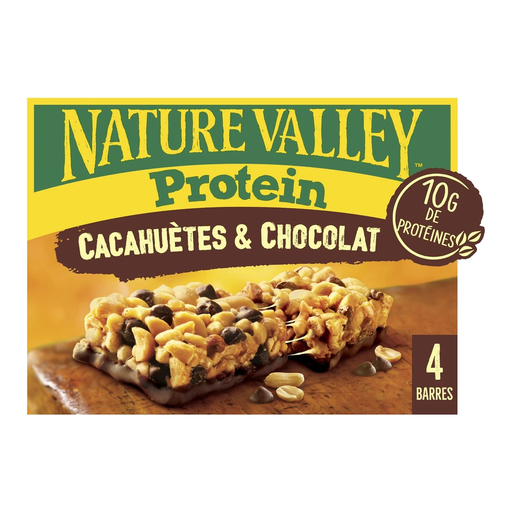 Image unavailable
The four individually wrapped portions are convenient for taking with you and sharing between snacks. The product information lists peanuts, soya and milk; for a 40 g bar, it gives 196 kcal and 6.9 g of sugars. Check the recipe label before packing one for a child.
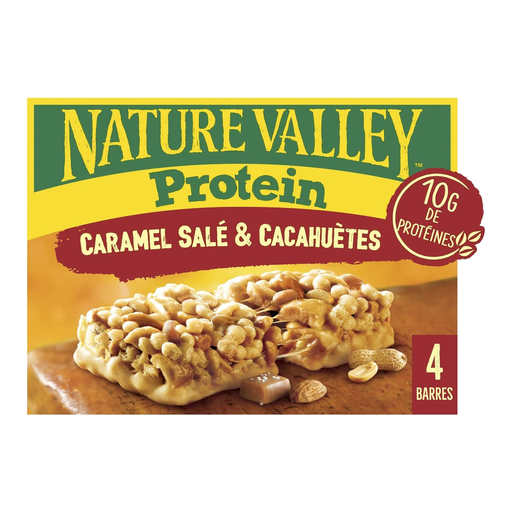 Image unavailable
The four individually wrapped bars can be shared between snacks to take with you. This recipe lists peanuts, soya, milk and almonds. Check these allergens and the nutritional values per bar before adding one to a lunchbox.
The word ‘protein’ alone doesn’t make it a suitable everyday choice. Manger Bouger recommends a varied snack instead, such as bread, a piece of fruit or a dairy product. If a bar is used occasionally as a snack to take with you, check its portion size, ingredients and allergens.
First compare the nutritional values per 100 g, a common basis explained by the DGCCRF, then look at the values per bar. Also check the weight of each bar and the number of portions: a box of 4 × 32 g and a box of 8 × 40 g won’t work in the same way for snack planning.
Read the ingredients and any ‘may contain’ warnings for the specific recipe. Depending on the product, the options featured by Carrefour and Auchan, as well as the Nature Valley bar available on Joybuy, list peanuts, tree nuts, milk, soya or wheat. The DGCCRF says allergenic ingredients must be highlighted in the ingredients list.
No. The presence of sweeteners doesn’t, by itself, answer questions about portion size, ingredients or allergens. For example, Auchan lists sucralose in a FULFIL bar. Read the full ingredients list and nutritional information for the recipe you’re considering.