Parents packing a snack to take along
For an outing, a journey or a school bag, you’re looking for a box with the right number of bars and packaging for your needs. Carrefour, Auchan and E.Leclerc, for example, stock boxes of six cereal bars.


When choosing cereal bars to take along for a child, first check the recipe’s allergens, then its ingredients and the number of portions in the box. The word ‘cereal’ and individually wrapped portions aren’t enough to judge a product. For an everyday snack, Manger Bouger recommends a varied snack for children aged 4–17 and advises limiting sugary and fatty foods. A bar can be a convenient option without becoming the automatic choice.
For an outing, a journey or a school bag, you’re looking for a box with the right number of bars and packaging for your needs. Carrefour, Auchan and E.Leclerc, for example, stock boxes of six cereal bars.
You want to check the ingredients and nutritional information for the bar you choose, taking portion size and the Nutri-Score into account when it appears on the packaging.
You need to check the recipe you’re actually buying, particularly if your child needs to avoid milk, soya, certain cereals, tree nuts or peanuts. The DGCCRF reminds consumers that allergens in the ingredients list must be clearly highlighted.
For a snack to take along, start with your child’s dietary requirements, then compare the recipes and box sizes.
| Criteria | What to check | Who is it for? |
|---|---|---|
| Ingredients and how it fits into snack time | Compare the sugars and saturated fats in similarly sized portions, as well as the ingredients list. If shown, the Nutri-Score is an additional guide. | When snacks are a regular part of the routine, I want to know what’s in a bar before choosing one. Around 40% of consumers prioritise comparing ingredients in this way. |
| Allergens | Read the highlighted ingredients on the packaging of the recipe you’re buying, even if you already know the brand. | If my child needs to avoid certain ingredients, the specific recipe matters more than its flavour or picture. Around 30% of consumers put suitability for these dietary requirements first. |
| Portions to take along | Check the number of bars, the net weight and the weight per portion. Also check whether the bars are individually wrapped. | For an outing, I’m looking for portions that are easy to carry and share out depending on the journey. Around 30% of consumers prioritise this convenient format above all. |
A bar’s name doesn’t tell you all its ingredients or how it fits into your child’s snacks. Manger Bouger recommends a varied snack for children aged 4–17 and advises limiting sugary and fatty foods as part of their everyday diet.
Read the exact recipe and plan other snack options too, rather than choosing based on the product name alone.
Two flavours from the same brand may have different ingredients lists. Kellogg’s France, for example, flags allergens in its Corn Flakes Cacao bar.
Check the highlighted ingredients on the pack you’ve bought every time an allergen needs to be avoided.
Cereal bar boxes stocked by retailers don’t necessarily have the same weight or number of bars.
Check the net weight, number of bars and packaging for each recipe before planning snacks to take along.
Shop shelves include different types of bars with different ingredients and uses. The name alone doesn’t prove that a bar is right for the snack you’re looking for.
Focus on your child’s specific needs and compare the ingredients, allergens and nutritional information for the exact product.
Kellogg’s France offers several ranges of bars, including Frosties, Coco Pops, Special K and Corn Flakes Cacao.
The Carrefour range includes Classic’ cereal bars in boxes of six, alongside other ranges.
Auchan offers cereal bars from its Crousti and Pouce ranges, as well as other types of bars.
The E.Leclerc range includes Grainea cereal bars in boxes of six, alongside other Marque Repère sub-brands.
These two 125 g LU Grany recipes are cereal bars to consider for a snack on the go. Before packing portions for a child, check the number of bars, how they’re packaged and the label for the recipe you’ve chosen.
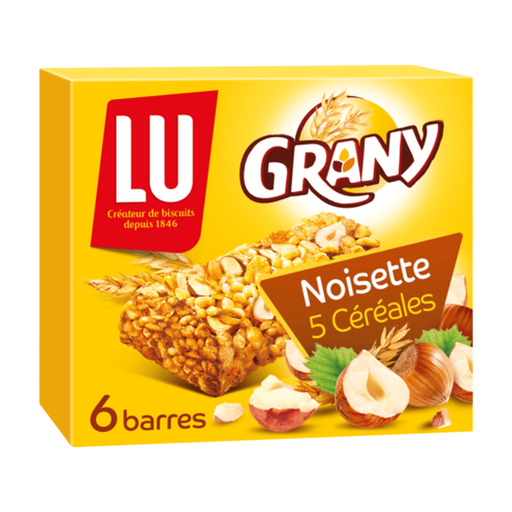 Image unavailable
If you’re packing a hazelnut recipe, first check that it meets your child’s dietary requirements. The pack weighs 125 g; check the packaging for the number of bars, how they’re wrapped and any allergens. Nutritional information per 100 g doesn’t tell you the values for an individual bar.
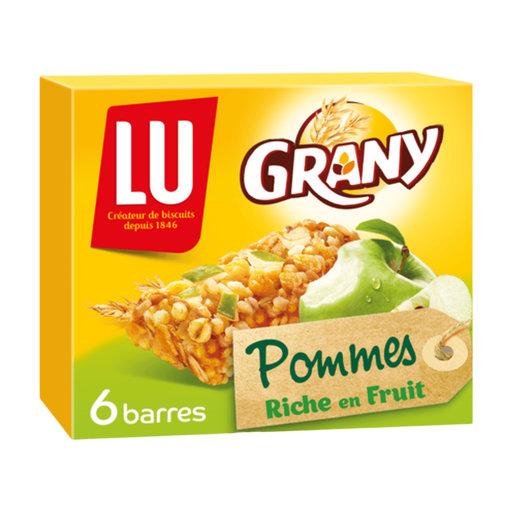 Image unavailable
If you’re looking for an apple recipe to take along, compare its label with those of other flavours rather than assuming they have the same ingredients. The pack weighs 125 g; check the packaging for the number of bars, how they’re wrapped and any allergens. Values per 100 g aren’t the same as values per portion unless you know the weight of an individual bar.
A bar isn’t automatically a substitute for a varied snack. For children aged 4–17, Manger Bouger recommends limiting sugary and fatty foods as part of their everyday diet and offering variety. If you choose a bar for convenience, check its recipe and what else you’re serving with it.
Compare the ingredients list, allergens, nutritional information and portion size, then check the number of bars and the net weight. For recipes with different portion sizes, distinguish between values per 100 g and per portion. If shown, the Nutri-Score doesn’t replace checking the rest of the label.
Read the ingredients list and allergen information on the pack you’ve actually bought rather than relying on the brand name alone. The DGCCRF states that allergens present in the ingredients must be highlighted. Also check any relevant information about ingredients your child needs to avoid.
The aisle a bar is sold in doesn’t prove that it’s suitable for a toddler. Consider your child’s age, the texture and the ingredients of the specific product. Manger Bouger’s guidance for young children includes limiting cakes, biscuits and chocolate products.