Parents keeping an eye on added sugars
For a celebratory tea, you want to check the sugar content and ingredients rather than assume a spread labelled ‘no added sugars’ contains no sugars at all.


For a children’s birthday tea, compare the sugars per 100 g and check the allergens on the jar you plan to serve: ‘no added sugars’ does not mean ‘sugar-free’. A fibre-rich recipe, a maltitol recipe and a classic cocoa and hazelnut spread suit different preferences. If reducing added sugars is your priority, the classic Nutella recipe described by Carrefour, which lists sugar as its first ingredient, does not meet that criterion.
For a celebratory tea, you want to check the sugar content and ingredients rather than assume a spread labelled ‘no added sugars’ contains no sugars at all.
Before serving a group of children, you need to know about their dietary restrictions and check the chosen recipe, particularly for nuts, milk, soya and any ‘may contain’ warnings.
If you’re considering a spread containing maltitol, the warning on some recipes and the amount served matter just as much as the ‘no added sugars’ claim.
Start by checking the restrictions of the children you’ve invited, then compare the ingredients of recipes that are suitable for them. The three options do not meet the aim of reducing added sugars in the same way.
Consider this if: you’re looking for this type of recipe and want to compare its sugar content per 100 g with other jars.
Good to know: the 280 g Lucien Georgelin product described by Auchan contains 8.5 g of sugars per 100 g; the Carrefour listing for a 400 g product notes that separation may mean you need to stir it.
Consider this if: you’re happy to have a sweetener in the ingredients and can plan how much to serve.
Good to know: Auchan’s listing for Karéléa spread warns that excessive consumption may have a laxative effect.
Consider this if: reducing added sugars isn’t one of your selection criteria.
Good to know: sugar is the first ingredient in the Nutella recipe featured by Carrefour; check the allergens too before serving it.
| What matters | What to check | Who it matters to |
|---|---|---|
| Sugars and ingredients | Compare the ‘of which sugars’ figure per 100 g and read the ingredients, including any added fibre or sweeteners. | For a celebratory tea, I want to limit added sugars without mistaking this claim for an absence of sugars. Around 45% of consumers prioritise this need. |
| Guests’ allergens | Ask about the children’s dietary restrictions; check the ingredients and any ‘may contain’ warnings on the jar you’ll serve. | If a child I’ve invited has a dietary restriction, I need a suitable recipe before I think about its sugar content. This comes first for around 36% of consumers. |
| Pack size and polyol recipe | Choose an amount that suits the tea; for a maltitol recipe, read the warning on the packaging. | With several foods planned for the party, I’m looking for a suitable pack size and want to avoid serving a product with a warning without limits. Around 19% of consumers prioritise this. |
The 280 g Lucien Georgelin product featured by Auchan has no added sugars, but contains 8.5 g of sugars per 100 g.
To compare two jars, check their ‘of which sugars’ figures on the same per-100 g basis, then read the ingredients.
Santé publique France says that displaying the Nutri-Score is voluntary. Its absence is no substitute for reading the nutritional information.
If the score appears on the jar, use it as an additional guide and check the sugars, fat, ingredients and allergens too.
The recipes mentioned by Carrefour and Auchan include hazelnuts and milk; some also contain soya. The DGCCRF states that allergenic ingredients in prepacked food must be highlighted.
Ask guests about their restrictions and read the label again, including any ‘may contain’ warnings, before serving the product.
Auchan’s listing for Karéléa spread states that it contains 44 g of polyols per 100 g and warns that excessive consumption may have a laxative effect.
Bear this warning in mind when planning portions for the tea.
Carrefour and Auchan listings include cocoa and hazelnut spreads with no added sugars.
The cocoa and hazelnut spread described by Carrefour is presented as having no added sugars and contains maltitol.
Its classic cocoa and hazelnut recipe can provide a point of comparison if reducing added sugars is the criterion you’re considering.
For toast or a dessert topping at tea time, this blueberry preparation with no added sugars is a different type of product from a cocoa and hazelnut spread. Its total sugar content is still worth taking into account.
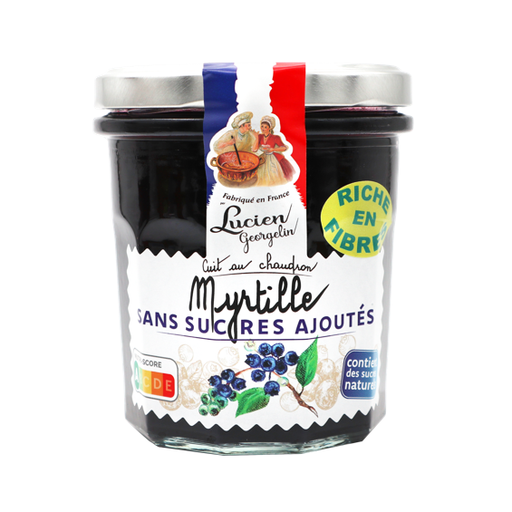 Image unavailable
Worth considering if a fruity topping for toast or desserts suits your plans for tea time better than a cocoa and hazelnut spread.
The product listing states that it contains 65% blueberries, 42.2% soluble fibre and 30 g of sugars per 100 g. Once opened, it should be kept in the fridge and used within 10 days. Before serving it to children with dietary restrictions, check the packaging of the product you’ve bought too.
No. A recipe with no added sugars can still contain sugars: the 280 g Lucien Georgelin spread featured by Auchan contains 8.5 g of sugars per 100 g. Check the ‘of which sugars’ figure to compare jars.
No. Santé publique France says that displaying it is voluntary. The DGCCRF states that nutritional declarations are compulsory for most prepacked foods and give figures per 100 g or 100 ml.
You can’t tell from the product category alone: ingredients vary from recipe to recipe. For example, Carrefour lists a Nocilla product with a ‘gluten-free’ claim, but that tells you nothing about other jars. Check the label of the product you plan to serve, along with the other allergens and any ‘may contain’ warnings.
First ask the person in charge about any restrictions that apply to the tea, then check the needs of the children you’ve invited. For the jar you’ve bought, read the ingredients and any ‘may contain’ warnings; the DGCCRF states that allergenic ingredients in prepacked food must be highlighted.
Take into account the warning for the recipe you’ve chosen. Auchan’s listing for Karéléa spread says that excessive consumption may have a laxative effect; plan how much to serve and keep the label to hand.