
Livraison le jour même ou le lendemain

Qualité garantie

Débloquez vos offres de bienvenue: Livraison GRATUITE | Jusqu'à -80 % | 30 jours d'essai gratuits à JoyPlus
Téléchargez l'application
Choosing a kids' bike is about more than just color or the number of wheels. Balance bikes, convertible tricycles, pedal bikes, or 4-in-1 models: each design directly impacts handling, longevity, and everyday comfort.
However, some marketing claims deserve a closer look. A product touted as "convertible" may require multiple tools to change its configuration. Similarly, a bike advertised as lightweight can still be difficult for a child to lift if its actual weight isn't clearly stated. As for training wheels, they don't always replace a progressive approach to learning balance.
The recommended age provides an initial guideline, but it's not enough to choose the right bike. Two 4-year-olds can have very different heights and inseam lengths. Therefore, check the seat height, the ability to place feet on the ground, and the distance between the handlebars and the seat.
For a beginner, feet must be able to touch the ground on a balance bike or a pedal-less tricycle. With a pedal bike, the child should be able to mount and dismount easily, without excessive leaning.
A 4-in-1 bike or a convertible tricycle can accompany several stages, but each additional accessory brings its own set of adjustments. Specifically, check whether the pedals, the parent push bar, and the training wheels are truly removable, and whether the configuration change is clearly explained in the manual.
A practical setup for a walk with an adult doesn't necessarily meet the needs of a child who wants to pedal independently.
A lightweight kids' bike is easier to right, push, and carry up stairs or into a car trunk. For a young child, a few extra kilograms can make maneuvering significantly more tiring.
The weight should be considered in relation to the child's weight, but also the intended use: daily commutes, park outings, storage in an apartment, or transport during vacations.
The most common wheel sizes for a kids' bike for ages 2 to 7 generally range from 12 to 18 inches, depending on the child's build and skill level. A 12-inch balance bike can be suitable for learning between ages 2 and 5, while a 14 or 16-inch bike often accompanies children who are starting to pedal.
Avoid choosing a larger wheel solely to artificially extend the bike's usable life. A bike that is too large reduces control and risks discouraging the child.
On a pedal bike, check for brakes suitable for small hands. Some models combine a front V-brake with a coaster brake. On a tricycle, a steering angle limiter can prevent overly sharp turns, without replacing adult supervision.
The parent push bar must be stable, properly attached, and sufficiently adjustable to suit the height of the adult accompanying the child.
EVA wheels are generally puncture-proof and require no inflation. They are practical for walks on hard surfaces and indoor storage. Classic tires offer a different riding feel but require regular pressure checks.
A steel frame can offer robustness, while an aluminum alloy frame often helps reduce weight. In all cases, check the tightness of components, brakes, seat, and wheels before each use. Wearing a helmet is essential when cycling. In France, it is mandatory for children under 12 riding a bike on public roads.
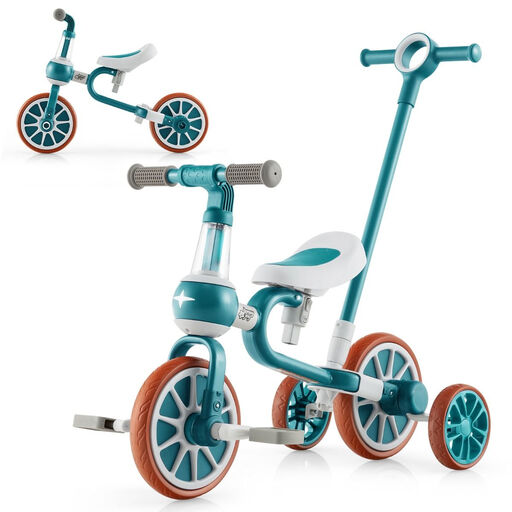
Why this model fits this profile: designed for children aged 2 to 4, it offers several configurations to transition from accompanied walks to pedal-less movement, and then to learning to pedal.
The product sheet mentions an adjustable bar with four positions, an adjustable seat with two positions, and removable pedals. The stated weight is 3.5 kg.
Non-slip EVA wheels, a stated maximum load of 30 kg, and a steering angle limited to 135° according to the product sheet.
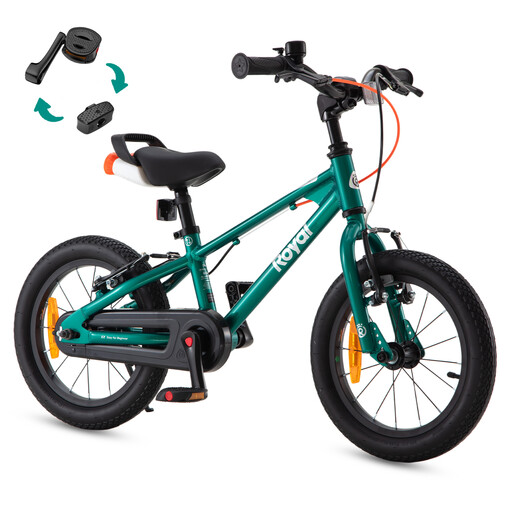
Why this model fits this profile: according to the product sheet, it is intended for children aged approximately 4 to 7 and is suitable for regular use in the park or on adapted paths.
According to the product sheet, the 2-in-1 design allows switching from balance mode to pedaling thanks to a tool-free quick-release crank system.
An aluminum alloy frame, an open geometry, and an adjustable seat and handlebars. The model features two hand brakes.
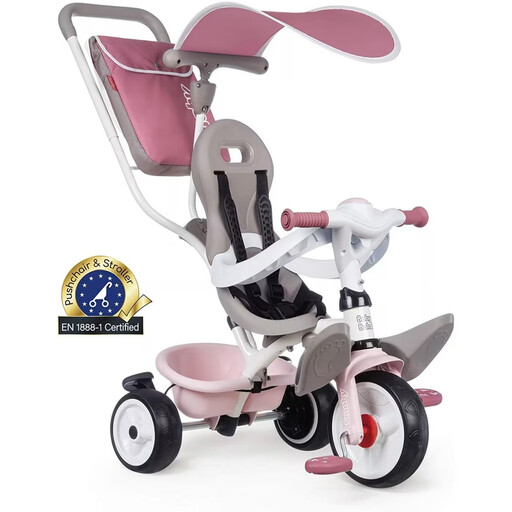
Why this model fits this profile: designed for use from 10 months, it accompanies outings with an adult before allowing more independent use as a tricycle.
The product sheet details the parent push bar, harness, roll bar, footrest, and parking brake. Accessories can be removed progressively.
An adjustable seat with two positions, quiet EVA wheels, and a 360° rotatable canopy, according to the manufacturer's information.
Discover a regularly updated selection of products meeting these criteria and the needs of families in France.
It all depends on the child's height and inseam. A 14-inch model may suit some children aged 3 to 5, while a 16-inch bike often corresponds to children aged 4 to 7. Always check the minimum seat height and the ability to place feet on the ground.
These two solutions don't exactly meet the same need. The balance bike focuses on learning balance and steering, without pedals. Training wheels allow starting to pedal directly, but can delay the awareness of balance. The choice depends on the child's level of independence and preferences.
The duration of use depends on the child's growth, weight, the range of adjustments, and the bike's maintenance. An adjustable seat and handlebars can extend its use, but do not justify keeping a model that has become too small. Regularly check the brakes, wheels, fastenings, and the condition of the frame.