
Livraison le jour même ou le lendemain

Qualité garantie

Débloquez vos offres de bienvenue: Livraison GRATUITE | Jusqu'à -80 % | 30 jours d'essai gratuits à JoyPlus
Téléchargez l'application
A dead battery, a flat tire at the worst possible moment?: every driver's nightmare. To tackle these headaches, the jump starter with air compressor stands out as the all-in-one miracle solution. But be warned, the market is flooded with products making often misleading marketing claims. To help you cut through the noise, we've broken down what separates a reliable device from a gadget that will fail you when the temperature drops.
Buying safety equipment for your car shouldn't be taken lightly. Here are the three common mistakes that can turn your investment into a useless, or even dangerous, object.
The "Peak Amps" Mirage: Many manufacturers flaunt impressive numbers, like 3000?A or 4500?A. This value, the peak amperage, only represents the maximum current the device can deliver for a split second. It is not a reliable indicator of its ability to actually start your engine. The only metric that matters is its compatibility with your vehicle's engine displacement (in litres, for petrol and diesel), which guarantees sufficient starting power.
The Lithium Battery Time Bomb: The majority of jump starters use standard lithium-ion batteries. These suffer from several major flaws?: rapid self-discharge (meaning the booster might be dead the day you need it), high sensitivity to extreme temperatures (overheating in summer, power loss in winter), and a limited lifespan of just a few hundred cycles. Leaving such a device in your car year-round is therefore a bad idea disguised as a good one.
The Gimmicky Compressor: A device marketed as a 4-in-1 emergency starter can hide a compressor with laughable performance. An air flow rate (L/min) that's too low or insufficient maximum pressure (PSI) will turn inflating a tire into an endless test of patience, making this feature completely useless in an emergency.
To avoid buyer's remorse, focus on these three technical points. They are the only true guarantee of performance and reliability.
This is THE key criterion that should guide your choice.
Forget peak amps. The only number that matters is the petrol/diesel jump-starting compatibility. This is always indicated by the maximum supported engine displacement. For example, a rating like "up to 9.0L petrol / 7.0L diesel" is a clear and reliable indicator. Ensure this capacity is well above your vehicle's engine size to maintain a safety margin, especially in winter when batteries struggle the most.
To ensure the compressor function isn't just a gimmick, keep an eye on two values:
Based on the safety and performance criteria we've just covered, we have selected three models that meet very specific needs.

Ideal for: Those who want absolute peace of mind. This device can stay in the car for years without any recharging, offering rock-solid reliability for families and cautious drivers.
Its sodium-ion battery sidesteps the safety risks of lithium and the self-discharge problem. According to the manufacturer, a single charge provides up to 5 years of standby time.
Unmatched chemical safety (no fire risk). Extreme temperature range (-40 °C to 80 °C). Lifespan of over 6000 cycles.

Ideal for: Owners of SUVs, 4x4s, vans, or vehicles with large diesel engines who require raw, flawless starting power. Its compatibility with up to 9.0L petrol and 8.0L diesel engines makes it a top-tier choice.
It doesn't just rely on a marketing-driven amp figure; it backs it up with clear and extensive engine compatibility. Its 150 PSI compressor with automatic shut-off is also up to the task.
Massive power for large engines (9.0L/8.0L). Digital compressor with 5 preset modes. Active cooling system for enhanced longevity.
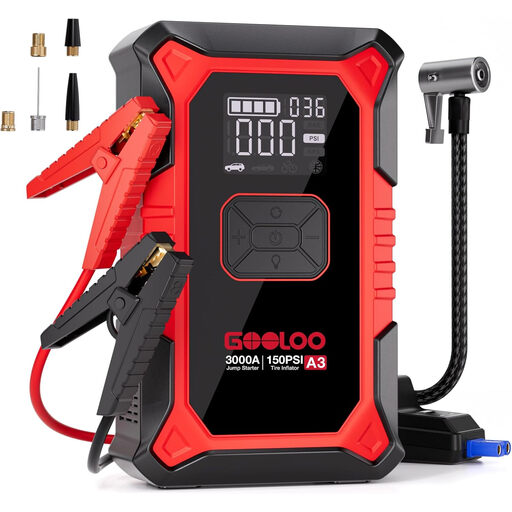
Ideal for: The perfect tool for the user seeking the Swiss Army knife of car emergencies. It combines comfortable starting power, an intelligent multi-mode compressor, and an effective fast-charging power bank function for recharging smartphones and tablets.
It avoids the trap of the mediocre "all-in-one" by offering consistent and convincing performance across the board. The compressor isn't just for show: its 5 modes and 35 L/min flow rate are genuinely effective.
Well-designed 7-in-1 versatility. Smart compressor with LED screen and pressure detection. Solid starting power for most cars (9.0L/6.5L).
To be prepared for any eventuality, a fire extinguisher suitable for your vehicle is essential. We have selected products that comply with French and European safety standards.
1. What is the lifespan of a jump starter with an air compressor? The lifespan primarily depends on its battery technology. A classic lithium-ion model will last 3 to 5 years (400 to 800 cycles), provided you recharge it every 2-3 months. In contrast, a sodium-ion battery model can exceed 6000 cycles. Its extremely low self-discharge allows it to remain operational for years without maintenance, making it a much more durable investment.
2. Can I leave a jump starter in my car permanently? This is a safety question that depends on the battery. It is strongly advised not to leave a lithium-ion jump starter in a car during hot summers or extreme cold, as the battery can get damaged and pose a risk. Sodium-ion models, on the other hand, are designed to tolerate extreme temperatures (typically from -40?°C to 80?°C), making them perfectly safe for permanent storage in a vehicle.
3. How do I choose the right power for my vehicle? Ignore peak amperage and rely solely on the engine compatibility, expressed in litres (L). Look for a rating like "for petrol engines up to X.X?L and diesel engines up to Y.Y?L". Always choose a model with a capacity greater than your engine's displacement to have a safety margin. For example, for a 2.0L diesel car, a jump starter compatible with up to 6.0L diesel engines will be more than sufficient and highly effective, even in the dead of winter.