
Livraison le jour même ou le lendemain

Qualité garantie

Débloquez vos offres de bienvenue: Livraison GRATUITE | Jusqu'à -80 % | 30 jours d'essai gratuits à JoyPlus
Téléchargez l'application
A dead battery first thing in the morning, an underinflated tyre far from any service station... these are scenarios every driver dreads. The jump starter with air compressor presents itself as the silver bullet, the Swiss Army knife that promises peace of mind. The problem? The market is flooded with marketing promises and devices that, when you actually need them, turn out to be completely useless.
As a product expert at Joybuy, my role is to help you see things more clearly. Let's analyse the common pitfalls and essential criteria together, so you can choose a device that will be genuinely reliable when the time comes.
On paper, many devices boast impressive specs. In reality, they hide critical flaws that render them useless in an emergency. Here are the traps to watch out for:
To avoid these pitfalls, you need to focus on the technical specifications that truly matter. These are what will guarantee the performance and reliability of your future portable jump starter.
The required power depends directly on your vehicle's engine.
The battery is the heart of the unit. Its technology determines its lifespan, safety, and, most importantly, its ability to remain operational after months of being forgotten in the boot.
To ensure the tyre inflator function is more than a useless gimmick, there are two specs to scrutinise:
Rather than an endless list, we've matched user profiles with products that tick all the boxes of our reliability criteria.
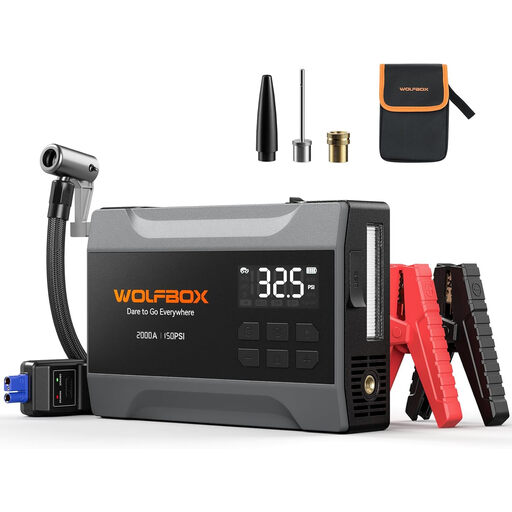
Its profile: Perfect for drivers of city cars and petrol saloons. It's the compact and simple solution for handling the most common breakdowns, without being cluttered with superfluous features. The essential safety equipment to slip into the glove compartment.
It plays it straight. Its 2000A peak current is clearly linked to compatibility with petrol engines up to 5.0L. No false promises for owners of large diesel vehicles.
Ultra-simple to use and compact, it's the reassuring and easy-to-store tool for everyday journeys.

Its profile: Built for high-mileage drivers and demanding vehicles (SUVs, vans, large diesel engines). Its firepower and high-performance compressor make it a powerful ally for long trips and critical situations.
It counters the trap of overrated power by being transparent: it advertises compatibility with very large engines (up to 9.0L petrol / 8.0L diesel). Its compressor, equipped with an automatic shut-off, prevents any risk of overheating or over-inflation.
Its versatility. Starting power capable of rescuing almost any vehicle on the road, and an intelligent compressor that turns tyre maintenance into a simple formality.

Its profile: For those who make no compromises on reliability and durability. This device relies on sodium-ion battery technology, designed to be forgotten for years and still work in extreme conditions. It's a long-term investment in peace of mind.
It shatters the "ghost battery" trap. Its sodium-ion technology guarantees virtually non-existent self-discharge (it's ready to use even after several years) and resistance to extreme temperatures (-40°C to +80°C). You can leave it in the car all year round with complete peace of mind.
Its outstanding durability and safety. With an advertised lifespan of 6000 cycles (compared to 500-1000 for a classic lithium battery) and a stable chemistry that prevents any risk of thermal runaway, it's designed to last a decade and offer maximum safety.
Explore our full selection of products that meet our strict selection criteria and European safety standards.
A diesel engine is very power-hungry at start-up, so you need a powerful battery booster. Don't just rely on the peak current (A); the crucial information is the compatibility with your engine's displacement. To be on the safe side, aim for a model compatible with diesel engines of at least 6.0L. This generally corresponds to boosters advertising 3000A peak current or more.
Yes, all jump starters lose charge over time. This is called self-discharge. But the rate varies dramatically: a low-end model can be empty in 2 or 3 months, while an excellent model (especially a sodium-ion one) will retain over 80% of its charge after a year. Our advice: check and top up your device's charge every 3 to 6 months, just in case.
Yes, provided you choose the right one. It is imperative to check the operating temperature range specified by the manufacturer. A car's interior can become a real oven in the summer, which lithium batteries do not handle well. For permanent storage in the vehicle, prioritise models certified to withstand high temperatures (up to 60°C and above) or, better yet, those equipped with sodium-ion batteries, which are much more stable and safe.