
Livraison le jour même ou le lendemain

Qualité garantie

Débloquez vos offres de bienvenue: Livraison GRATUITE | Jusqu'à -80 % | 30 jours d'essai gratuits à JoyPlus
Téléchargez l'application
A dead battery or a flat tyre at the worst possible moment can quickly turn any trip into a nightmare. That's why the jump starter with compressor has become an essential piece of equipment for many drivers. The problem is, the market is flooded with often misleading marketing promises. How can you sort the reliable devices from the gadgets that will let you down when you need them most?
As the Head of Product Recommendations at Joybuy, my role is to help you see things more clearly. We're going to break down the 3 most common pitfalls and identify the technical criteria that truly matter so you can make the right choice.
Purchasing a piece of safety equipment shouldn't be taken lightly. Beware of these often deceptive marketing claims.
To avoid falling into these traps, focus on these three essential parameters.
It's crucial to distinguish between two values:
For a standard 12v battery jump starter, a peak current of 2000A to 3000A is generally sufficient for most medium-sized gas and diesel vehicles. A gas/diesel car booster intended for SUVs, campervans, or large-displacement engines will require more power, often over 4000A, to ensure an effective start in all weather conditions.
The maximum pressure, expressed in PSI (Pound-force per square inch) or Bars, indicates the compressor's ability to inflate high-pressure tyres. Most models list 150 PSI, which is more than enough.
However, the true performance metric is the air flow rate, measured in litres per minute (L/min). A flow rate of 25 to 35 L/min ensures a reasonably fast inflation for a standard car tyre. Below that, the task can become an ordeal. Also, check for convenient features like an automatic shut-off at the desired pressure.
A good multifunction jump starter must perform well on all fronts.
Rather than an exhaustive list, we've matched specific products to clear user profiles, based on the objective criteria defined above.
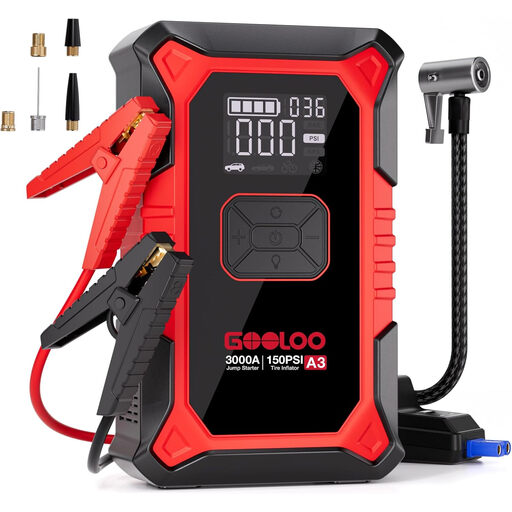
Why we chose it: This is the ultimate all-around tool, suitable for the majority of drivers. It offers a perfect balance between a 3000A starting power, sufficient for common cars and SUVs (up to 9.0L gas / 6.5L diesel), and an effective 150 PSI compressor for regular top-ups.
With its 35 L/min flow rate, the compressor is more than just for show. It can reinflate a tyre quickly, saving you the frustration of underpowered models.
Its 5 preset inflation modes (car, bike, etc.) make it incredibly easy to use, even for a novice.
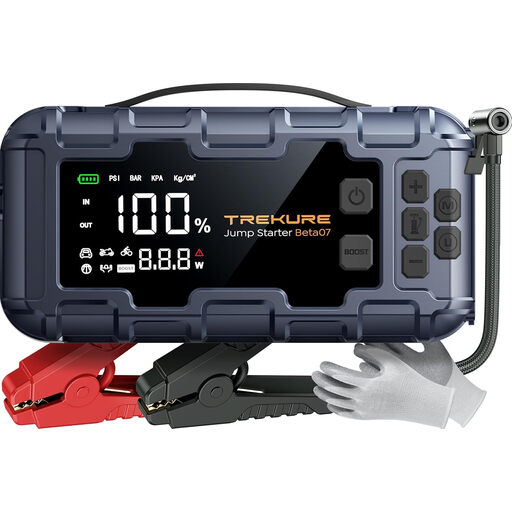
Why we chose it: For owners of large SUVs, campervans, or commercial vehicles with diesel engines up to 12L. Its 6000A peak power provides the necessary reserve for difficult starts, and its 160 PSI compressor with a 45 L/min flow rate is suited for large tyres.
It doesn't just boast an impressive number. It pairs it with PD 45W fast charging/discharging, ensuring the battery can be recharged quickly and efficiently, thereby avoiding the self-discharge trap.
Very high starting power (6000A) and a fast compressor (45 L/min) for the most demanding vehicles.
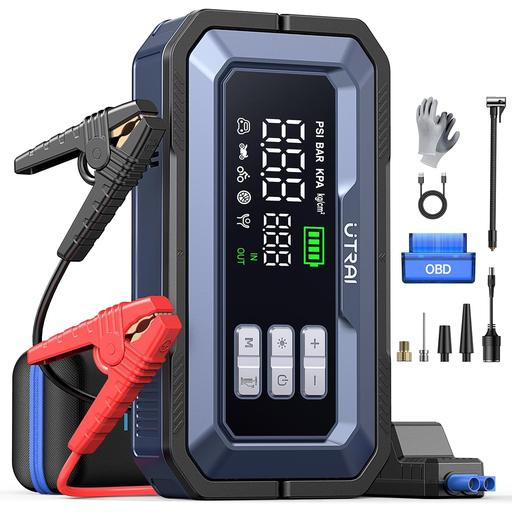
Why we chose it: This model is for those looking for more than just a simple emergency tool. With a phenomenal 7000A of power, it also integrates an OBD2 fault code reader, a 160W DC output (cigarette lighter type), and a 2000-lumen work light. It's a true portable power and diagnostics station.
It goes beyond the category of a simple jump starter by adding a genuinely useful car diagnostic function, which justifies its positioning and makes it a wise investment for the home mechanic.
The unique combination of a super-powerful jump starter, a compressor, a 160W DC output, and an OBD2 fault code reader.
A jump starter is a valuable ally on the road, but also for all your outdoor adventures. Discover our full selection of reliable and versatile equipment, designed for camping and outdoor enthusiasts.
The lifespan, expressed in charge cycles, primarily depends on the quality of its internal battery. A good model can withstand between 500 and 1000 cycles. To maximise its longevity, it's advisable to recharge it every 3 to 6 months, even when not in use, to maintain battery health.
For most diesel engines in medium-sized cars and SUVs (up to about 6.5L), a high-quality 3000A jump starter is generally sufficient. However, for larger engines (vans, campervans) or in extremely cold conditions, it's better to opt for a 4000A model or higher. This will give you a comfortable margin of safety.
Yes, but with a few precautions. Most jump starters are designed to operate over a wide temperature range (often from -20°C to +60°C / -4°F to 140°F). However, leaving the device in direct sunlight in an overheated car (over 60°C / 140°F) can damage the battery in the long run. Conversely, in extreme cold, its performance will be temporarily reduced. Ideally, you should store it in the glove box or boot, away from direct sunlight.