
Livraison le jour même ou le lendemain

Qualité garantie

Débloquez vos offres de bienvenue: Livraison GRATUITE | Jusqu'à -80 % | 30 jours d'essai gratuits à JoyPlus
Téléchargez l'application
A dead battery: every driver's nightmare, especially when you're short on time or in the middle of nowhere. A battery jump starter with a compressor is the ultimate multi-tool for handling this and many other unexpected situations. The problem? The market is flooded with models making over-the-top claims, but their performance is often disappointing. As a product expert at Joybuy, my mission is to teach you how to read between the lines of technical specs so you can make a choice that's truly right for your needs.
Navigating the overwhelming selection of portable starters can quickly become a headache. Too many buyers regret their purchase, trapped by overrated specs or unreliable features. Here are the two most common traps.
To avoid these pitfalls, focus on a few key technical specifications that define the true utility of a portable car starter.
Instead of being mesmerised by peak amps, look for the stated compatibility with your engine's displacement. A reputable product page will always specify the maximum compatible engine sizes, differentiating between petrol and diesel (e.g., "up to 8.0L petrol / 6.0L diesel"). Remember: a 12V jump starter for a diesel engine will always require significantly more starting power. Logically, a model labelled as a 5000A booster will have a better chance of handling a large diesel engine than a 2000 A model.
Battery capacity, measured in milliampere-hours (mAh), is crucial for autonomy. A generous capacity (over 20,000 mAh) ensures you can perform multiple jump-starts or recharge your devices several times. Your booster then becomes a true portable power station. For the compressor, look for the maximum pressure (expressed in PSI or bars). Aim for at least 150 PSI, a threshold that guarantees a quick inflation for a car tyre. A digital pressure gauge with an automatic shut-off at the desired pressure is not a gimmick, but a genuine convenience.
A jump starter delivers a very powerful surge of current, so its safety features are non-negotiable. It is imperative that the model you choose includes comprehensive protections. Check that the clamps are "smart" and protect against, at a minimum:
These features not only protect your vehicle's electronics but also ensure your own safety during every use.
Rather than aiming for a "one-size-fits-all" product, it's better to choose a model that perfectly matches your needs.
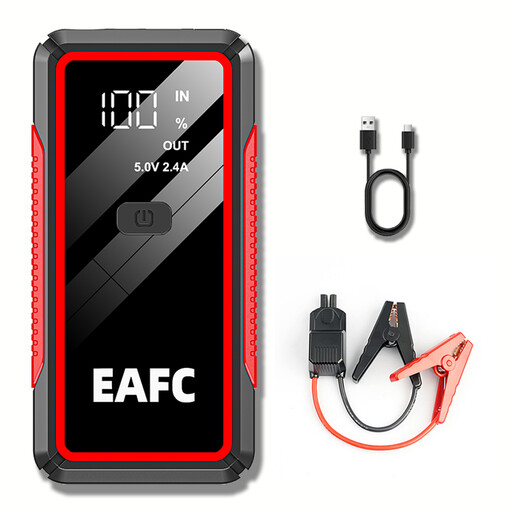
Why this one? Perfect for city cars and saloons (petrol or medium-displacement diesel). Compact enough to fit in the glove box, it packs enough punch to get you out of the most common breakdowns.
This model clearly states its compatibility (up to 6.0L petrol / 4.0L diesel), which is far more useful information than the peak rating alone. It focuses on its core mission as a starter, without being bogged down by subpar extra features.
Excellent balance of compactness and power; smart clamps with all safety features; handy USB power bank function (5V/2.4A) for mobile devices.
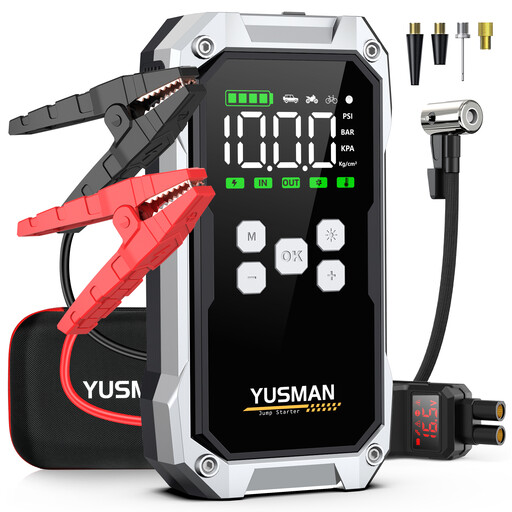
Why this one? Built for large engines: SUVs, utility vehicles, motorhomes, and especially large diesels. Its raw power is your best guarantee for a smooth start, even in the dead of winter.
It shatters the marketing power trap by displaying compatibility with diesel engines up to 10.0L. This concrete specification proves its 5000 A rating isn't just for show.
Very high current for demanding engines; large battery capacity (21800 mAh); robust clamps with an intelligent protection system and audible alerts.
Why this one? The ideal companion for adventurers, campers, and road-trippers. It's the complete solution for managing your vehicle's battery, tyre pressure, and power for your gadgets, far off the grid.
It avoids the mediocre "all-in-one" trap by integrating a genuinely powerful 150 PSI compressor and a high-capacity battery. Each function is designed to be truly effective in an emergency or off-grid situation.
A no-compromise 3-in-1 solution: a powerful jump starter, an air compressor with an LCD screen, and a 21800 mAh power bank with two USB ports.
We have curated a complete range of products that meet our strict selection criteria and current safety standards.
A diesel engine requires more torque to start, so it's crucial to aim for a high starting current. Forget peak amps and rely on engine compatibility. For a 2.0L to 3.0L diesel, a model rated for a 6.0L diesel engine is a solid baseline. For larger engines (utility vehicles, motorhomes), look for models compatible with 8.0L to 10.0L diesel engines.
The lifespan of the internal battery depends on its quality and maintenance. Generally, a quality booster will hold its charge for several months. However, it's recommended to fully charge it every 2 to 3 months to preserve the longevity of the lithium-ion battery and ensure it's ready when you need it most. Most models recharge in 4 to 8 hours via a USB-C port.
Yes, these devices are designed to be stored in a vehicle and can withstand a wide range of temperatures. However, it's best to avoid leaving it to bake in direct sunlight behind the windscreen in summer, as extreme heat can degrade the battery's performance and lifespan. The glove box or the boot is the best place for it.