
Livraison le jour même ou le lendemain

Qualité garantie

Débloquez vos offres de bienvenue: Livraison GRATUITE | Jusqu'à -80 % | 30 jours d'essai gratuits à JoyPlus
Téléchargez l'application
A dead battery on a cold morning, a tyre deflating in the middle of nowhere… these are the headaches every driver dreads. A jump starter with a compressor is the ideal all-in-one solution to get back on the road independently. The problem: the market is flooded with marketing promises that often hide disappointing products. Before you invest, it's crucial to know how to decipher spec sheets to equip yourself with a reliable tool that will be there when you really need it.
As a product specialist at Joybuy, I'm here to demystify this world for you. Let's analyse the red flags and the criteria that truly matter to make the right choice.
Marketers love to highlight impressive numbers that mask critical weaknesses. Here are the three most common traps?:
To avoid falling into these traps, focus on a few objective characteristics that determine the reliability and performance of your emergency jump start kit.
Power is the number one criterion. It must be suitable for your vehicle's engine.
Always check the starting current (sometimes called "cranking amps") rather than just the peak current ("peak amps").
The capacity, expressed in mAh, determines the device's autonomy: how many jump starts or smartphone recharges you can perform. A capacity of 15,000 to 25,000?mAh is a good sweet spot for most uses.
But beyond the numbers, the battery technology is crucial for its lifespan and safety. Lithium-ion batteries are common, but new technologies like sodium-ion are emerging. Their advantage? Near-zero self-discharge (the device stays charged for years), better resistance to extreme temperatures, and enhanced safety (no risk of thermal runaway).
A good integrated 12v air compressor should be both powerful and practical.
Here is our selection, designed for different user profiles, keeping these performance and reliability criteria in mind.
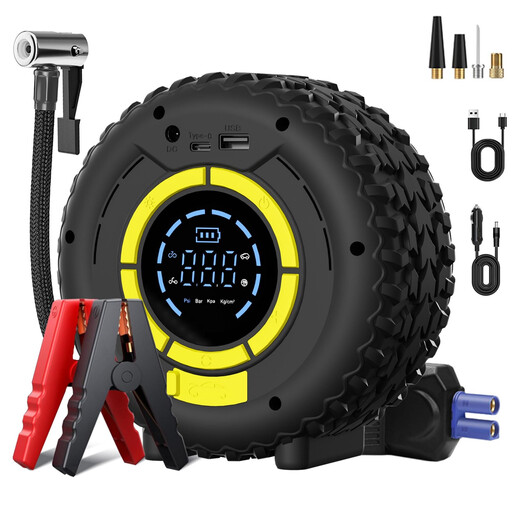
Why we chose it: This is a compact and versatile solution for drivers of city cars, petrol sedans, or small diesels. It offers the essentials (jump-starting, inflation, power bank, light) in a format that's easy to store in the glove box, for everyday peace of mind.
It advertises realistic specs for its size (120W power, 150 PSI compressor) without over-the-top claims. Its LCD screen allows you to monitor the real pressure, avoiding the trap of an imprecise compressor.
4-in-1 versatility (jump starter, compressor, power bank, LED light). Compressor with auto-shutoff and 4 smart modes.

Why we chose it: Ideal for those who want a "set it and forget it" device without worrying about maintenance. The sodium-ion battery technology allows it to hold its charge for years and operate in extreme conditions, making it the perfect candidate to be permanently stored in the boot.
It directly tackles the self-discharge trap. According to the manufacturer, a single charge provides up to 5 years of standby time, unlike lithium batteries that need to be recharged every 2-3 months to be useful when you need them.
Sodium-ion battery technology (very low self-discharge). Extreme operating range (-40°C to 80°C) and high intrinsic safety.
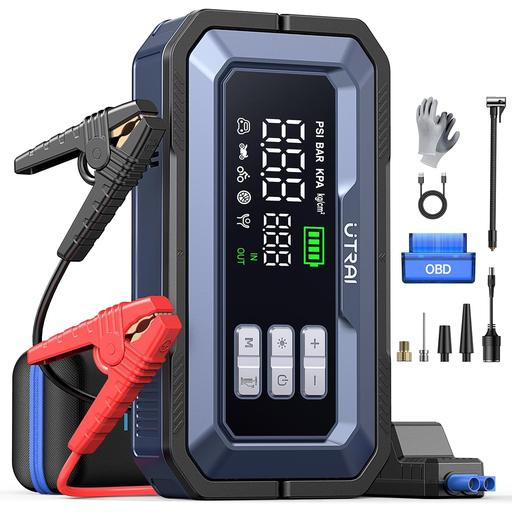
Why we chose it: This device is built for the toughest jobs. Its 7000 A peak power can start diesel engines up to 14L. Additional features like the 160W DC output (cigarette lighter type) and the OBD2 fault code reader make it a true roadside repair toolkit.
It doesn't just boast a high peak number; it backs it up with a 1000 A starting current and robust clamps (8 AWG)—solid, concrete specs for large engines. The V0 flame-retardant casing adds tangible hardware safety.
Very high power for diesel engines up to 14L. Advanced features: 160W DC output, OBD2 fault code reader, 2000-lumen work light.
A jump starter is a must-have, but a complete safety kit is even better. Browse our selection to build the perfect emergency kit for your vehicle.
For a diesel car jump starter, power is the most critical factor. A diesel engine has a higher compression ratio and requires more force to start, especially in cold weather.
This depends entirely on the battery technology and its self-discharge rate.
Caution is advised. Most lithium-battery jump starters are designed to operate within a range of -20°C to 60°C. However, the interior of a car parked in direct sunlight can easily exceed 60°C, which can damage the battery and pose a safety risk. In winter, extreme cold can drastically reduce their effectiveness. Models based on more stable technologies, like sodium-ion, support wider temperature ranges (e.g., -40°C to 80°C), making them much better suited to be "left and forgotten" in a vehicle year-round. Always check the manufacturer's specifications.