
Livraison le jour même ou le lendemain

Qualité garantie

Débloquez vos offres de bienvenue: Livraison GRATUITE | Jusqu'à -80 % | 30 jours d'essai gratuits à JoyPlus
Téléchargez l'application
A dead battery on a cold morning, a flat tire on a road trip… scenarios every driver dreads. Faced with these hassles, the jump starter with compressor presents itself as the ideal all-in-one solution to get back on the road with peace of mind. The only problem: the market is flooded with products making tempting promises that often fall flat. As a Product Specialist at Joybuy, my mission is to help you decipher spec sheets to make a truly informed choice, cutting through the marketing jargon.
Before we get to our selection, let's review the 3 most common pitfalls that can turn a good investment into a useless gadget.
Many manufacturers bombard buyers with impressive numbers: 4000A, 5000A, or even more. The problem? This peak amperage only corresponds to a split-second burst of power. What really matters for starting your engine, especially a diesel in cold weather, is the starting amperage (or cranking amps), a much more stable figure that is often relegated to the bottom of the spec sheet. The result: a device with a huge peak rating but weak starting current will fail to start a mid-size engine.
The 12v tire inflator function is a major selling point, but its quality varies dramatically. A poor-quality compressor can be identified by several signs:
A good portable car air compressor must go the distance to reinflate at least one full tire and guarantee a reliable pressure reading.
What's the point of an emergency jump starter if it's dead when you need it? The quality of the internal lithium battery is therefore crucial. Low-end models suffer from rapid self-discharge and can lose a significant portion of their charge in just a few weeks sitting in your trunk. A quality device, on the other hand, should retain most of its charge for several months.
To avoid these disappointments, focus on the few objective characteristics that define the true performance of a multifunction jump starter.
Forget peak amps. Instead, look for the engine compatibility clearly stated by the manufacturer (e.g., "for up to 8.0L gas and 6.0L diesel engines"). This is the most reliable indicator of the real power of your car jump starter with compressor. For a gas-powered compact car, a model compatible with up to 4.0L or 5.0L is more than sufficient. For an SUV or a diesel utility vehicle, aim for a compatibility of at least 6.0L diesel.
The maximum pressure (often 150 PSI) is a fairly standard figure. It's the airflow, measured in liters per minute (L/min), that makes all the difference. An airflow of 35 L/min or more is a good indicator of rapid inflation. Also, check for an auto-shutoff function at the desired pressure: it prevents over-inflation and greatly simplifies use.
Capacity is often expressed in milliamp-hours (mAh), but this value can be misleading. The capacity in watt-hours (Wh) is a much more universal measure of the total energy actually stored. The higher it is, the more runtime you'll have for multiple jump-starts or for recharging your devices. Finally, ensure the device includes essential protections: spark-proof clamps, reverse polarity protection, and safeguards against overcharging and overheating. This is an indispensable safety guarantee when handling such a powerful car power bank.
Here is a selection of products that meet specific needs, taking into account our performance and reliability criteria.
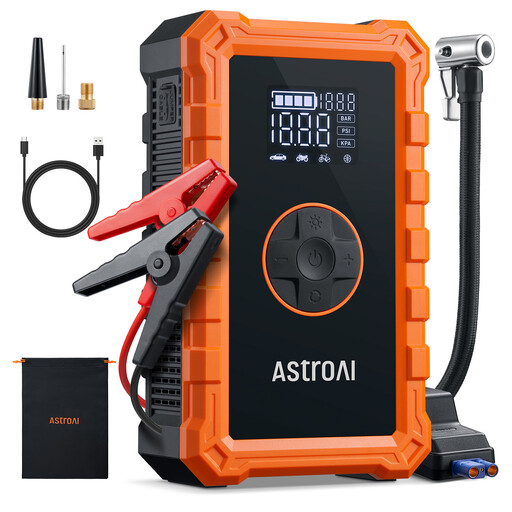
Why we chose it: It's the quintessential balanced and reliable device for city car and sedan drivers. It offers peace of mind without the frills, making it an excellent first purchase to handle the unexpected.
Its stated power (6.0L gas / 3.0L diesel) is realistic and perfectly suited for the vast majority of vehicles, avoiding overblown amperage claims.
Its large 2.4-inch screen clearly displays all information (battery level, pressure), and its automatic compressor shutoff makes it especially simple and safe to use.
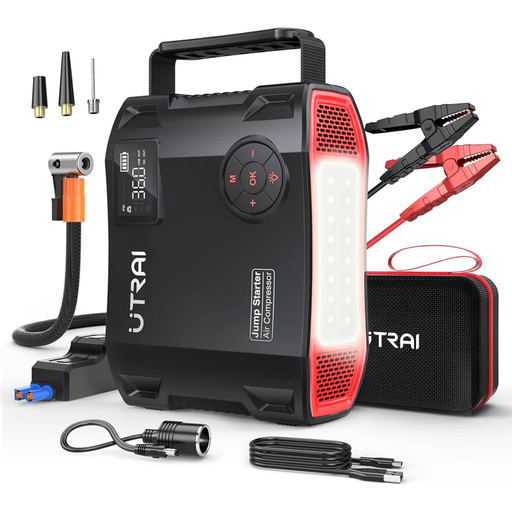
Why we chose it: Built for large engines and heavy-duty use. Its starting power and high-performance compressor make it a reliable workhorse for owners of large SUVs, vans, or RVs.
It tackles the underpowered compressor pitfall with a high airflow of 45 L/min, capable of inflating a tire from 0 to 36 PSI in just 4 minutes (manufacturer's data).
Its compatibility with diesel engines up to 10.0L and its 160W DC output for powering accessories (coolers, vacuums, etc.) make it especially versatile for long journeys and road trips.
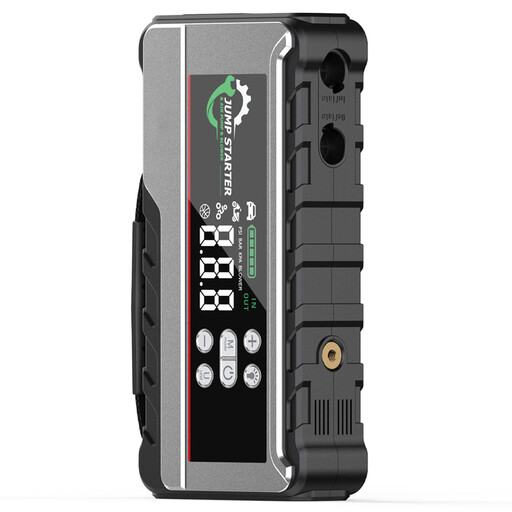
Why we chose it: For those looking for more than just a simple roadside solution. This device is a true mobile power hub, perfect for remote work on the go, camping, or outdoor activities.
It doesn't sacrifice essential functions for its extras. Its starting power remains solid and its 24,800 mAh battery ensures excellent runtime, allowing it to avoid the "gimmicky gadget" trap.
The fast PD 65 W charging via USB-C allows you to recharge a laptop at full speed: a rare and ultra-practical feature that clearly sets it apart from the competition.
We've compiled a complete, up-to-date selection of products that meet our strict selection criteria and safety standards.
Its lifespan primarily depends on the lithium battery, which is typically designed to handle several hundred charge cycles. To maximize its longevity, it's recommended to recharge it every 3 to 6 months, even when not in use. Also, avoid storing it in extreme temperatures (high heat in summer, freezing cold in winter) that could degrade the battery.
No, this is strongly discouraged. Never leave it permanently plugged in or exposed to direct sunlight inside the car. Extreme temperatures can damage the battery and drastically reduce its lifespan. The ideal approach is to keep it charged in its case, stored safely in the trunk or under a seat, and to check its charge level periodically.
Absolutely not. In fact, it's one of the least reliable criteria. As we've discussed, it's primarily a marketing figure. Instead, rely on the engine compatibility (gas/diesel displacement) specified by the manufacturer. This is a much more concrete indicator of the booster's ability to deliver the necessary power to start your vehicle.