
Livraison le jour même ou le lendemain

Qualité garantie

Débloquez vos offres de bienvenue: Livraison GRATUITE | Jusqu'à -80 % | 30 jours d'essai gratuits à JoyPlus
Téléchargez l'application
A dead battery or a flat tyre on the side of the road? It's every driver's nightmare. In the face of this anxiety, the jump starter with compressor emerges as the all-in-one miracle solution. The problem? The market is flooded with products making flashy marketing promises that often fall flat.
As a product expert for the Joybuy editorial team, my mission is to help you navigate this jungle and avoid the most common pitfalls. Here are the essential points to check before investing in this accessory, which is indispensable for your peace of mind.
To ensure you're buying a reliable tool, don't be fooled by the marketing—focus on the real technical specifications. This is where the true indicators of performance and safety for your future automotive survival kit are hidden.
Forget peak amperage. The number that matters is the starting amperage (often much less visible on the packaging). Above all, check the manufacturer's recommended compatibility in terms of engine displacement (in litres) and engine type (petrol or diesel). A standard 12v battery booster will suffice for a small city car, but a diesel SUV or van will require a whole different level of power. The quality of the clamps and cables is also crucial for ensuring the current flows efficiently and safely.
A 150 PSI portable air compressor is now standard on good models. This pressure is sufficient for most car tyres. But as always, the devil is in the details:
A good portable car starter must include an array of protections. Check for safety features against reverse polarity, short circuits, overcharging, and overheating. These are essential for protecting your car's electronics as well as the booster itself. Finally, a readable LCD screen, a multi-mode torch (steady, strobe, SOS), and USB ports for charging your devices transform this simple emergency tool into a true Swiss Army knife for the modern driver.
To help you see how these criteria apply in practice, here are a few recommended options, each suited to a specific need.
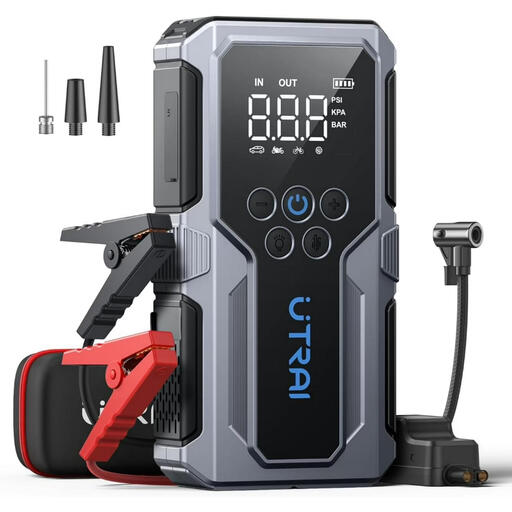
Why we chose it: This is the perfect model for drivers of family cars, saloons, and SUVs who want a reliable tool for daily commutes and holiday trips alike. It represents an excellent balance between power and features.
It doesn't sacrifice any function for the sake of versatility. Its 3000A power is calibrated for a wide range of engines (up to 8.5L petrol / 6.5L diesel), and its 150 PSI compressor, with its LCD screen and automatic shut-off, really gets the job done.
Its 2-inch LCD screen clearly displays tyre pressure and battery level. The fast-charging USB and USB-C ports also make it a particularly effective external battery.

Why we chose it: Designed for owners of large SUVs, pickup trucks, motorhomes, or powerful diesel engines who can't afford to take chances and for whom starting power is non-negotiable.
It settles the amperage debate by delivering a peak power of 4500A, enough to crank over petrol engines up to 9.0L and diesel engines up to 8.0L. This is raw, real, and effective power.
Its starting power is backed by a robust design, a wide operating temperature range (-20°C to 60°C), and 10 levels of intelligent protection. Rock-solid reliability.
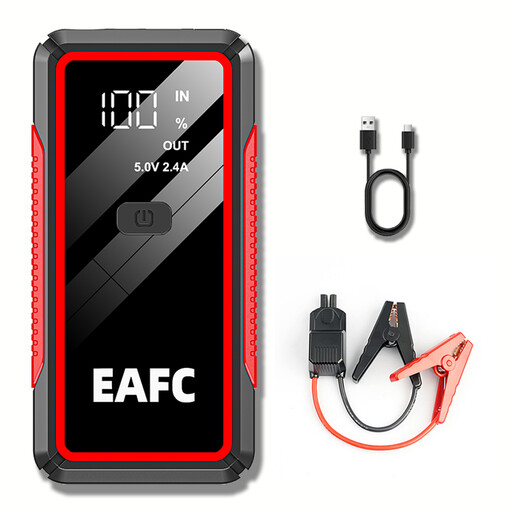
Why we chose it: The perfect ally for drivers of city or compact cars who are primarily looking for a go-anywhere format and have no need for a compressor. It gets straight to the point: a reliable starter and a backup battery.
By focusing on its primary mission, it avoids the disappointing 'jack-of-all-trades' syndrome. It delivers excellent starting performance (2000A) for its size, without the bulk of a compressor.
Its ultra-compact size (18 x 8.7 cm) allows it to be tucked away in the glove box. Its 10,000 mAh battery remains a very comfortable power reserve for recharging a smartphone in a pinch.
In the darkness of a breakdown, good lighting makes all the difference. Complete your kit with our selection of high-performance torches, hand-picked for their reliability.
Its longevity mainly depends on the quality of its lithium-ion battery and its maintenance. A good model can handle several hundred charge cycles. To keep it in top shape, remember to recharge it every 3 to 6 months, even when not in use, and store it away from extreme temperatures.
It all depends on the engine displacement. Diesel engines require much higher starting torque than petrol engines. A 2000A booster can do the job for a small diesel engine (up to about 4.0L, like the one in the EAFC model). For larger engines, it's wiser to aim for 3000A models and above, such as the UTRAI or BuTure options. In any case, always trust the manufacturer's recommendations.
Yes, most good models are designed for it. Take a look at the operating temperature range specified by the manufacturer. The BuTure and UTRAI models, for example, can withstand -20°C to +60°C, which covers almost all situations. However, you should still avoid leaving it baking in the sun behind the windscreen, as extreme heat will eventually degrade the batteries.