
Livraison le jour même ou le lendemain

Qualité garantie

Débloquez vos offres de bienvenue: Livraison GRATUITE | Jusqu'à -80 % | 30 jours d'essai gratuits à JoyPlus
Téléchargez l'application
A dead battery or a flat tyre? It's every driver's worst nightmare. When faced with these unexpected issues, a jump starter with compressor is the ultimate multi-tool. The problem? The market is flooded with models making tempting promises that often don't hold up. As a product expert at Joybuy, my mission is to help you decode the spec sheets to find the model that's truly right for you, without falling for marketing hype.
Buying emergency equipment isn't a decision to be taken lightly. Some selling points hide weaknesses that can render the device completely useless when you need it most. Here are the critical red flags.
To make the right choice, focus on the features that truly matter: those that guarantee the performance and reliability of your future car emergency kit.
Its number one job is to restart your vehicle. Instead of being blinded by peak amps, look at the manufacturer's stated compatibility with engine sizes:
A good portable car air compressor must combine efficiency with ease of use.
The battery capacity, expressed in milliampere-hours (mAh), determines the device's endurance. A good capacity (over 15,000?mAh) ensures you can perform multiple jump-starts or inflate several tyres on a single charge. This is also what makes the power bank function so useful, perfect for recharging a smartphone or tablet in an emergency.
There's a solution for every driver. Here is our selection of reliable models, each tailored to a specific user profile, that successfully avoid the pitfalls mentioned above.
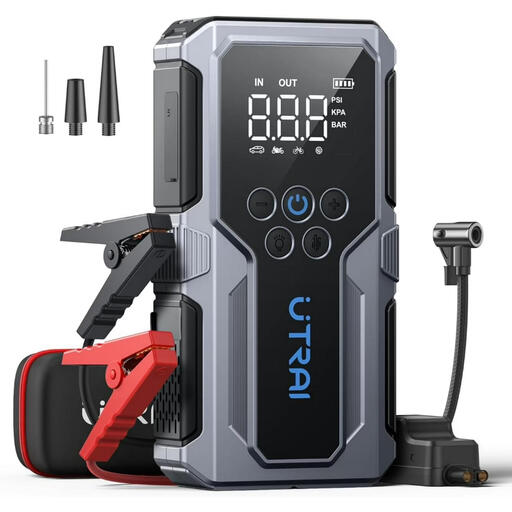
Why we chose it: Perfect for drivers of city cars, saloons, or small SUVs. It's the reliable, all-round device for daily commutes and weekend getaways. Its key strength: an excellent balance of power, features, and a compact form factor.
Its LCD screen, which displays live pressure, and its preset function tackle the problem of inaccurate gauges. With 15,000 mAh, it offers comfortable battery life and low self-discharge.
A true 5-in-1 multi-tool (jump starter, compressor, power bank, LED light, multiple safety features) in a format that slips easily into the boot.

Why we chose it: Built for owners of SUVs, commercial vans, or cars with large diesel engines (up to 8.0L). Its starting firepower makes it a heavy-duty ally for power-hungry vehicles and long-distance travellers.
It doesn't fall for the "peak amps" marketing trap. Its clearly stated compatibility with large engines is a guarantee of real, massive starting power.
Colossal starting power (4500 A) and an efficient cooling system ensure its reliability, even under repeated use.

Why we chose it: For those who put safety and peace of mind above all else. Thanks to its innovative battery technology, it can be left in the car all year round without worry.
It tackles the Achilles' heel of its competitors: self-discharge. The manufacturer claims a standby time of up to 5 years, ensuring it will be ready to go the day you truly need it.
Its sodium-ion battery technology is not only stable in extreme temperatures (-40°C to 80°C) but also offers far superior fire safety compared to conventional lithium batteries.
Discover our full selection of products that meet our demanding selection criteria and current safety standards.
It all depends on your engine size. For a petrol-powered city car or saloon, a jump starter compatible with engines up to 6.0L is more than enough. For an SUV, a commercial van, or a diesel engine, aim higher: a model compatible with 3.0L to 8.0L diesel engines will give you a comfortable safety margin, especially in cold weather.
Most lithium-battery models suffer from self-discharge and need recharging every 3 to 6 months to remain operational. Newer technologies, like sodium-ion, are a game-changer: their self-discharge rate is so low that they can hold a charge for several years, according to manufacturer data.
This is a critical point. Conventional lithium batteries do not handle extreme temperatures well (typically -20°C to 60°C). Leaving them in a car in the height of summer or in freezing cold can damage them irreversibly. Always check the manufacturer's recommended temperature range. For complete peace of mind, sodium-ion models, designed to withstand extreme conditions, are the best option for permanent storage in your vehicle.