
Livraison le jour même ou le lendemain

Qualité garantie

Débloquez vos offres de bienvenue: Livraison GRATUITE | Jusqu'à -80 % | 30 jours d'essai gratuits à JoyPlus
Téléchargez l'application
A dead battery first thing in the morning, a flat tire on your way to a vacation... situations every driver dreads. The jump starter with an air compressor presents itself as the silver bullet, the promise of restored peace of mind. But here's the catch: the market is flooded with models boasting flattering spec sheets that often hide major disappointments in practice.
To help you see things more clearly, we've identified the three most common pitfalls to avoid before you buy.
To choose an effective portable car jump starter, you need to look beyond the peak amps advertised on the box. The crucial information is its compatibility with the displacement (in litres) and engine type (gas or diesel) of your vehicle.
A diesel engine requires significantly more power to start than a gas engine of the same size, due to its higher compression ratio.
Always check the manufacturer's spec sheet, which clearly indicates the maximum supported engine sizes (e.g., "up to 6.0L Gas / 3.0L Diesel").
A multifunction jump starter is more than just a starter; it's also a power bank and an inflator. The performance of these secondary functions is just as important as its jump-starting capability.
Capacity, expressed in milliamp-hours (mAh), determines the number of jump-starts possible on a single charge, or how many times you can recharge your smartphone. But it's the battery technology, above all, that will affect its long-term reliability.
Don't just rely on the maximum pressure (PSI or bars). The essential criterion is the airflow rate, measured in litres per minute (L/min). The higher it is, the faster the inflation.
Rather than looking for a one-size-fits-all model, it's better to choose a device tailored to your vehicle and your needs.
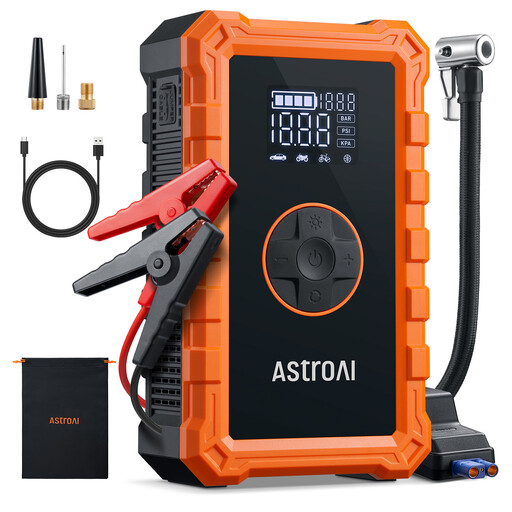
Why we recommend it: This is the ultimate balanced, all-in-one tool, perfect for drivers of city cars, gas sedans, or small diesel vehicles. Compact and easy to use, it's a reliable road companion for daily commutes and unexpected events alike.
Its compressor delivers an airflow of 25 L/min, which is perfectly adequate for standard car tires, allowing it to avoid the "anemic compressor" trap. Its 1500 A power is calibrated for engines up to 6.0L gas and 3.0L diesel: a realistic and fulfilled promise.
Its large 2.4-inch screen for comfortable reading. Its all-in-one design integrates accessory storage, so you'll never lose them again.
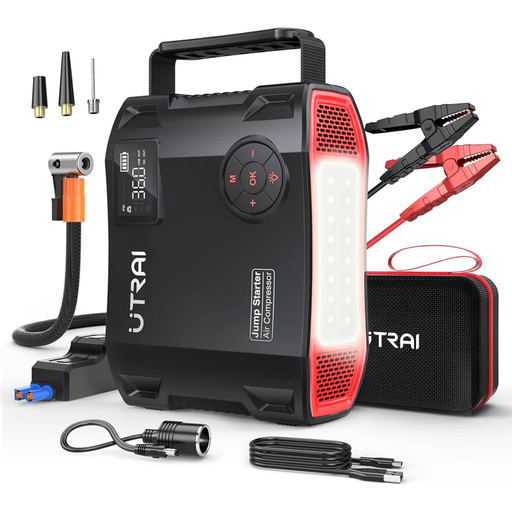
Why we recommend it: Built for extreme situations. With its colossal power, it's aimed at owners of SUVs, RVs, or large diesel vehicles who can't afford failure and demand uncompromising starting power.
It shatters the "peak amps mirage" by delivering a real 6000 A of power, enough to start any gas engine and diesel engines up to 10.0L. Its high-flow compressor (45 L/min) is also up to the task for large tires.
Its 27,000 mAh battery and 160W DC output to power other 12V devices (cooler, vacuum, etc.). Its ultra-powerful 1600-lumen LED light.

Why we recommend it: This is the jump starter for "forgetful" drivers, the one you can leave in your trunk for months on end. Its sodium-ion battery technology not only makes it ultra-reliable for the long term but also safer in extreme temperatures, summer or winter.
It directly tackles the "fatal self-discharge" pitfall. According to the brand, its self-discharge rate is only 1% per month, compared to 5-10% for lithium. A single charge is enough to keep it operational for years.
Its sodium-ion battery technology, a guarantee of very low self-discharge and enhanced safety. Its extreme operating temperature range (-40°C to 80°C / -40°F to 176°F), ideal for leaving it in the car year-round.
Discover our full selection of products that meet our selection criteria and European safety standards.
It all depends on the engine size. For a diesel engine over 2.0 litres, it's advisable to choose a jump starter with at least 2000?A of peak current. Always refer to the manufacturer's recommendations, which specify compatibility in litres (e.g., "for diesel engines up to 8.0L"). When in doubt, it's better to have more power and not need it: opt for a more powerful model.
A standard lithium-ion model should be recharged every 3 to 6 months to remain reliable. Newer models, especially those with sodium-ion batteries, benefit from a much lower self-discharge rate, allowing them to stay operational for over a year without a recharge.
It depends on its battery technology. Most lithium-ion jump starters can handle a temperature range of -20°C to 60°C (-4°F to 140°F). Leaving them in a car during a heatwave or a deep freeze could degrade their performance and lifespan. Conversely, devices with sodium-ion batteries are designed for extreme temperatures (from -40°C to 80°C / -40°F to 176°F), making them much better suited for permanent storage in a vehicle. In any case, consult the technical specifications.