
Livraison le jour même ou le lendemain

Qualité garantie

Débloquez vos offres de bienvenue: Livraison GRATUITE | Jusqu'à -80 % | 30 jours d'essai gratuits à JoyPlus
Téléchargez l'application
A dead battery first thing in the morning, a flat tyre far from any service station: classic breakdowns that are every driver's nightmare. A jump starter with a built-in compressor is the ideal all-in-one solution to regain peace of mind on the road. The problem is, the market is flooded with products making tempting promises that often hide deal-breaking flaws.
As a product selection expert for our editorial team, my mission is to help you decode the spec sheets to make the right choice. Here are the most common pitfalls and the criteria to check before you buy.
Too many devices disappoint their users at the first opportunity, due to design flaws or inflated specs. Keep an eye out for these three points.
To ensure you don't make a mistake, here are the three features to examine closely.
This is the heart of the machine, the most critical component. Compared to conventional lithium-ion batteries, a new technology is a game-changer: the sodium-ion battery starter.
Don't be blinded by peak current. Check the device's compatibility with your engine type. A good jump starter compatible with both diesel and petrol engines must provide sufficient starting current for both, keeping in mind that diesel engines are much more demanding. A reputable device will always specify the maximum engine displacement it can handle (e.g., up to 8.0L petrol / 6.0L diesel).
The effectiveness of a portable tyre inflator isn't just measured in PSI.
Here are a few models that meet different needs, based on the performance and safety criteria we've just discussed.

Why it's a great choice: Ideal for the driver seeking absolute peace of mind. Its philosophy: a device you can forget in your car all year round, from winter frosts to summer heatwaves, confident that it will be ready when you need it most, even after months of inactivity.
Its sodium-ion battery shatters the limitations of lithium: no safety risks and virtually zero self-discharge. The manufacturer claims up to 5 years of standby on a single charge. Goodbye, maintenance chores!
Exceptional Thermal Stability: operates from -40°C to 80°C. Record-Breaking Lifespan: up to 6,000 charge cycles claimed.
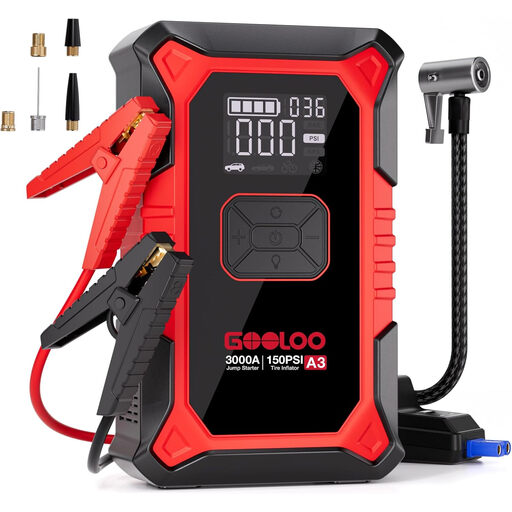
Why it's a great choice: Perfect for the owner of multiple vehicles (SUV, van, motorcycle) or for someone who needs to start a stubborn, large diesel engine. They're looking for a heavy-duty, robust, and high-performance tool for frequent use.
It counters the power and compressor pitfalls by clearly stating its compatibility with large engines (up to 9.0L petrol / 6.5L diesel) and featuring a compressor with a generous 35 L/min airflow rate.
Serious Cranking Power: the 3,000 A peak current and "BOOST" function tackle even the most difficult starts. Fast Compressor: the 35 L/min airflow rate ensures efficient inflation, even for large tyres.
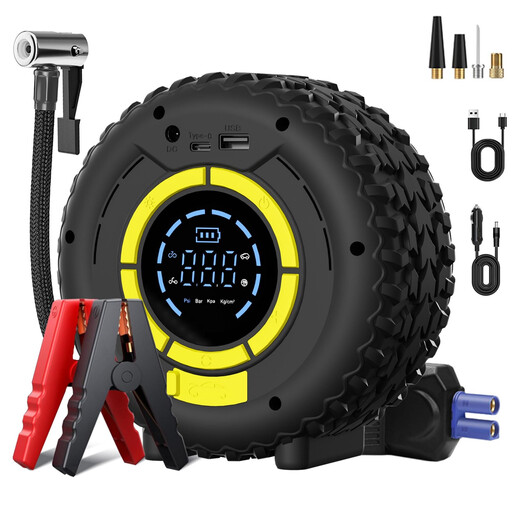
Why it's a great choice: For the driver of a city car or compact sedan. They're looking for a simple, compact, and versatile emergency solution (jump starter, compressor, and even a car power bank) for occasional mishaps, without the bulk of an oversized model.
It offers a very cohesive feature set in a mini format, saving you from juggling multiple devices. Its LCD screen makes monitoring pressure and battery life very intuitive.
Compact and Lightweight: at 600g, it slips easily into the glove box. 4-in-1 Versatility: it combines jump-starting, inflation, power bank, and LED light functions.
We have selected a full range of products for you that meet our performance criteria and European safety standards.
The lifespan primarily depends on the battery technology and the number of charge/discharge cycles it can withstand. Standard lithium-ion models generally last for 400 to 800 cycles. Newer models, such as those based on sodium-ion, can reach several thousand cycles, offering a much longer lifespan. Maintenance (like avoiding prolonged deep discharges for lithium) also plays a crucial role.
This is a critical safety question. It is strongly advised not to leave a standard lithium-ion battery jump starter in a vehicle exposed to extreme temperatures (above 60°C or below -20°C) due to the risks of accelerated degradation and safety hazards. Devices designed with more stable batteries, like sodium-ion, are specifically built to withstand a wide temperature range (e.g., from -40°C to 80°C), making them much safer for permanent storage in a vehicle.
The 1,500 A figure most likely refers to the "peak current". For a diesel engine, which requires more power to start than a petrol engine of the same displacement, it is more important to look at the starting current (if listed) or the manufacturer's recommendation for maximum diesel engine size (e.g., "up to 6.0L diesel"). When in doubt, always opt for a more powerful model to ensure an effective start, especially in cold weather.