
Livraison le jour même ou le lendemain

Qualité garantie

Débloquez vos offres de bienvenue: Livraison GRATUITE | Jusqu'à -80 % | 30 jours d'essai gratuits à JoyPlus
Téléchargez l'application
A silent winter morning. Your car won't start. Or worse, your tyre pressure light flashes on mid-journey. For these headaches, all too familiar to drivers, the jump starter with a compressor emerges as the ultimate lifesaver. This true Swiss Army knife for drivers promises autonomy and peace of mind. The problem? The market is flooded with products making tempting promises that often don't deliver.
As Head of Product Curation at Joybuy, my role is to guide you through this jungle of options. Together, we'll break down the 3 common pitfalls that lead to instant buyer's remorse and identify the technical specs that truly matter for making the right choice.
The idea of a single device to handle both dead batteries and flat tyres is appealing. But be warned, certain features, often overrated or misunderstood, can let you down when you need them most.
To avoid these traps, focus on the technical specifications that truly guarantee the effectiveness and reliability of your jump starter.
Forget peak current. The crucial information is the advertised compatibility with your engine's displacement (in litres), distinguishing between gas and diesel. A diesel engine, especially when cold, requires a significantly higher starting current.
A compressor worthy of the name must meet specific criteria.
The usefulness of the 12V power bank function depends directly on the quality of the internal battery.
Here are some options that meet these criteria, tailored for different user profiles.
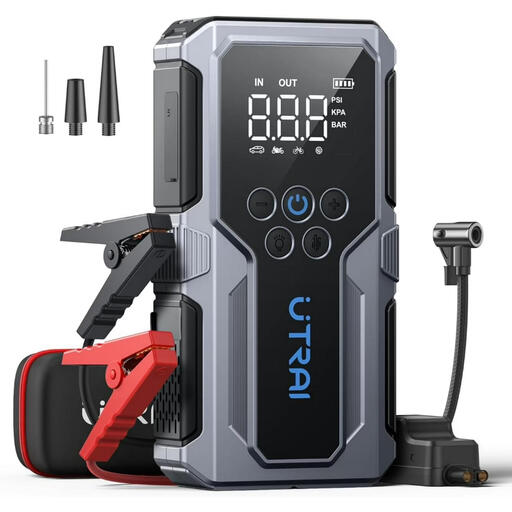
Why it's a great choice: Perfect for the driver seeking a reliable all-in-one tool, whether for daily commutes, holiday trips, or outdoor activities. It covers all unexpected situations for complete peace of mind behind the wheel.
It bypasses the peak current trap by specifying its compatibility with large engines (8.5L gas, 6.5L diesel). Its 150 PSI compressor with an LCD screen and auto-stop is a real tool, not a gimmick.
A true 5-in-1 solution: powerful jump starter, efficient compressor, 15,000 mAh power bank with fast charging, 3-mode LED light, and 10 built-in safety protections.
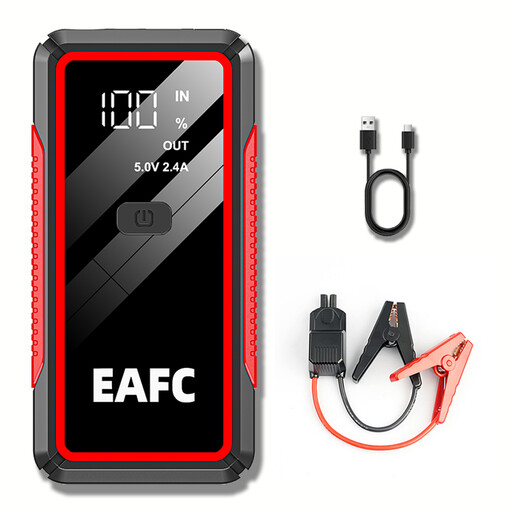
Why it's a great choice: Perfect for the user who prioritises starting power in a compact form factor. It fits in the glove box and focuses on one mission: getting you started, fast.
This model doesn't include a compressor, thus avoiding the risk of a low-quality feature. It focuses on its strength: high starting power (compatible with 6.0L gas / 4.0L diesel) in a compact package.
Very compact and lightweight, ideal for smaller vehicles or motorcycles. High starting power for its size and smart safety clamps.
We have curated a complete selection of products that meet our demanding specifications for performance and safety.
For a diesel engine, the starting current is even more critical than for a gas engine, especially in cold weather. Don't rely solely on peak current. Look for a jump starter that clearly states its compatibility with your diesel engine's displacement (e.g., "up to 4.0L diesel"). As a general rule, a starting current of at least 600 A to 800 A is a solid baseline for most modern diesel passenger cars.
A quality jump starter can hold its charge for 3 to 6 months without use. However, it's highly recommended to check its charge level and top it up every 3 months to ensure it's ready when you need it. The spec sheet sometimes mentions the number of starts possible on a single charge (e.g., up to 40), which is a good indicator of its battery's endurance.
No, this is not recommended. You should neither leave it constantly charging in the vehicle nor expose it to extreme temperatures (in direct sun in summer, or freezing conditions in winter), which could irreversibly damage its lithium battery. The best practice is to fully charge it at home, then store it in its case, safely in the glove box or trunk.