
Livraison le jour même ou le lendemain

Qualité garantie

Débloquez vos offres de bienvenue: Livraison GRATUITE | Jusqu'à -80 % | 30 jours d'essai gratuits à JoyPlus
Téléchargez l'application
A dead battery first thing in the morning, a flat tyre on a road trip… these are the classic nightmares every driver dreads. Instead of cluttering your trunk with multiple pieces of equipment, the jump starter with a built-in compressor is the ideal all-in-one solution. This versatile device combines a portable car starter and a cordless tyre inflator to get you back on the road with peace of mind.
Our editorial team's mission is to help you make sense of it all. This guide breaks down the essential criteria and practical features to help you choose a reliable device that's perfectly suited to your needs.
Before diving into our selection, let's review the key points to check to ensure you make the right choice.
This is the most critical factor. The starting power, expressed in amps (A), is the number one criterion. It is defined by two values:
For a gasoline compact car, a jump starter with 600 A to 1500 A of peak current is generally sufficient. However, for an SUV, a van, or a more power-hungry diesel vehicle, you'll need to aim for a diesel jump starter with at least 2000 A of peak current. A well-sized car starter kit ensures your engine starts in an instant, even in extreme cold.
Don't overlook the compressor. Check the maximum pressure, expressed in PSI (Pounds per Square Inch) or Bars. A capacity of 150 PSI is a benchmark figure that allows you to easily inflate the tyres of cars, motorcycles, and bicycles, as well as sports balls or air mattresses.
Also, take a look at the air flow rate (often in L/min): the higher it is, the shorter the inflation time. Models with an automatic shut-off at the desired pressure and a digital display offer a real bonus for convenience.
A good multifunction jump starter does more than just start and inflate. Its internal battery technology has a direct impact on its safety and lifespan. Some recent models feature sodium-ion batteries, known for their excellent stability in extreme temperatures and their longevity.
Also, consider the little extras that make all the difference:
Here are three models that caught our attention for their technical specifications and versatility.
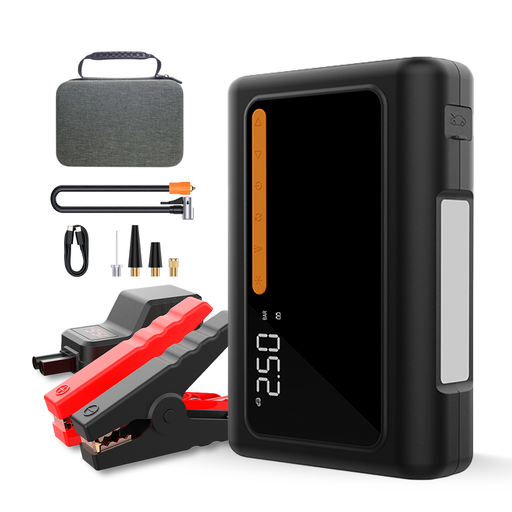
Why it stands out: Its main advantage lies in its sodium-ion battery technology. Unlike conventional lithium batteries, this one ensures an extreme operating range (-40°C to 80°C) and enhanced safety. In case of overheating, it does not release oxygen, which virtually eliminates any fire risk.
Advantages:
Who is it for? For drivers who prioritise long-term safety and reliability. Its resistance to extreme temperatures makes it a wise choice for those who plan to keep the device in their vehicle permanently, summer or winter.
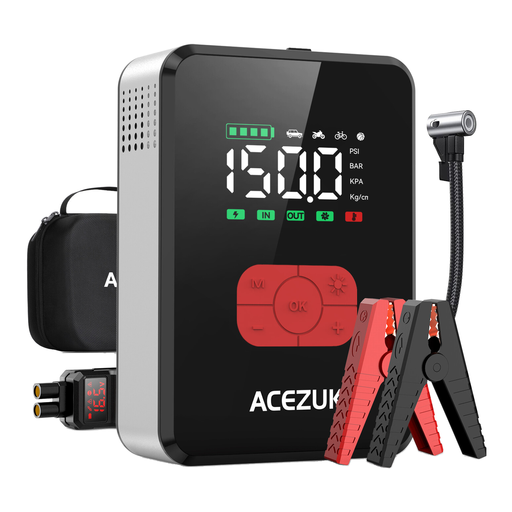
Why it stands out: Its herculean starting power of 7000 A peak current. This device is built to handle any vehicle, including the largest diesel engines (up to 12 L).
Advantages:
Who is it for? The go-to choice for owners of large vehicles: trucks, motorhomes, vans, large SUVs, and commercial vehicles. It is also a top pick for professionals looking for an ultra-powerful and foolproof emergency tool.
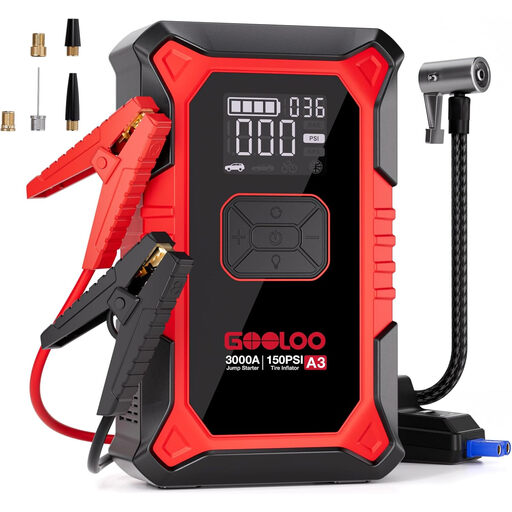
Why it stands out: It represents the ideal balance of power, features, and simplicity, all in a compact design. Its compressor is particularly fast.
Advantages:
Who is it for? For the everyday driver looking for a versatile, high-performance, and easy-to-use device. Its fast compressor and numerous inflation modes make it an ideal road trip companion, for both the car and leisure activities.
Our selection highlights three devices that cater to very specific needs. Want to explore other avenues or compare more models? Feel free to browse our complete category. There you will discover a wide range of solutions to ensure you are never caught unprepared again.
? Discover our full range of portable jump starters and power stations
1. How do I safely use a jump starter with an air compressor? The golden rule: always read the user manual. In short, here is the standard procedure: make sure the jump starter is sufficiently charged (over 50%). Connect the red clamp to the positive (+) terminal of the battery, then the black clamp to an unpainted metal part of the chassis (the ground), away from the battery. Try to start the car. Once the engine is running, remove the clamps in the reverse order (black first, then red).
2. What power (amps) do I need for my diesel vehicle? Diesel engines, with their higher compression ratio, require more energy to start. For a 2.0 L diesel, a jump starter with 1500 A to 2000 A of peak current is a comfortable baseline. For larger engines (3.0 L and up, or on commercial vehicles), aim for at least 2500 A to 3000 A for peace of mind. The ACEZUK M06, with its 7000 A, is built for the most extreme cases.
3. Can I leave the jump starter in my car during summer or winter? It all depends on its internal battery technology. Conventional lithium-ion models do not handle extreme temperatures well (below 0°C and above 45°C), which degrades their performance and lifespan. Newer models, like the GOKKCL GK01 with its sodium-ion battery, are specifically designed to withstand a wide temperature range (-40°C to 80°C), making them perfect candidates to be kept in your car permanently, whatever the season.