
Livraison le jour même ou le lendemain

Qualité garantie

Débloquez vos offres de bienvenue: Livraison GRATUITE | Jusqu'à -80 % | 30 jours d'essai gratuits à JoyPlus
Téléchargez l'application
A dead battery. It's every driver's nightmare, especially when it happens at the worst possible moment: on a freezing morning, at a deserted rest stop, or just before a crucial appointment. Fortunately, there's a solution that means you no longer have to rely on a good Samaritan or a tow truck. The jump starter with air compressor is the all-in-one device that guarantees your peace of mind.
This guide is here to help you make sense of it all and choose the portable car starter that truly fits your needs. We'll break down the essential features and present our top picks, cutting through the often-opaque marketing jargon.
Before you take the plunge, let's review the criteria that make all the difference. Here are the key points to check to ensure you make the right choice.
Power, measured in Amps (A), is the most critical factor. A high peak current is essential for jump-starting large-displacement engines, especially diesel ones.
Always check for compatibility with your engine's displacement (e.g., up to 8L for petrol/diesel), information that is often specified by the manufacturers.
Most modern jump starters use lithium batteries. However, a new technology is setting itself apart: the sodium-ion battery jump starter. This is a game-changing innovation, especially for a device that will be kept in a car.
The advantage of a multi-function model lies in its versatility.
We have selected three models with diverse profiles to meet different needs.
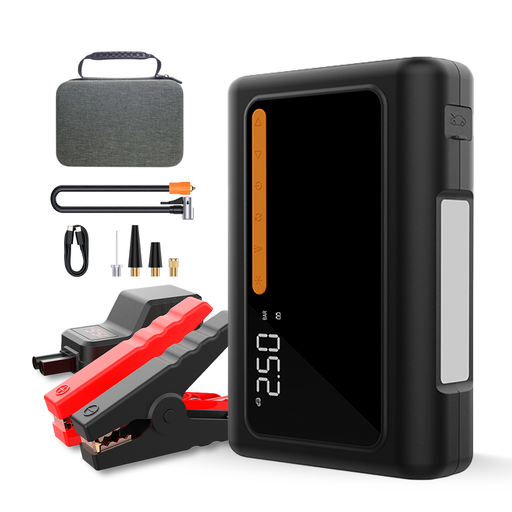
Why It Stands Out This model perfectly embodies the new generation of jump starters with air compressors. It combines 1500A of starting power with the safe technology of a sodium-ion battery. Designed to tackle the harshest conditions, it's the ideal solution for a dead battery, whatever the weather.
Advantages:
Who is it for? For proactive drivers, SUV owners, and camper or van owners who want a single solution to handle both a dead battery and a flat tyre, in any season.
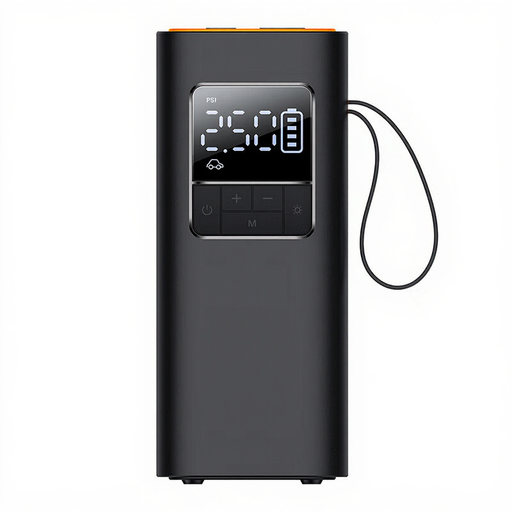
Baseus SuperMini Pro Series Wireless Car Inflator Cluster Black
Why It Stands Out If your only concern is tyre pressure and you already own a jump starter, this wireless portable air compressor is an excellent alternative. Compact and easy to store, it focuses on one job and does it well.
Advantages:
Who is it for? For drivers who want a dedicated, portable, and reliable tool for regular tyre pressure maintenance, as well as for bicycles or sports equipment.
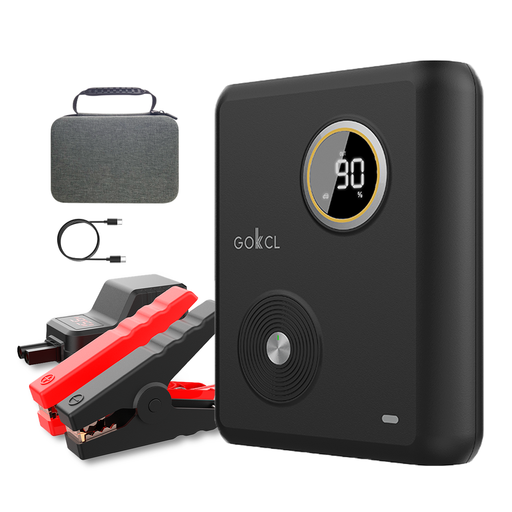
GOKKCL GK03 Sodium Ion Car Jump Starter 27500mAh, PD60W Fast Charge Power Bank
Why It Stands Out This model shares the sodium-ion technology benefits of the GK01 but focuses on its primary function: being a high-capacity portable car starter and power bank. With its 27500mAh, it offers a substantial power reserve for multiple jump-starts or for powering your electronic devices on the go.
Advantages:
Who is it for? For users who prioritise maximum battery life and uncompromising starting power, and who don't need an integrated air compressor. Ideal for long trips, camping, or as a backup power source.
Our selection is just a starting point. If you have different needs, many other models are available.
? Discover our complete collection of charging and jump starter kits
1. What power level should I choose for a jump starter? The required power depends on your vehicle. For a small or medium-sized petrol car, a peak current of 800A to 1200A is sufficient. For an SUV, van, or diesel engine, it is recommended to choose a model with at least 1500A. Always refer to the manufacturer's specifications for compatibility with your engine's displacement (L).
2. Is a sodium-ion jump starter really safer? Safety is indeed one of the main selling points of sodium-ion technology. According to technical data from manufacturers, its specific chemistry does not release oxygen during high heat, which prevents thermal runaway and the resulting fire risk that can occur with some lithium batteries. This is a major advantage for a device stored in a car cabin, which is subject to extreme temperature fluctuations.
3. Can I leave a jump starter in my car during summer or winter? It all depends on the battery technology. Conventional lithium jump starters have a more limited operating range, and it's often advised not to leave them in a vehicle in direct sunlight or extreme cold. Sodium-ion models, with their very wide operating range (typically from -40°C to 80°C), are specifically designed for this purpose. They can be kept in the car all year round without affecting their performance or safety.