
Livraison le jour même ou le lendemain

Qualité garantie

Débloquez vos offres de bienvenue: Livraison GRATUITE | Jusqu'à -80 % | 30 jours d'essai gratuits à JoyPlus
Téléchargez l'application
A dead battery on a cold morning or a flat tire far from any service station: situations every driver dreads. The jump starter with air compressor stands out as the all-in-one solution to avoid these headaches. But be warned, the market is flooded with marketing promises that often hide disappointing products. As a product expert at Joybuy, my mission is to help you navigate this jungle and decode the spec sheets to make the right choice.
Before you buy, watch out for these 3 common pitfalls that can render a device nearly useless:
jump starter power bank you thought could recharge your laptop multiple times barely manages to complete a single charge for your smartphone.To make the right choice, focus on the technical specifications that truly matter. Here are the 3 points you must check before any purchase.
Amperage is the most critical factor for an emergency car jump starter. You need to distinguish between two values:
In practice, rely on the manufacturer's recommendations regarding engine displacement. A diesel jump starter always requires more power than a model for a small gasoline engine.
The maximum pressure, often listed as 150 PSI, is a market standard. It's sufficient for all passenger vehicle tires. What really makes a difference is the air flow rate, measured in liters per minute (L/min).
Rather than mAh, the capacity in Watt-hours (Wh) is a more reliable indicator of the total stored energy. It's calculated by multiplying the capacity (in Ah) by the voltage (in V). A higher Wh capacity means more possible jump starts or more recharges for your devices.
Also, check for the extra features that turn a simple jump starter into a true Swiss Army knife for drivers:
Instead of an endless list, we've selected products tailored to specific profiles, ensuring they avoid the classic pitfalls.
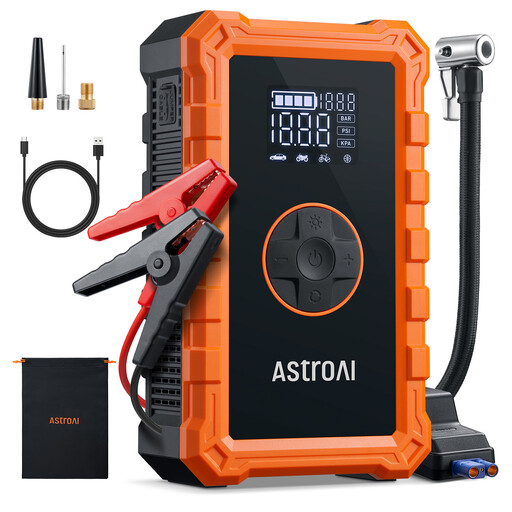
Why we chose it: Ideal for drivers of city cars, gasoline sedans, or small diesel vehicles. Its compact size and large, intuitive screen make it very easy to use, even for a novice. It offers an excellent balance of performance and practicality for total peace of mind.
It doesn't promise outrageous power. Its 1500A is calibrated for common vehicles (up to 6.0L gas / 3.0L diesel), avoiding the trap of unnecessary and costly oversizing.
Its large 2.4-inch screen clearly displays real-time pressure and device status, which greatly simplifies the inflation and jump-starting process.
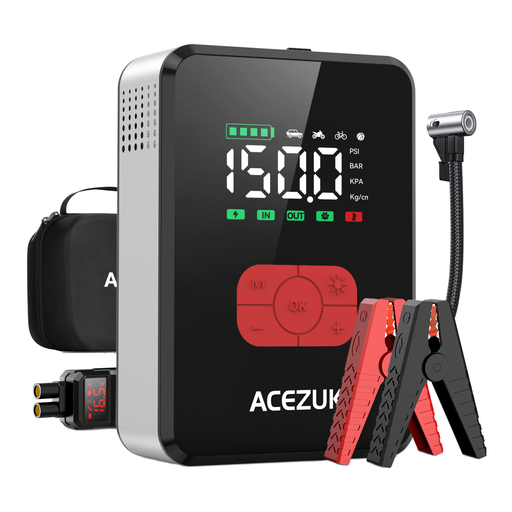
Why we chose it: Designed for large engines, including diesels up to 12L. Its high starting power and robust construction make it a trusted ally for owners of SUVs, vans, RVs, or older vehicles.
It doesn't just display a high number. Its advertised compatibility with diesel engines up to 12L is a clear indication of its ability to deliver sustained cranking current, avoiding the pitfall of an underpowered device for a large vehicle.
The smart jumper clamps feature their own screen and audible alerts, providing real-time feedback on the connection. This is an extra layer of safety during use.
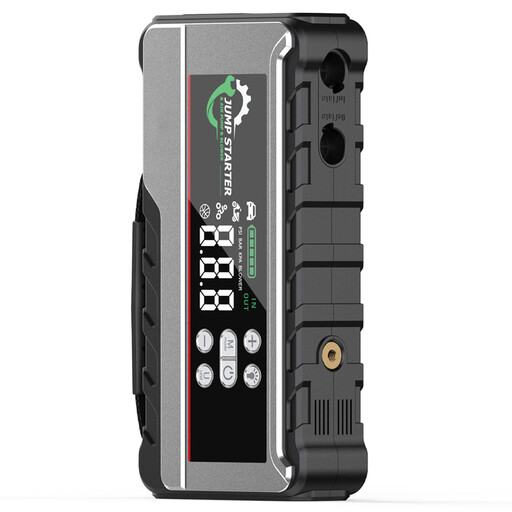
Why we chose it: For those who work on the road or never travel without their laptop, tablet, and smartphone. This model stands out for its ability to function as a true high-performance mobile charging station.
It bypasses the "fake power bank" trap by integrating PD65W fast-charging technology via its USB-C port. This is powerful enough to efficiently charge most modern laptops, a rare feature on this type of device.
The 65W two-way fast charging not only powers your devices but also recharges the jump starter itself in record time (about 1.2 hours, according to the manufacturer), making it ready to go again quickly.
We have selected other products for you that meet our quality criteria and current safety standards.
The required power depends on your engine. For a standard gasoline car (up to 5.0L), 1500A to 2000A is sufficient. For a large gasoline engine or a diesel engine (up to 8.0L), look for a model with 3000A or more. Always check the compatibility specified by the manufacturer.
It is strongly advised not to leave it permanently in your car. Extreme temperatures inside the cabin (heatwaves in summer, freezing in winter) can damage its internal battery and reduce its lifespan. It's better to keep it in its case, stored safely in the trunk or glove box, and remember to recharge it every 3 to 6 months to keep it operational.
The lifespan of a jump starter depends on the quality of its lithium-ion battery and its usage. A good model can withstand several hundred charge/discharge cycles. In practice, with proper maintenance (regular recharges every 3-6 months), it will remain a reliable ally for several years.