
Livraison le jour même ou le lendemain

Qualité garantie

Débloquez vos offres de bienvenue: Livraison GRATUITE | Jusqu'à -80 % | 30 jours d'essai gratuits à JoyPlus
Téléchargez l'application
A dead battery or a flat tyre at the worst possible moment? It's a mishap that can quickly turn a simple trip into a total nightmare. To handle these unexpected events, the jump starter with air compressor has established itself as the motorist's Swiss Army knife. But how do you navigate the jungle of offers and often misleading marketing claims?
As a product expert at Joybuy, my mission is to help you avoid the pitfalls. Because before you choose, it's crucial to understand why some devices, which look so promising on paper, turn out to be completely useless on the day you're really counting on them.
To avoid unpleasant surprises, forget the marketing hype and focus on these key technical specifications. They, and they alone, guarantee the performance and reliability of your future car emergency kit.
This is its number-one job. Don't fall for the Peak Amps trap plastered on the box.
An integrated 12V air compressor should be a real tool, not a gimmick. Its true effectiveness depends on two inseparable factors.
A good portable car starter must also serve as a versatile power bank.
To move from theory to practice, here are three products that perfectly illustrate these criteria, each meeting a specific need.
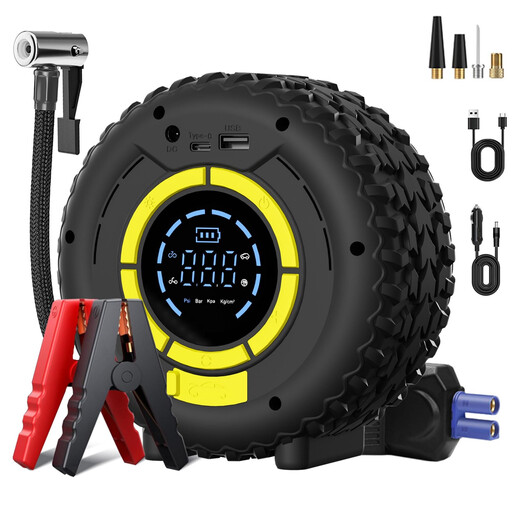
Why we chose it: Ideal for drivers of city cars and compact saloons. It's the all-in-one solution, lightweight and easy to slip into the glove box to handle common breakdowns without the bulk.
This model doesn't overpromise. It states a power of 120 W and a capacity of 8000 mAh: an honest and realistic balance for small to medium engines (petrol/diesel), which will save you the disappointment of an underpowered device.
Its ultra-compact size (600 g) and its very readable LCD screen make it a simple and accessible tool, even for novices. The compressor, with its 4 smart modes and automatic shut-off, is a real asset at this price point.
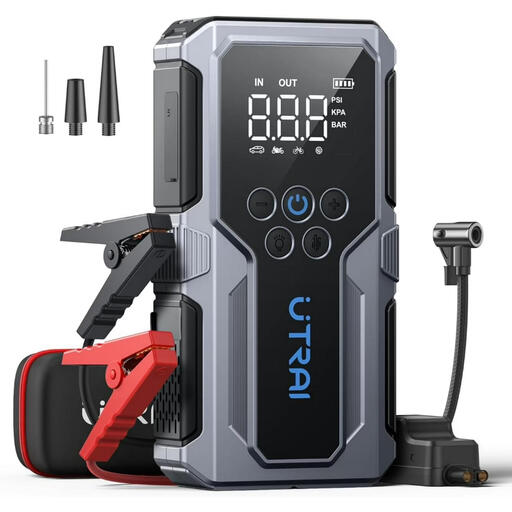
Why we chose it: The perfect solution for owners of SUVs, MPVs, or for camping enthusiasts. Its substantial power and 15000 mAh battery provide true peace of mind on long journeys and with more demanding vehicles.
With a peak current of 3000 A, it has the power needed to start petrol engines up to 8.5 L and diesel engines up to 6.5 L. It thus avoids the trap of boosters that promise the world but falter on large engines, especially in winter.
Its large 2-inch LED screen clearly displays the battery level and real-time tyre pressure. Its 10 intelligent safety protections, which notably confirm that the clamps are correctly connected, drastically reduce the risk of user error.
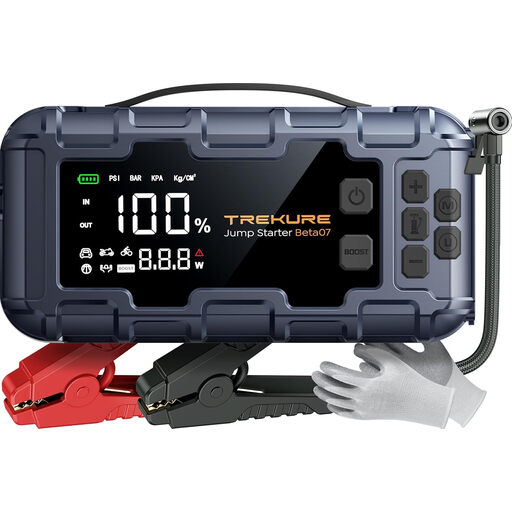
Why we chose it: Built for extreme situations. This is THE powerhouse solution for owners of large 4x4s, utility vehicles, motorhomes, or even boats with very large displacement diesel engines (up to 12 L).
Here, there are no compromises on power. Its 6000 A of peak current delivers the brute force needed where all others fail. Its compressor is just as impressive: with a flow rate of 45 L/min, it reinflates a tyre in record time.
Major asset: its 45 W PD fast charging allows the booster itself to be recharged at high speed, a feature as rare as it is valuable. Its huge 3.3-inch screen and super-powerful 600-lumen LED light make it the ultimate emergency tool.
Explore our complete selection of jump starters and car accessories, all rigorously selected for their reliability and compliance with safety standards.
A diesel engine is harder to start, so always opt for a booster with a high peak current. For a compact diesel car, a 1500 to 2000?A model may be suitable. For an SUV or utility vehicle, don't go below 2500?A. In any case, the golden rule is to check the maximum engine displacement (in L) recommended by the manufacturer.
It all depends on the compressor's air flow rate (L/min). A good model, with a flow rate of 35 to 45?L/min, will reinflate a standard car tyre (e.g., from 1.8 to 2.5?BAR) in 2 to 4 minutes. Entry-level devices with a low flow rate can take more than 10 minutes for the same task.
Yes, they are designed for that. However, a few precautions are necessary: avoid leaving it in direct sunlight behind the windscreen in summer, as extreme heat is the enemy of lithium batteries. Also, remember to check its charge level and fully recharge it every 3 to 6 months to ensure it's always ready to go.