
Livraison le jour même ou le lendemain

Qualité garantie

Débloquez vos offres de bienvenue: Livraison GRATUITE | Jusqu'à -80 % | 30 jours d'essai gratuits à JoyPlus
Téléchargez l'application
The icy silence of a winter morning. You turn the key, and... nothing. Your car refuses to start. The nightmare scenario: a flat tire on a deserted country road. These breakdowns, the dread of every driver, can turn any trip into a disaster. Faced with these unexpected events, the jump starter with air compressor emerges as the all-in-one solution to get you back on the road with peace of mind.
But here's the catch: the market is a jungle of often misleading marketing promises. A device that claims to start a semi-truck, inflate four tires, and charge your laptop simultaneously? On paper, it sounds like a dream. In reality, disappointment is often just around the corner. As a section editor at Joybuy, my mission is to help you decipher the technical specs to make a truly informed choice, far from the advertising hype.
Before you pull out your credit card, let's review the pitfalls to avoid and the features that truly make a difference.
The appeal of a versatile tool can sometimes hide major design flaws. Here are the red flags to watch out for so you don't regret your purchase.
To be confident in your purchase, focus on these three fundamental technical parameters.
Place limited trust in peak amperage. The key is the device's compatibility with your vehicle's engine size and type (gas or diesel). A diesel engine, for example, requires a much stronger starting current. A good rule of thumb: look for a model that clearly specifies the engines it can handle (e.g., "up to 8.0L Gas / 6.0L Diesel"). A 3000A jump starter can be an excellent choice, as long as its starting power is up to par.
An effective compressor must have a few non-negotiable features. Aim for a model capable of reaching at least 100-150 PSI, which is more than enough for most car tires. The two game-changing options are:
Battery capacity, expressed in milliampere-hours (mAh), is the heart of the matter: it determines your device's runtime. A capacity of 15,000 mAh or more is a good baseline to ensure multiple jump starts or charges for your devices. Finally, make sure the portable car starter includes essential protections: reverse polarity, overload, over-current, and short-circuit. These safeguards protect your vehicle's electronics as well as the jump starter itself.
Rather than searching for the elusive one-size-fits-all product, it's better to choose a device tailored to your needs. Here are our recommendations.
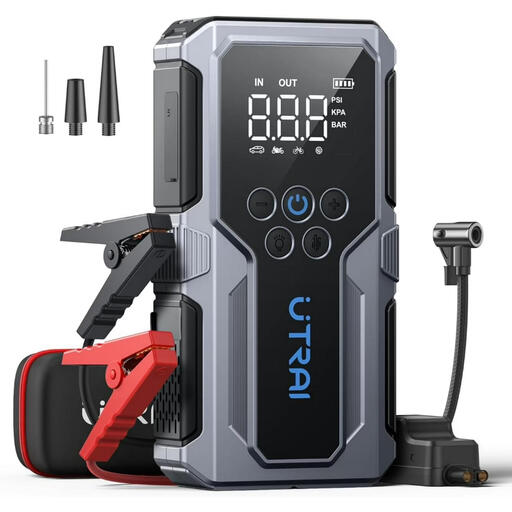
Why we chose it: Perfect for frequent drivers, families with SUVs or minivans, and outdoor enthusiasts. It packs all essential emergency functions into a glove-box-friendly size.
It checks all the right boxes: its power is clearly calibrated for large engines (up to 8.5L Gas / 6.5L Diesel), and its 150 PSI compressor with preset and auto-shutoff makes it a reliable tool, not a gimmick.
A true 5-in-1 Swiss army knife (jump starter, compressor, power bank, flashlight, 10 safety features) that doesn't compromise on any of its core functions.
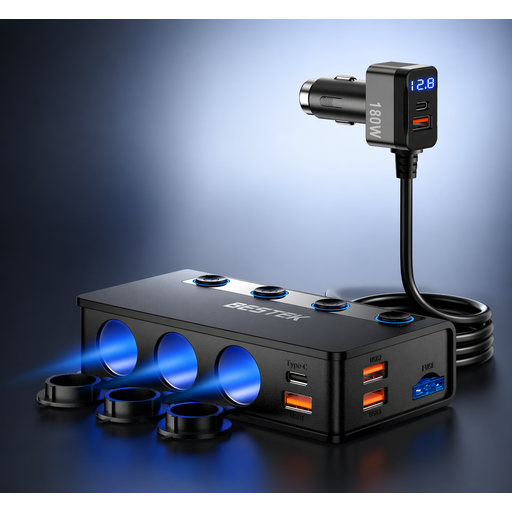
Why we chose it: Essential for those who don't need to jump-start their car but need to plug everything in at once: traveling professionals, large families, rideshare drivers...
It doesn't try to do everything. Its sole mission: to provide a stable and powerful charging station for a multitude of devices. It thus avoids the trap of watered-down versatility.
Ultra-comprehensive connectivity with 6 USB ports (including a 65W PD port for laptops) and 3 cigarette lighter sockets, all managed by independent switches for controlled power consumption.
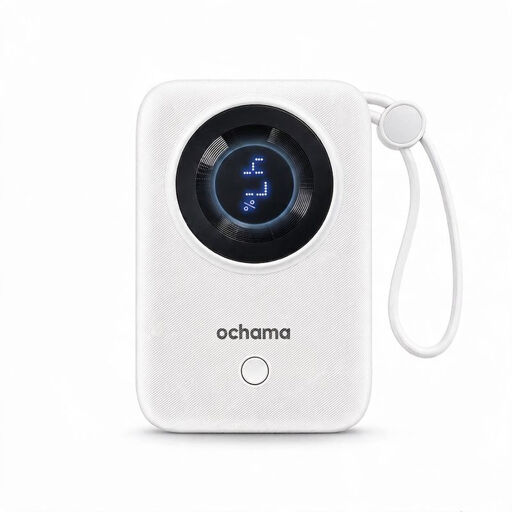
Why we chose it: For those primarily seeking a reliable backup battery for their everyday devices (smartphone, earbuds). Perfect for public transit, weekend trips, or just to keep in your bag.
It's a fast-charging power bank that focuses on one thing and does it perfectly: charging your mobile devices, quickly and efficiently. No superfluous features, no diluted performance.
Its ultra-compact design and built-in Lightning and USB-C cables. No need to carry extra cables, making it the ultimate portable solution.
We have curated a full range of products that meet our criteria for reliability and safety.
Diesel engines, with their high compression ratio, are more demanding, especially in winter. Generally, we recommend a jump starter capable of delivering a starting current of at least 800A. For a model advertising a peak of 3000A, make sure it explicitly mentions its compatibility with your engine size (e.g., "up to 6.5L Diesel").
Yes, they are designed for that. Just avoid extreme temperatures: don't let it bake on the dashboard in the summer or freeze in the glove box in the winter. To preserve its battery, remember to fully recharge it every 3 to 6 months, even if you haven't used it.
No, and this is a crucial point. A portable car starter is not a 12v battery charger. Its role is to deliver a very intense, brief burst of current to start the engine. It does not recharge the battery. Once the engine is running, the alternator takes over and handles the recharging.