
Livraison le jour même ou le lendemain

Qualité garantie

Débloquez vos offres de bienvenue: Livraison GRATUITE | Jusqu'à -80 % | 30 jours d'essai gratuits à JoyPlus
Téléchargez l'application
A dead battery, a flat tire in the middle of nowhere… It's every driver's nightmare. A jump starter with an integrated compressor presents itself as the lifesaver to get you back on the road without assistance. But be warned?: the market is flooded with models making tempting promises that often hide disappointing performance. To help you avoid a double disaster—for both your car and your wallet—here are the pitfalls to avoid and the essential criteria to check.
As a Product Specialist at Joybuy, my mission is to help you separate the wheat from the chaff. Follow this guide to find a reliable device and steer clear of unpleasant surprises.
All too often, versatility comes at the expense of quality. Keep an eye out for these three common pitfalls?:
To ensure you're investing in a tool that will live up to its promises, focus on these three key points.
Forget the peak amperage displayed in big letters. The crucial information is the compatibility with your engine's displacement. A reputable manufacturer will always clearly state the compatible engine sizes (e.g., gas engines up to 8.0L and diesel up to 6.0L). For the majority of vehicles on the road, a 1500A to 3000A peak jump starter is more than enough, as long as the overall build quality is high.
The effectiveness of a car tire inflator is measured by two things?: its maximum pressure and its air flow rate.
Expressed in milliamp-hours (mAh), the internal battery's capacity determines the device's overall autonomy. Aim for at least 15,000 mAh to perform multiple starts or recharge your portable devices without stress. Also, check the connectivity. A USB-C Power Delivery (PD) port of at least 18W will turn your portable car starter into a true car power bank, capable of quickly charging a smartphone or even a laptop.
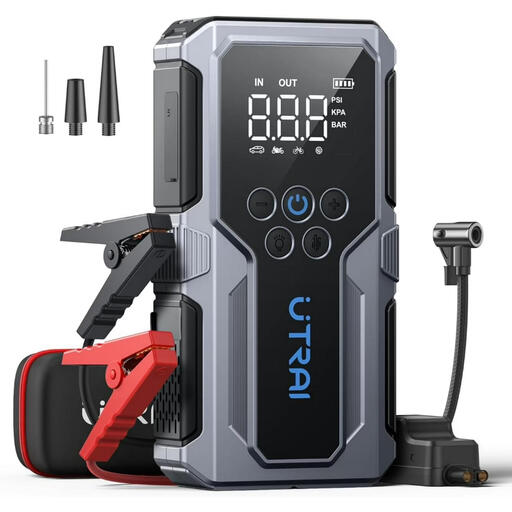
Why it stands out : This is the ideal Swiss Army knife for families, van life enthusiasts, and anyone who wants to be prepared for any eventuality. It combines ample starting power with a truly effective compressor to handle most roadside troubles.
Its 150 PSI compressor with preset and auto-shutoff is anything but a gimmick. With its 10 levels of protection and a clear LCD screen, it checks all the boxes for reliability and safety.
3000A power capable of starting large gas (up to 8.5L) and diesel (up to 6.5L) engines. 18W power bank function via its USB-C and USB-A ports.
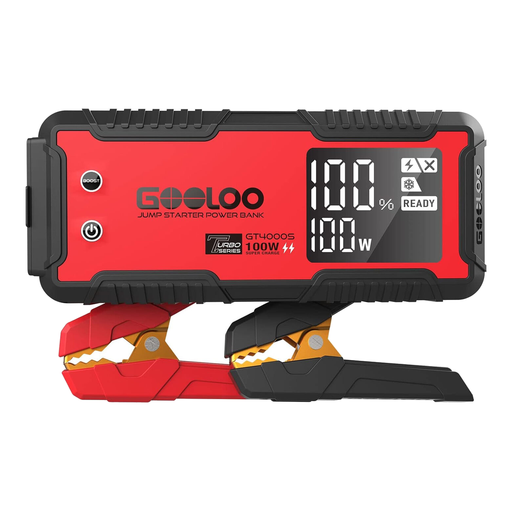
Why it stands out : The solution for owners of 4x4s, utility vehicles, boats, or farm equipment. When raw starting power is the only criterion that matters, this model delivers for the most demanding engines.
It doesn't just display a number; it proves it. Its ability to start diesel engines up to 10.0L confirms that its power is real. Its 100W fast charging puts it far ahead of the competition.
4000A peak power for uncompromising performance. 100W two-way charging to recharge the jump starter in 1.25 hours or power a laptop.
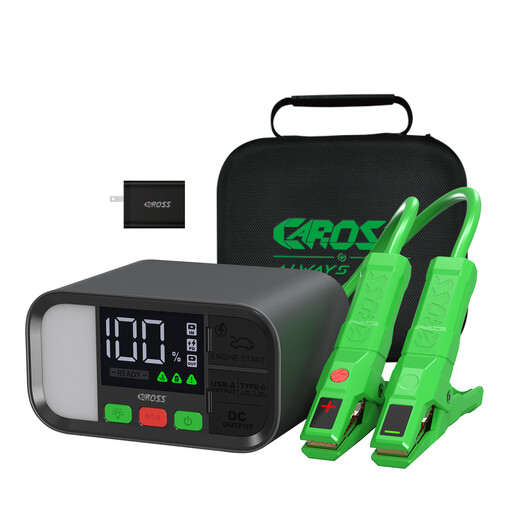
Why it stands out : For those who want a reliable emergency starter for their everyday car, without the bulk (or cost) of a compressor. It gets straight to the point : safety and efficiency.
Its "Smart Connect" technology and intelligent clamps eliminate any risk of reverse polarity, making it safe to use even for a novice. No frills, just formidable efficiency.
Mistake-proof connection for absolute safety. 65W PD fast charging to recharge the jump starter and power a laptop.
Explore our full selection of products that meet our rigorous selection criteria and current safety standards.
For a city car or a gasoline sedan (up to 3.0L), a 1000A to 1500A model is usually sufficient. For larger displacements or diesel engines (which are more demanding to start), aim for 2000A or more. In any case, rely on the manufacturer's recommendations regarding your engine's displacement.
Yes, provided you choose a quality device. A high-performance compressor (150 PSI minimum) can inflate a standard tire in 5 to 10 minutes. Entry-level models will take much longer and risk overheating before they're finished. The automatic shut-off function at the desired pressure is a true hallmark of quality.
Most models recharge in 3 to 6 hours via USB-C. Devices with fast charging (65W, 100W) can get below the 2-hour mark. Even when not in use, remember to recharge it every 3 to 6 months. This is essential to preserve the battery and ensure it's ready the day you need it.