
Livraison le jour même ou le lendemain

Qualité garantie

Débloquez vos offres de bienvenue: Livraison GRATUITE | Jusqu'à -80 % | 30 jours d'essai gratuits à JoyPlus
Téléchargez l'application
A dead battery, a flat tyre?– every driver's nightmare. Being stranded on the side of the road is a situation no one wants to experience. Fortunately, the jump starter with air compressor has emerged as the all-in-one tool to get you back on the road without waiting for a tow truck. But be warned: the market is a jungle of misleading marketing claims. To help you see clearly and make the right choice, we've decoded the traps to avoid and the criteria that truly matter.
Faced with an avalanche of offers, it's easy to get lost. Many devices boast impressive specs on paper that, once on the tarmac, fail to deliver. Here are the points to watch closely.
To choose a device that will perform when you need it most, here are the three criteria on which you should make no compromises.
Don't be blinded by the peak current. Look for the Starting Current, if the manufacturer bothers to disclose it. If not, ensure the peak power is more than sufficient for your engine. The needs are not the same for a petrol engine and a diesel one. The latter, with their higher compression ratio, require significantly more cranking power than their petrol counterparts.
Expressed in milliamp-hours (mAh), the battery capacity determines your jump starter's endurance. A high capacity will allow you to attempt several starts before needing to recharge it. It's also what turns your device into a true power bank for your car. A capacity of 15,000 mAh or more is recommended to charge a smartphone or tablet multiple times, a must-have for long trips or weekends off the grid.
A good car tyre inflator should be more than just a gimmick. For a compressor worthy of the name, check the following points:
There's an ideal jump starter for every driver. We have selected three models that stand out for their reliability and their ability to outsmart marketing traps.
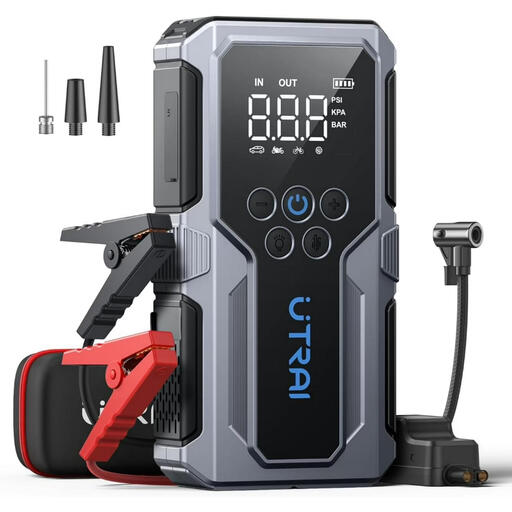
Why we chose it: The perfect road trip companion for most drivers (saloons, SUVs, MPVs). It offers an excellent balance for daily commutes and holiday getaways. Its power is well-calibrated for the majority of vehicles (petrol and diesel), and its compressor is a real asset for regular maintenance and emergencies.
No more gadget compressors! With its LCD screen and automatic shut-off, inflation is precise and stress-free. Its 10 levels of protection make it foolproof against user error.
Its strong suit: a perfect balance between starting power (3000A), battery endurance (15000 mAh), and modern connectivity (fast-charging USB/USB-C ports).

Why we chose it: Do you drive a large SUV, a 4x4, a camper van, or a commercial vehicle? This powerhouse is for you. With its 4500A peak current, it's not afraid of large displacement engines (up to 9.0L petrol / 8.0L diesel) or starting in extreme cold.
Here, the advertised power isn't just for show: it can genuinely crank the most stubborn starters. Its well-designed cooling system allows it to go the distance where less robust models throw in the towel.
A striking force of 4500A to tame the most demanding engines. Its digital compressor with 5 preset modes (car, motorbike, bicycle...) makes it incredibly versatile.
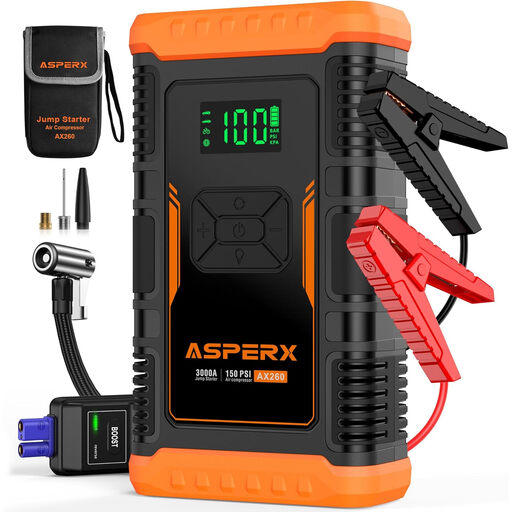
Why we chose it: Ideal for those who want a "no-fuss" solution. Connect, start, inflate: everything is designed to be simple and intuitive, thanks to smart functions that do the work for you.
It avoids the trap of risky inflation with its smart compressor (presets and auto-stop). It's impossible to connect the clamps incorrectly: clear alarms and 10 automatic safety features stand guard.
Its smart compressor that handles everything on its own. Its design, optimised for heat dissipation, is a guarantee of longevity.
Explore our full selection of products that meet our quality criteria and European safety standards.
The required power primarily depends on your car's engine. For a petrol car under 4.0L, a model with 1500A to 2000A peak current will generally do the job. For a diesel engine or a large petrol engine, it's better to aim for a model with at least 2500A to 3000A to ensure a flawless jump-start, especially in winter.
Even when unused, a jump starter's battery naturally loses its charge (this is self-discharge). To keep it in top condition and ensure it's ready when you need it, remember to give it a full charge every 3 to 6 months. Most models include charge indicators to let you know its status.
Absolutely, that's what they're made for. These devices are designed to withstand a wide range of temperatures, typically from -20°C to +60°C. A simple precaution: avoid leaving it baking on the dashboard in the summer sun to prevent damage to its battery. Opt for the glove box or the boot, where it will be sheltered.